Value-Added Coconut Products from India: What Exporters Must Master Before Finding Buyers
A coconut harvested for tender coconut water, a mature coconut processed into desiccated coconut, coconut milk or oil, the husk converted into coir pith, the sap processed into coconut sugar and the shell converted into a bowl or activated carbon may all come from the same crop.
But commercially, these are completely different export products.
A packed tender coconut water producer may need 6–8-month-old nuts and has to control extraction, processing, microbial safety, packaging and shelf life. A desiccated coconut buyer may discuss oil content, moisture and particle size. A greenhouse substrate buyer purchasing coir pith may ask about EC, pH, particle profile and expansion. A water-treatment buyer purchasing coconut-shell activated carbon may discuss mesh, ash, hardness and adsorption performance.
This is why an exporter describing the business simply as “we supply coconut products” has still left most of the sales work unfinished.
The useful question is:
Exactly which coconut product can we supply, to what specification, for which application, to which buyer, and what proof can we give?
That is Product Mastery.
The timing is relevant. Coconut products under the Coconut Development Board's export-promotion scope reached ₹7,038.35 crore, about US$794.7 million, in 2025–26, up 62% over the previous year. Husk and fibre products such as coir are handled separately under the Coir Board.
So the opportunity is better understood product by product.
Join other exporters in the India 2030 – USD 2 Trillion Exports Community
Our free WhatsApp community brings manufacturers, exporters and export-support businesses together for export updates, networking and market opportunities.
Join the free India 2030 community
https://www.consultkriba.com/india2030

1. Start Product Mastery with the coconut itself
India produced about 13.97 million tonnes of coconut from 2.19 million hectares in 2024–25. Tamil Nadu led overall production, Kerala had the largest area under cultivation, and Andhra Pradesh recorded the highest productivity according to the latest government sector review.
For an exporter, those production figures are only the first layer.
The important sourcing question is: what type and maturity of raw material does your finished product require?
For packed tender coconut water, the Coconut Development Board describes tender nuts at around 6–8 months. The requirement changes when the exporter moves to mature-kernel products such as coconut milk, desiccated coconut, VCO or conventional coconut oil. Coconut sugar starts even earlier in the plant: it is produced from sap collected from the unopened coconut inflorescence rather than from the nut.
This has a direct commercial consequence.
A company manufacturing five coconut products should maintain separate raw-material specifications for each product rather than one general “coconut procurement” specification.
That should cover maturity, variety where relevant, source area, acceptable nut condition, yield expected from the raw material, procurement radius, supplier capacity and the effect of raw-material variation on the finished product.
For example, a variety suitable for good tender-water volume may have a different commercial value from one selected for copra or oil recovery. Product Mastery therefore starts before processing.
2. Coir pith or coco peat: sell the growing medium, not simply the block
Coir pith is the spongy material associated with coconut husk after fibre extraction. It has developed into an important horticultural growing medium and soil conditioner. Coir Board recognises raw coir pith under IS 17739:2022.
The exporter's first job is to define the exact product form.
“Coco peat 5 kg block” mainly describes the compressed packing format.
A professional product specification may need to establish whether the material is raw, washed, treated or buffered; its EC and pH; moisture; particle-size distribution; fibre content; expansion after hydration; water-holding behaviour; air porosity; bulk density; compression; and block, slab or grow-bag dimensions.
The correct specification depends heavily on application.
A nursery raising seedlings, a hydroponic tomato grower, a berry grower and a potting-mix manufacturer can require different physical characteristics from the substrate. This is where customisation becomes commercially valuable.
The buyer categories therefore extend beyond “coir importers”. They include commercial greenhouse suppliers, substrate blenders, hydroponic-growing companies, nurseries, horticulture distributors and companies supplying professional growers.
India already has specialised production clusters. Coir Board lists coir-pith clusters in areas such as Tirunelveli/Tenkasi, Dindigul and Dharmapuri, along with specialised grow-bag activity around Palladam in Tamil Nadu.
The alternatives also matter. Depending on the growing system, a buyer may compare coco substrate with peat-based media, rockwool, perlite, wood fibre or mixed substrates.
So the exporter's sales question becomes more specific:
Which crop and growing system is the buyer supplying, and what substrate performance does that application require?
That question is considerably more valuable than starting with “Do you import coco peat?”
3. Desiccated coconut: the grade changes the buyer
Desiccated coconut is another good example of why a product name alone gives limited sales information.
Codex CXS 177-1991, updated in 2023, distinguishes products by particle size and composition. Its quality requirements include moisture of 4% m/m, total acidity of extracted oil of 0.3% measured as lauric acid, and oil content of at least 60% for the full-fat styles covered by the standard. Reduced-fat desiccated coconut falls in the 35% to below 60% oil range. Foreign matter should be absent in 100 g.
Codex also differentiates sizes such as extra-fine, fine, medium and other cuts.
That changes the commercial conversation.
A bakery ingredient manufacturer may require one particle size. A confectionery factory may require another. A snack brand may care about a particular texture or toasted format. A bulk ingredient distributor may purchase several grades.
Product Mastery for desiccated coconut should therefore establish the grade, cut, fat content, moisture, colour, taste and odour, microbiological specification, foreign-matter control, packing format and storage conditions.
Rancidity, abnormal colour, fermented or smoky notes, mould, contamination and moisture pickup are commercially important quality risks.
The specification sheet should answer these points before a serious buyer has to ask.
The buyer profile can then be narrowed to industrial bakeries, confectionery manufacturers, cereal and snack manufacturers, food-ingredient importers, repackers and private-label food businesses.
This changes buyer finding from:
“Find desiccated coconut importers.”
to:
“Find industrial buyers using full-fat medium-grade desiccated coconut in bakery or confectionery production.”
That is a much more usable sales target.
4. Coconut milk and coconut cream: fat and solids define what you are selling
Coconut milk is often marketed as one general product, while the commercial specification can vary significantly.
The current Codex standard CXS 240-2003 distinguishes the main aqueous coconut products by total solids and fat.
Product | Total solids | Minimum fat | What the exporter should clarify |
|---|---|---|---|
Light coconut milk | 6.6–12.6% | 5% | End use, required fat, pack and processing method |
Coconut milk | 12.7–25.3% | 10% | Exact fat/solids, ingredients, viscosity, pack |
Coconut cream | 25.4–37.3% | 20% | Fat level, application, texture and stability |
Coconut cream concentrate | Minimum 37.4% | 29% | Concentration, industrial use and reconstitution requirements |
This is a major Product Mastery point.
Two exporters may both say, “We export coconut milk”, while one supplies a 10% fat product and another supplies a much richer formulation. The food manufacturer buying it will see two different ingredients.
The exporter should therefore master the exact composition, processing method, ingredients and permitted additives, viscosity, sensory profile, microbial controls, heat treatment, pack format, storage conditions and verified shelf life.
The buyer category also changes by format.
An industrial food manufacturer may buy bulk coconut milk as an ingredient for curry sauces, desserts or ready meals. A supermarket buyer may look for a retail private-label can or aseptic pack. A beverage company may have a different formulation requirement. Foodservice distributors may need yet another pack size.
The practical sales preparation is:
Product composition → finished-food application → buyer category → pack → compliance → price
That sequence is far stronger than distributing one coconut-milk catalogue to every food importer.
5. Coconut oil and Virgin Coconut Oil: separate the products clearly
Coconut oil and Virgin Coconut Oil should have separate product masters.
VCO is associated with a different processing route, quality expectation and buyer positioning from conventional refined coconut oil.
The Coconut Development Board's VCO processing reference cites APCC quality factors including maximum moisture of 0.1%, free fatty acid of 0.2% and peroxide value of 3 meq/kg, along with requirements around colour, odour and taste.
For an exporter, the real Product Mastery questions include the extraction method, whether heat is involved and to what extent, moisture, FFA, peroxide value, filtration, sensory profile, batch consistency, pack material, storage, shelf life and test evidence.
Then identify the actual commercial use.
A bulk food-ingredient buyer, a retail edible-oil brand, a cosmetic formulation company and a private-label wellness company can all evaluate the same base coconut material differently.
An exporter specialising in certification can build the offer around traceability, food-safety systems, organic status where genuinely certified, laboratory testing and process control.
An exporter specialising in customisation may offer pack sizes, private labels, buyer-specific specifications or product development.
The strongest USP should come from capability that can be repeatedly proven.
6. Tender coconut water: the challenge starts after the coconut is opened
Packed tender coconut water is a processing business as much as an agricultural product.
CDB's current product reference describes tender coconut water from 6–8-month-old coconuts and identifies extraction, filtration, processing and packaging as part of the production system. It also refers to IS 18252:2023 for packed tender coconut water.
The exporter therefore needs clarity on raw-nut maturity, source, natural variation in taste and soluble solids, filtration, treatment, microbial control, filling technology, packaging, storage and verified shelf life.
Packaging could include cans, bottles, flexible packs or aseptic formats depending on the process and commercial model. The process and pack have a direct effect on shelf life and logistics.
This means the exporter should resist giving a standard shelf-life claim simply because another brand has achieved it.
The correct proof is the shelf-life study and microbiological evidence for the exporter's own product, process and pack.
The buyer categories can include beverage importers, supermarket/private-label buyers, health-food distributors, foodservice suppliers and beverage brands.
For such buyers, the conversation is more useful when the exporter can say:
Here is the nut maturity we use, our product specification, processing method, package, microbiological evidence and validated shelf life.
That gives the buyer something to qualify.
7. Coconut sugar: control the sap before discussing the sweetener
Coconut sugar comes from coconut sap or neera collected from the unopened inflorescence.
ICAR/Coconut Development Board material describes sap collection as a technically sensitive stage because fresh sap can ferment quickly. Controlled collection and temperature management help preserve it for further processing. Coconut sugar is produced by concentrating the sap and continuing heating and stirring until crystallisation, followed by cooling and sieving for particle consistency.
That creates a very different Product Mastery sheet from coconut oil or desiccated coconut.
The exporter should define sap collection controls, processing temperature and method, colour, taste, moisture, granulation, solubility, foreign matter, microbiology, packing, storage and batch consistency.
For organic positioning, certification and traceability need to support the claim.
For nutritional or glycaemic claims, destination-market rules and reliable test evidence should guide what appears on the label or in buyer communication.
The likely buyers include natural-ingredient distributors, food manufacturers, bakery and snack companies, retail private-label brands and specialist sweetener businesses.
Here the exporter should understand whether the buyer wants an industrial ingredient, a retail product or a private-label finished pack.
The same coconut sugar can require a different price, pack, certificate and sales presentation for each route.
8. Coconut shell handicrafts: design consistency becomes Product Mastery
A coconut shell bowl looks simple until a buyer orders 5,000 pieces in the same size range.
Coconut Development Board material on shell utility products identifies bowls, tumblers, ice-cream cups, accessories and several decorative products. An industry example published by the Board also describes one practical production challenge: natural shells vary in shape and size, while bulk buyers expect greater consistency in capacity and dimensions.
That is the commercial issue an exporter should solve.
For a coconut-shell bowl or cup, define diameter range, height, capacity, wall condition, finish, colour variation, acceptable natural variation, polishing method, coating where used, crack tolerance, odour, wash/care instructions and individual/export packaging.
If the item is intended for food contact, the material and surface treatment should be checked against the applicable requirements of the destination market.
If it is decorative, design, finishing quality, consistency and safe export packing become central.
Buyer categories may include homeware importers, sustainable-product brands, gift distributors, hospitality suppliers, private-label retailers and design-led e-commerce brands.
Here customisation can become a stronger USP than simply low price: engraving, design collections, pack development, retail-ready presentation and buyer-specific sizing can create a more defendable offer.
9. Coconut shell activated carbon: sell against the application
One of the highest-value transformations of coconut shell takes the exporter into an entirely different buyer environment: activated carbon.
The buyer is no longer a food or homeware company.
The buyer may be a water-treatment company, filtration specialist, activated-carbon distributor, environmental engineering company or industrial user.
This changes Product Mastery completely.
Iodine number can be an important parameter, but an industrial buyer may also evaluate particle or mesh size, ash, moisture, hardness, density, trace metals, adsorption performance and batch consistency depending on the application.
The application should therefore come first:
Drinking-water treatment? Industrial water? Air purification? Process purification? Precious-metal recovery? Another adsorption requirement?
Only after that can the exporter decide which specification and performance proof matter.
This is especially relevant for Europe, where EU-wide systematic PFAS monitoring requirements for drinking water became applicable in January 2026, increasing attention on treatment and adsorption technologies. The commercial opportunity, however, depends on whether the carbon can meet the required contaminant-specific performance and qualification requirements.
This is a good example of why a buyer may care more about application performance than a general product claim.
10. One coconut business can require several different buyer profiles
An exporter with a broad coconut range may be tempted to make one list of “coconut importers”.
Product Mastery shows why segmentation works better.
Coir pith belongs to horticulture and growing-media supply chains.
Desiccated coconut belongs mainly to food ingredient, bakery and confectionery supply chains.
Coconut milk can enter food manufacturing, retail private label and foodservice.
VCO can move through food, cosmetics, private-label and specialist ingredient channels.
Tender coconut water belongs to beverage channels.
Coconut sugar belongs to food ingredient and natural-sweetener channels.
Shell handicrafts belong to homeware, gift and lifestyle channels.
Activated carbon belongs to technical filtration and treatment industries.
A business exporting several of these products therefore needs separate buyer maps, even when all of them appear in the same company catalogue.
That is exactly why the RSM Product Mastery stage comes before buyer development.
11. India's sourcing base should become part of the supply plan
Product Mastery also asks whether the exporter can supply consistently.
India's production base gives exporters several sourcing possibilities, particularly across Tamil Nadu, Kerala, Karnataka and Andhra Pradesh. The processing network is also specialised.
For example, CDB's 2025 Export Excellence Awards recognised shell-based exporters from Tiruppur, Tirunelveli and Coimbatore in Tamil Nadu, a water-based product exporter from Pollachi, and kernel-based businesses from Kerala and Maharashtra.
Coir Board separately identifies strong coir-pith and grow-media clusters across Tamil Nadu, including Tirunelveli/Tenkasi and other production areas.
For exporters, the practical question is therefore wider than “Where is coconut available?”
It is:
Where can I source the right raw material and process it consistently for my exact export specification?
A processor should know primary supplier locations, alternate suppliers, normal production capacity, procurement lead time, raw-material variation, laboratory access, packing capability and the point at which a larger export order begins to affect supply or quality.
12. Global demand should be studied product by product
The overall coconut-export number can identify sector momentum. It cannot select a market for an individual exporter.
Coir offers a good example. Coir Board's 2024–25 trade data shows large coir-product flows to markets including the United States, China, Netherlands, Spain, United Kingdom, South Korea, Peru and Australia.
But those figures combine several types of coir products.
A grow-bag exporter should study horticultural substrate demand.
A coir mat manufacturer should study home and floor-covering channels.
A coir geotextile manufacturer should study erosion-control and civil-engineering applications.
Exactly the same logic applies to coconut food products.
A country importing substantial coconut oil may have little relevance to an exporter specialising in premium retail coconut water. A market with a large food-processing industry may be more valuable for bulk coconut milk than a market with stronger retail demand.
The correct research unit is:
Exact product × specification × application × buyer category × country.
13. Your USP should come from what you can prove
The Product Mastery framework identifies four broad USP directions: competitive pricing, certifications, customisation and range.
For coconut products, each produces a different export business.
A cost-led coir-pith supplier needs raw-material access, production scale, freight efficiency and reliable compression.
A certification-led food processor can build buyer confidence through food-safety systems, traceability, laboratory evidence and destination-market readiness.
A customisation-led coconut-milk, coconut-water or shell-products manufacturer may win through pack development, private label, formulation, size or design.
A range-led exporter may give a distributor access to several relevant coconut products through one supply relationship.
The useful USP is the one the exporter can demonstrate through production, documents, samples, test results, capacity and execution.
14. Build a Coconut Product Master before building a buyer database
For each product you want to export, create one working sheet that answers:
Exact product → raw material/source → maturity or input requirement → grade/specification → application → buyer type → processing method → test/quality proof → certification/compliance → pack → shelf life/storage → MOQ → capacity → lead time → alternative products → competing supplier countries → genuine USP
For coir pith, that may become:
Buffered grow bag → greenhouse strawberry production → buyer-defined EC/pH/particle specification → substrate distributor/grower → expansion and physical-performance proof → grow-bag dimensions → production capacity.
For desiccated coconut:
Full-fat medium grade → confectionery use → Codex-aligned moisture/oil/quality specification → industrial ingredient buyer → microbiological and product test report → bulk food-grade pack.
For coconut milk:
17% fat coconut milk → sauce/ready-meal manufacturing → industrial food manufacturer → composition + microbial + processing proof → buyer-required bulk/retail pack.
For shell activated carbon:
Specified mesh carbon → drinking-water treatment → filtration company → adsorption/hardness/ash/batch-performance evidence → agreed industrial pack.
Now buyer finding becomes easier because the exporter knows exactly whom to find and what to discuss.
Product Mastery is where coconut export sales should begin
India's value-added coconut sector now covers food ingredients, beverages, horticultural substrates, natural sweeteners, homeware and high-performance industrial materials.
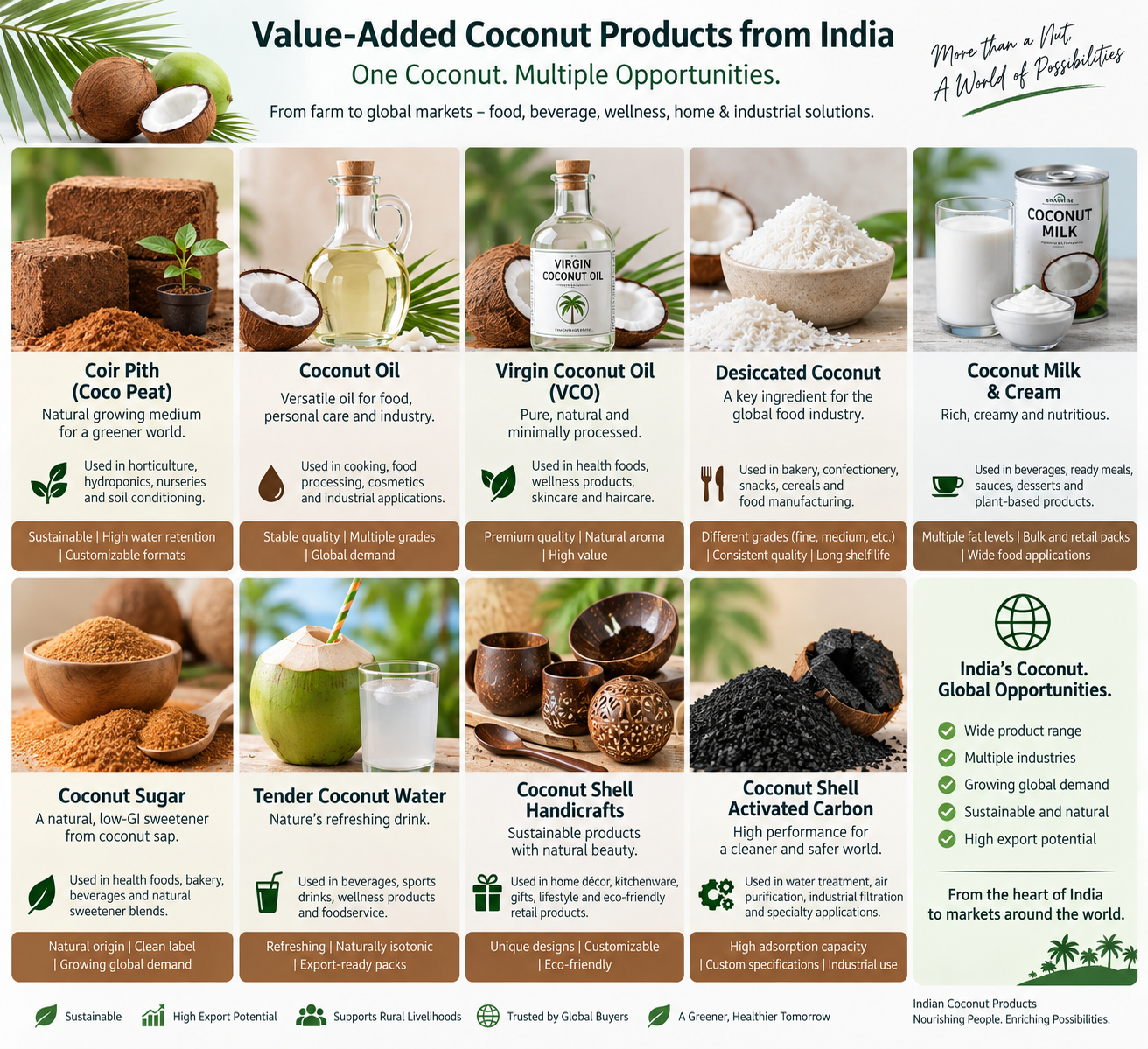
The commercial opportunity becomes clearer when each of these is treated as its own product business.
Before increasing buyer contacts, answer four questions:
What exactly are we supplying?
Who uses this exact specification?
Why should that buyer consider us?
What proof can we give immediately?
Once those answers are clear, market research becomes more focused, buyer selection improves, enquiries are easier to qualify and quotations can be prepared against an actual requirement.
That is the purpose of Product Mastery in the Reverse Sourcing Method: do the important preparation before connecting with the buyer, so the buyer connection can be used for selling.
Want to apply this process to your own export business?
Consult Kriba's Export Sales Process Workshop takes exporters through three connected stages:
Prepare → Find Buyers → Start the Sales Process
If you are a manufacturer, trader or existing exporter and want a more systematic way to prepare your business, find suitable overseas buyers and move buyer conversations towards sales:
Join the Export Sales Process Workshop
https://consultkriba.com/2tnexports