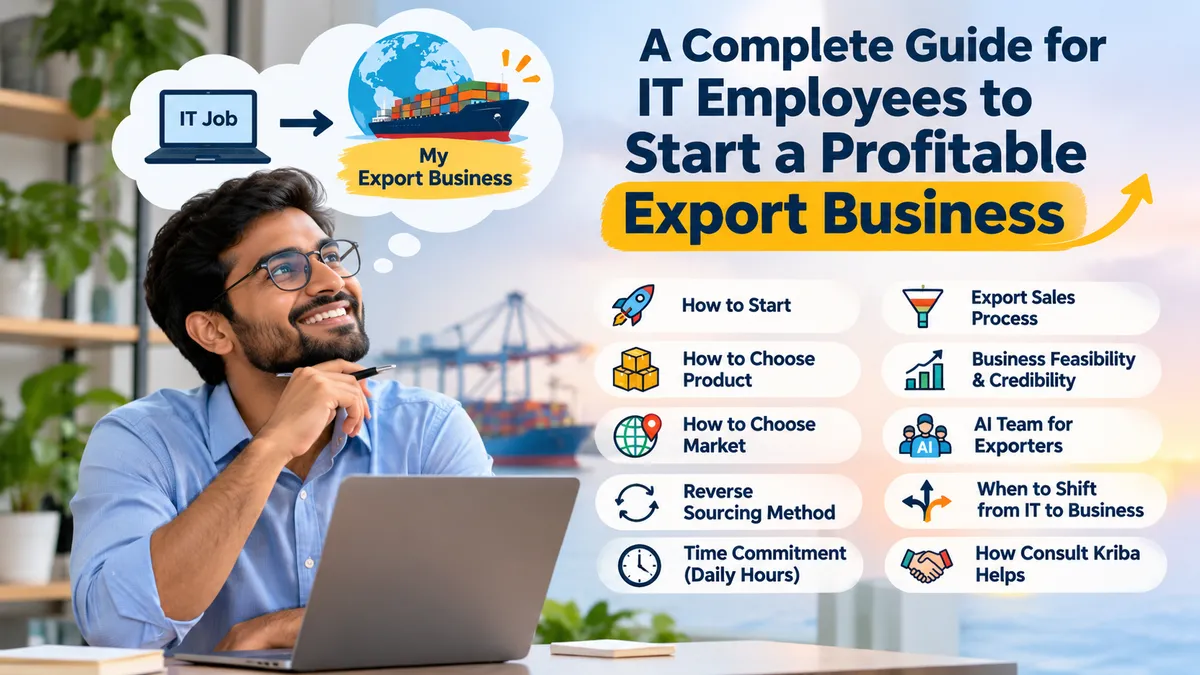
How IT Employees Can Start an Export Business in India Without Leaving Their Job
Your practical guide to choosing export products, finding overseas markets, using AI, building buyer trust and developing a profitable export business through Consult Kriba's Reverse Sourcing Method.
Quick Answer: Can You Start an Export Business While Working in IT?
Yes. You can start an export business in India while continuing your IT job, provided your employment terms permit it. You can begin by working with Indian manufacturers and selling their products to suitable overseas buyers.
You need to choose a product, identify a suitable market, assess supplier capability, understand export costs and prepare a proper sales process.
As a practical starting plan, spend 1–2 focused hours on working days and 3–4 hours over the weekend. Your time commitment will increase when you start handling active buyer enquiries and orders.
You can use AI for research, business communication and follow-up preparation. Consult Kriba's Reverse Sourcing Method (RSM) helps you decide what to prepare before contacting buyers and how to move buyer conversations towards export sales.
Keep your IT income until your export business demonstrates reliable profit, manageable cash flow and a realistic opportunity for further growth.
Your IT Job Can Help You Build an Export Business
Imagine Karthik, a 35-year-old IT professional working in Chennai.
He earns ₹1.2 lakh per month.
He has experience working with international clients, managing projects and using technology to improve business processes.
He wants to start an export business but has three concerns.
Will he need a large investment?
Can he manage the business alongside his job?
And how will he know whether exporting can eventually replace his salary?
Karthik begins researching export opportunities.
He finds websites offering lists of export products, overseas buyer contacts and information about business registrations.
All of this may be useful.
But he still needs to answer a more important question:
Which product can I supply to which overseas buyer, at what cost, and why would that buyer choose my business?
That question determines whether he has a serious business opportunity.
Let us follow Karthik's decisions and understand how an IT employee can build an export business step by step.
Karthik is an illustrative character. The product comparisons, business figures and timelines in this article are teaching examples, not verified customer outcomes.
1. How Can an IT Employee Start an Export Business in India?
An IT employee can begin by identifying a product, evaluating Indian suppliers, choosing a suitable overseas buyer category and testing whether the proposed business is commercially feasible.
You do not always need to establish a manufacturing unit.
For Karthik, there are two main ways to enter the product export business.
Manufacturing exporter: He manufactures products and sells them overseas. This requires manufacturing capability, investment, production management and suitable infrastructure.
Merchant exporter: He sources products from Indian manufacturers and sells them to overseas buyers under agreed commercial terms.
Because Karthik works full-time, merchant exporting may be a practical starting option.
He can focus on supplier relationships, market understanding, buyer development and export sales.
The manufacturer can handle production, while Karthik coordinates the agreed commercial and delivery requirements.
However, merchant exporting still involves responsibility. If a buyer places an order with Karthik's business, he must ensure that the product, documents, payment and shipment meet the agreement.
What registrations are required to start an export business?
For an Indian goods-export business, Karthik should examine:
A suitable business structure, such as proprietorship, partnership, LLP or private limited company
Permanent Account Number (PAN) and suitable business banking arrangements
Importer Exporter Code (IEC), unless a specific exemption applies
Applicable GST registration and export tax procedures
Correct product classification and any required product-specific licences
Customs, shipping and banking requirements
According to India's Directorate General of Foreign Trade (DGFT), an IEC is generally required for importing or exporting goods, subject to specified exemptions.
Official reference: DGFT — Importer Exporter Code and Foreign Trade Procedures
Exports are generally treated as zero-rated supplies under GST. The correct procedure, including applicable Letter of Undertaking (LUT) requirements, should be confirmed for the business.
Official reference: Central Board of Indirect Taxes and Customs
Karthik must also check whether his IT employment agreement permits outside business activities. Employer confidentiality, conflicts of interest and company resources must be handled separately.
The first business decision is whether the export opportunity is worth developing. Registration enables the business to operate; it does not establish demand or profitability.
2. How Should an IT Professional Choose the Right Export Product?
Choose a product that matches your knowledge, access to reliable manufacturers, investment capacity and the requirements of a suitable overseas buyer.
A product being manufactured in India or exported in large quantities is not enough to establish that it will be suitable for your business.
Karthik considers two possibilities:
Mobile accessories
Industrial electrical enclosures
He has experience working with technical information and has access to an industrial manufacturer near Chennai.
He now needs to compare these opportunities.
Product comparison: Which business fits Karthik better?
Decision factor | Mobile accessories | Industrial electrical enclosures |
|---|---|---|
Product understanding | Consumer product features, compatibility and quality | Technical drawings, materials, dimensions and applications |
Possible buyers | Importers, wholesalers, retailers | Panel builders, industrial distributors, manufacturers |
Possible competitive advantage | Design, brand, range or packaging | Customisation, specifications, quality and supply reliability |
Supplier checks | Product quality, authenticity, safety and availability | Manufacturing capability, materials, testing and lead time |
Business difficulty | Product changes, competition and inventory management | Technical approval, sample requirements and industrial buyer qualification |
Fit with Karthik's skills | Depends on his product and consumer market knowledge | Potentially stronger because of his technical experience |
This is a qualitative comparison. It does not prove that one product has greater overseas demand or higher profit than the other.
Karthik decides to study industrial electrical enclosures first.
His next step is not to immediately start contacting overseas buyers.
He visits the manufacturer.
He checks the product specifications, production capacity, quality controls, customisation capability, prices and delivery schedules.
He learns what the manufacturer can supply confidently and what might require additional approval.
This is the beginning of Product Mastery, the first area of Consult Kriba's Reverse Sourcing Method.
What does RSM Product Mastery examine?
Product Mastery goes beyond the product name, catalogue and HS code.
It examines the product's actual business potential.
Karthik needs to understand:
Product specifications: What materials, dimensions, grades, variants and technical properties are available?
Product applications: Which industries use the product, and what problem does it solve for them?
Production and sourcing: Where can the product be manufactured? Can the supplier deliver consistent quality and quantity?
Quality and certification: What tests, certificates or technical evidence might buyers require?
Competition: What alternative products and competing suppliers exist?
Cost and supply risks: What can affect the manufacturer's price, capacity, quality or delivery date?
The four RSM product advantages
Consult Kriba's Product Mastery framework identifies four ways an exporter may differentiate the business.
Competitive pricing: The ability to offer a commercially suitable price through strong sourcing, cost control and supplier relationships.
Certifications: Access to relevant testing, quality standards or certification capabilities that buyers value.
Customisation: The ability to supply products in different specifications, designs, materials or packaging according to buyer requirements.
Range of products: The ability to supply related products through dependable manufacturers.
Karthik notices that his prospective manufacturer can make enclosures according to customer drawings.
That may give him a reason to approach buyers who need customised industrial products rather than compete only on the lowest price.
He still needs to confirm that overseas buyers value this capability and will pay a commercially suitable price.
RSM Product Selection Test
Before finalising a product, answer these six questions:
Can I clearly explain what the product is and where it is used?
Do I have access to a manufacturer who can supply it reliably?
Can I identify the overseas businesses that might need it?
Can the product meet the target market's standards and buyer specifications?
Can I compete through a real advantage such as quality, customisation, price or service?
Can I calculate a suitable profit after all relevant costs and risks?
If an important answer is still unknown, that becomes your next research task.
A strong product choice is supported by product knowledge, supplier capability, market fit and commercial feasibility.
Related reading: Electronic Components Exports from India — Product Mastery
3. How Do You Choose the Right Overseas Market?
Choose the market where your exact product fits the buyer's needs, competition, compliance requirements, expected price and your ability to supply.
A country importing large quantities of a broad product category is not automatically the right market for your particular product.
Karthik considers the UAE, Saudi Arabia and Germany.
His first idea is to target whichever country imports the most electrical equipment.
But electrical equipment covers many different products.
A country could import large quantities of a broad category while offering limited commercial opportunity for his particular industrial enclosure.
Consult Kriba's second RSM area, Market Genius, helps him narrow the decision.
How does Market Genius work?
Instead of asking:
"Which country imports electrical equipment?"
Karthik asks:
"Which companies in a particular country may purchase the industrial enclosures my manufacturer can supply, and what specifications do they require?"
That changes his research.
He begins examining the businesses that purchase enclosures.
For example, a control panel manufacturer might need customised enclosures made to specific drawings.
An industrial distributor might prefer standard enclosures in regular quantities.
A project contractor might require project-specific approvals, technical documentation and delivery schedules.
The country alone does not determine the opportunity.
The combination of product, market, buyer category and commercial requirements determines whether the opportunity deserves attention.
Six checks before choosing an export market
Market check | What Karthik must understand |
|---|---|
Demand | Does the market import the exact product or a close equivalent? |
Buyer category | Which companies and purchasing roles need this product? |
Competition | Which suppliers or countries are already serving those buyers? |
Compliance | What technical, safety, testing or documentation rules apply? |
Pricing | Can the product compete after applicable transport, duties and other costs? |
Business access | Can Karthik identify and communicate with suitable purchasing decision-makers? |
He can use official trade data to shortlist markets.
Useful sources include India's Trade Statistics and ITC Trade Map.
These sources help identify trade patterns. Product-specific market requirements and actual buyer opportunities still need separate verification.
What if two markets look attractive?
Karthik should compare the same product specification in both markets.
For each country, he can record the likely buyer category, main competing products, compliance requirements, estimated selling price, freight responsibility, payment risks and supplier capability.
He can then identify the market that deserves the next stage of research.
This is more useful than selecting a country based only on total import value.
RSM Market Genius connects market demand to an exporter's actual product and ability to do business.
Related reading: Electronic Components — How to Choose Export Markets
4. What Is the Reverse Sourcing Method?
The Reverse Sourcing Method (RSM) is Consult Kriba's export sales method that places important business preparation before buyer connection, so the exporter can focus on selling when an opportunity comes.
It covers the complete process, from understanding the product and market to buyer development, sales conversion, shipment and repeat business.
Think about Karthik's situation.
Suppose he contacts a buyer who asks for 500 customised industrial enclosures.
The buyer wants product drawings, technical specifications, delivery time and a price quotation.
If Karthik has already prepared this information, he can discuss the requirement and coordinate the next business step.
If he begins learning about his product only after receiving the enquiry, valuable time may be lost.
RSM is built around this distinction.
Before connecting with buyers
Prepare the product information, supply capability, market understanding, buyer categories, quality evidence, compliance, costing, payment conditions and delivery arrangements.
After connecting with buyers
Understand the actual requirement, qualify the opportunity, provide relevant proof, agree the next step, follow up, prepare a suitable quotation, negotiate, execute the order and work towards repeat business.
The Six Areas of RSM
1. Product Mastery: Understand the product, specifications, applications, production capability and commercial strengths.
2. Market Genius: Understand suitable countries, buyer categories, competition, demand and market conditions.
3. Legal Know-How: Understand registrations, product regulations, quality standards, documentation, payment risks and delivery responsibilities.
4. Marketing Proficiency: Make suitable buyers notice, understand and trust the export business.
5. Sales Conversion Strategy: Move buyer discussions towards clear requirements, quotations, negotiation and commercially sound decisions.
6. Shipment & After-Sales: Deliver the agreed product, protect payment and build opportunities for repeat business.
These six areas are connected.
Product specifications influence the market. Market requirements influence compliance. Compliance and sourcing influence costs. Product and business proof influence buyer confidence. All of these affect sales conversion.
RSM is more than a method for finding buyers.
It is a way to prepare and execute the entire export sales process.
5. What Is an Export Sales Process?
An export sales process is the series of business activities that moves a suitable overseas buyer from first contact to a qualified requirement, quotation, negotiation, order and repeat purchase.
Karthik identifies a company that manufactures industrial control panels.
He finds a relevant purchasing contact and introduces his product.
The buyer replies:
"Please send your enclosure specifications."
This is a useful reply.
But a reply is not yet a confirmed requirement.
Karthik needs to find out whether the product is suitable, what the buyer wants and whether a real purchasing opportunity exists.
The RSM Export Sales Journey
Suitable company → Relevant person → Buyer conversation → Qualified requirement → Quotation → Follow-up → Negotiation → Commercial decision → Order execution → Repeat business
Karthik begins by asking the buyer about the required material, dimensions, protection rating, order quantity, delivery destination and expected purchase timing.
He checks whether a sample, technical drawing or test report is needed.
He confirms the manufacturer's ability to supply the requirement.
He then prepares a quotation based on the agreed specification, costs, payment conditions and delivery responsibilities.
A quotation should be the result of understanding the requirement, rather than simply sending a price.
What happens when the buyer does not respond?
Karthik should examine four possible reasons.
Person: Is he speaking with someone responsible for purchasing the product?
Trust: Has he provided useful evidence that his company can supply the requirement?
Timing: Is the buyer currently looking for a supplier, or is the requirement expected later?
Process: Is his communication relevant, and does each follow-up have a clear purpose?
For example, instead of repeatedly asking for an update, Karthik can ask whether the technical team has reviewed the drawing or whether a sample is needed for approval.
The follow-up now helps the buyer make a decision.
This is what a proper sales process should achieve.
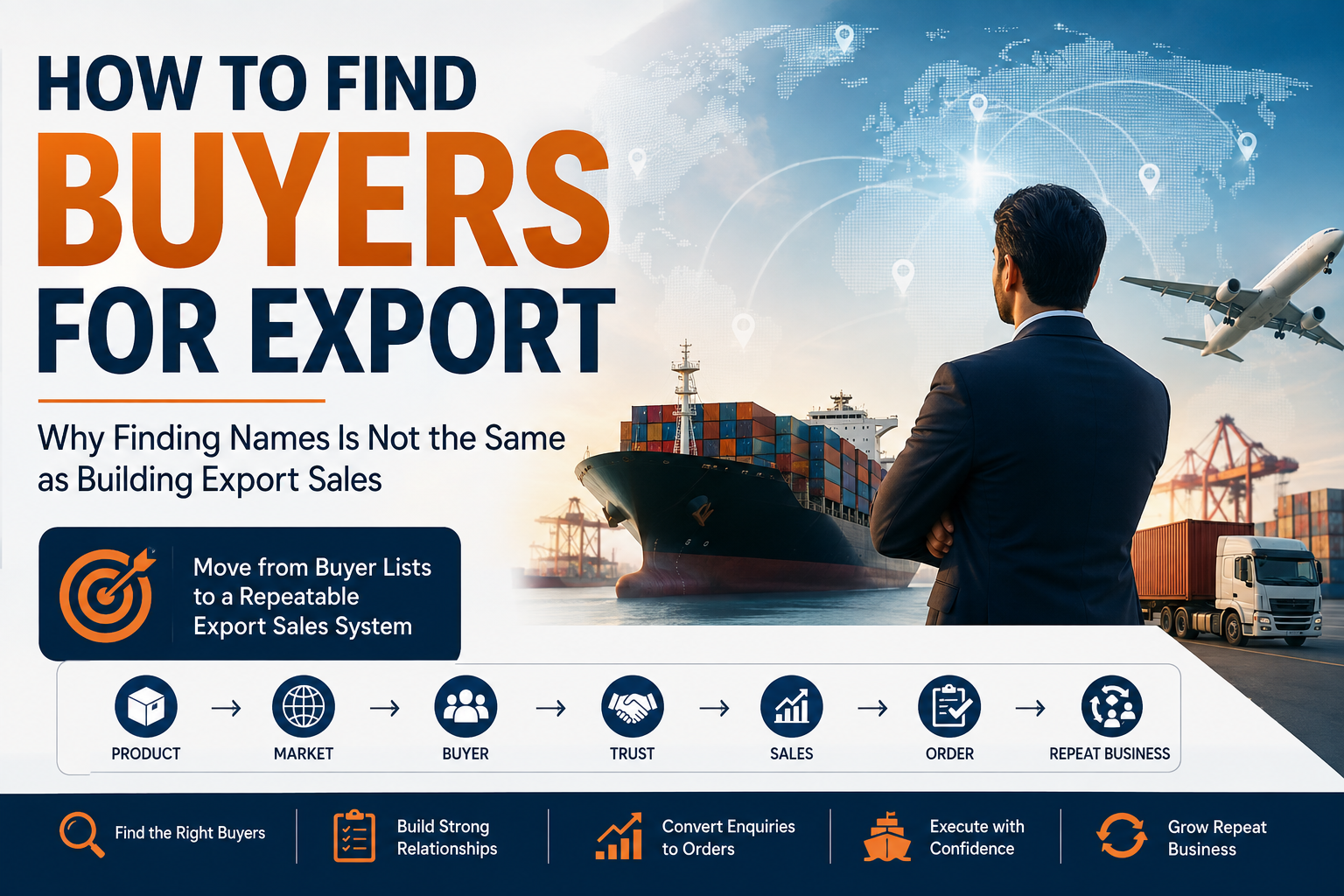
Related reading: How to Find Buyers for Export from India Using RSM
https://consultkriba.com/post/how-to-find-buyers-for-export-from-india-rsm
6. How Can an AI Export Team Help an IT Employee?
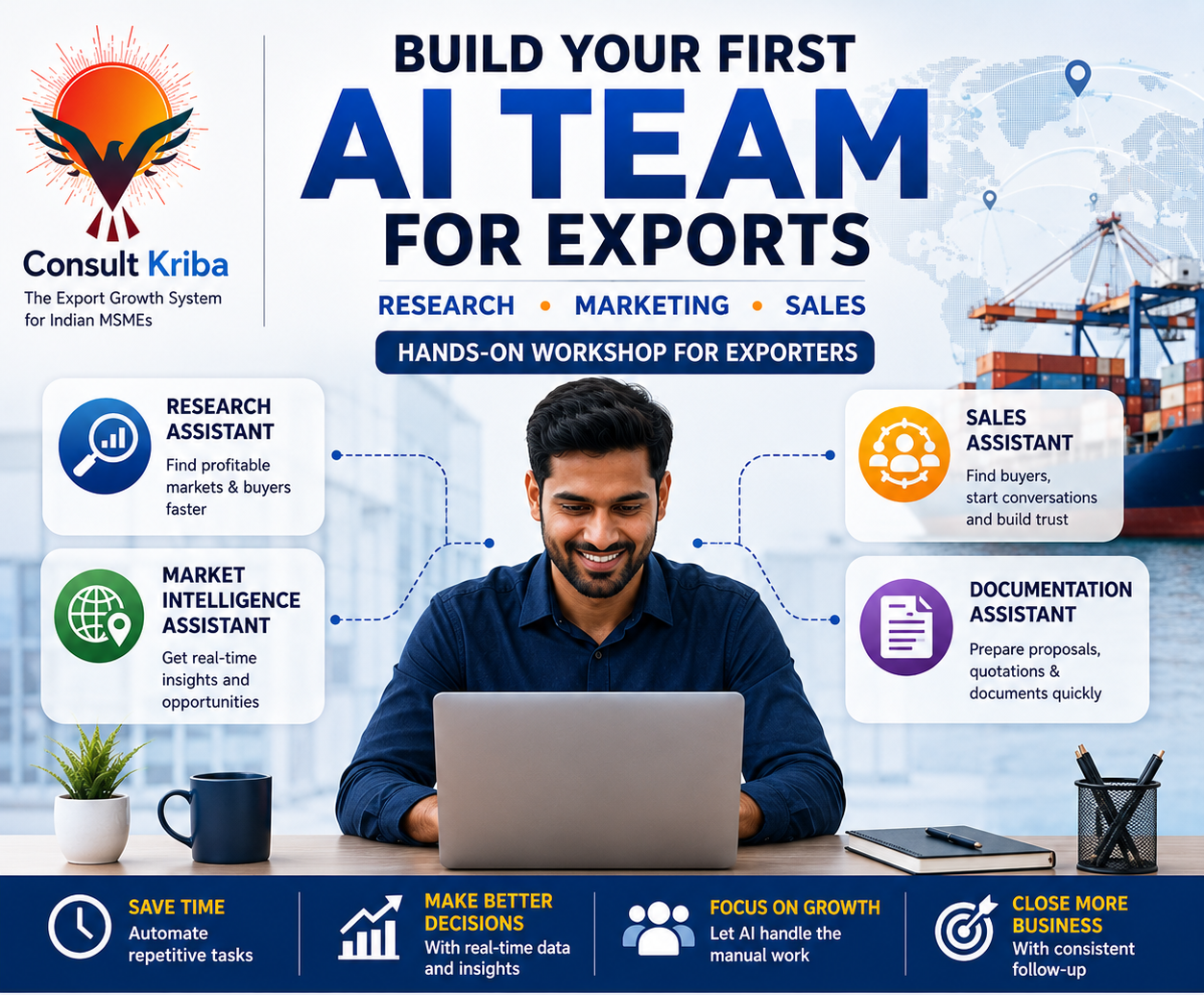
AI can help an IT professional research markets, organise product information, identify possible buyers, prepare communication and manage follow-up tasks. It supports the export sales process but cannot replace supplier checks, buyer relationships or commercial decisions.
Karthik reaches home at 7.30 PM.
He has 90 minutes available to work on his export business.
He decides to use AI for research and preparation so he can concentrate on business decisions.
A practical 90-minute AI-supported routine
First 20 minutes: Product and market research
Karthik gives an AI assistant the manufacturer's verified product specifications.
He asks it to organise possible applications, buyer categories and questions that need further research.
He checks the output against technical documents and reliable sources.
Next 20 minutes: Buyer identification
He asks a research assistant to help identify companies that manufacture industrial control panels.
He reviews company websites and checks whether the companies could genuinely use the enclosures he offers.
Next 20 minutes: Buyer communication
He prepares an introductory email explaining the product, available specifications and the manufacturer's relevant capabilities.
AI helps prepare the draft.
Karthik checks the claims, selects the relevant company contact and decides whether the message is appropriate.
Next 20 minutes: Follow-up preparation
He reviews existing buyer conversations.
AI helps organise outstanding questions, promised documents, meeting notes and next actions.
Final 10 minutes: Business review
Karthik records which buyer discussions have progressed, what requires manufacturer confirmation and what he needs to complete next.
This example shows how AI can support a limited working schedule. It is not a measured claim that AI will always complete these activities within the stated time.
What should an AI Export Team do?
Different AI-supported tasks can help with different parts of the RSM process.
A product research assistant can help organise specifications and supplier questions.
A market research assistant can help compare market information and potential buyer categories.
A sales support assistant can help prepare communication, analyse enquiries and organise follow-ups.
A costing assistant can help structure calculations, provided the figures and assumptions are verified.
However, AI cannot guarantee buyer replies, export orders or profit.
Karthik must still confirm product capability, market requirements, buyer identity, pricing, compliance and payment conditions.
He must also ensure that confidential commercial information is used appropriately.
RSM tells you what business decisions matter. AI helps you organise and carry out suitable parts of the work.
Learn more: Consult Kriba — AI Export Team Workshop
7. How Many Hours a Day Are Needed to Run an Export Business?
An IT professional can begin export business preparation with around 1–2 hours on working days and 3–4 hours during the weekend. Once buyer enquiries, samples and shipments begin, the time needed will depend on actual business activity.
Karthik creates a weekly routine.
Day | Main activity |
|---|---|
Monday | Product and market research |
Tuesday | Identify suitable overseas companies |
Wednesday | Prepare buyer communication and relevant follow-ups |
Thursday | Check supplier specifications, prices and availability |
Friday | Review buyer discussions and next steps |
Saturday | Manufacturer visits, samples and practical business work |
Sunday | Review progress and plan the coming week |
This gives his business a regular working rhythm.
But he also needs flexibility.
An overseas buyer may request a meeting during Indian office hours.
A manufacturer may require an urgent decision about a specification.
A shipment may need documents or approvals at a particular time.
These activities cannot always wait until the evening.
Karthik can coordinate routine work with suppliers and suitable service providers. As the business grows, he may need an employee or trusted operational partner.
If he works night shifts, he should adjust the schedule to protect sleep, health and job responsibilities.
The important measure is whether the business receives enough attention to serve buyers reliably.
The time required depends on whether you are researching an opportunity, developing buyer conversations or executing confirmed orders.
8. How Much Investment Is Needed to Start an Export Business?
There is no fixed minimum investment that suits every export business. The amount depends on your product, supplier payment terms, sample costs, registration expenses, marketing, freight, insurance and working capital.
Karthik has saved ₹5 lakh.
He should not assume that the entire amount is available to invest.
Part of his savings may be needed for family expenses and emergencies.
He must first estimate the financial requirements of his chosen product and business model.
How do you check whether an export order is profitable?
Suppose Karthik receives an overseas enquiry that could lead to an order worth ₹6 lakh.
He prepares the following illustrative estimate.
Expense | Estimated amount |
|---|---|
Product purchase | ₹4,00,000 |
Packing and handling | ₹20,000 |
Freight and shipment-related expenses | ₹50,000 |
Documentation and banking | ₹10,000 |
Other order expenses and risk provision | ₹50,000 |
Total estimated order cost | ₹5,30,000 |
Estimated order contribution | ₹70,000 |
The order contribution is ₹70,000.
That is approximately 11.7% of the ₹6 lakh selling price.
This contribution is not necessarily the final net profit.
Karthik must also consider any remaining business expenses, finance charges and applicable taxes.
The costs must match the agreed delivery terms, including the relevant Incoterm. Freight and insurance responsibilities, for example, will differ according to the contract.
A profitable order can still create a cash shortage
Now suppose Karthik's manufacturer requires ₹3 lakh before beginning production.
The overseas buyer agrees to pay only after shipment, subject to the agreed payment terms.
Karthik must arrange money for production and other expenses before receiving the buyer's payment.
That money is part of his working capital requirement.
He must also check what happens if production is delayed, freight costs change or the buyer's payment arrives later than expected.
Profit and available cash are different.
A business may report a profit on an order while still struggling to pay the supplier.
The RSM Business Feasibility Test
Before accepting an export opportunity, Karthik examines six areas.
Product feasibility: Can the manufacturer supply the exact specification and quantity?
Market feasibility: Is there a realistic buyer requirement for this product?
Commercial feasibility: Can the product be sold at a suitable price after all costs?
Financial feasibility: Can the business pay suppliers and complete the order before receiving the full buyer payment?
Legal feasibility: Can the product meet the applicable Indian and destination-market requirements?
Operational feasibility: Can Karthik coordinate production, quality checks, shipment and buyer communication?
These checks draw on the connected RSM areas. They are a practical way to apply the method to business feasibility, rather than a separate formal RSM level.
An export opportunity becomes commercially attractive when the product, buyer, costs, payment conditions and delivery capability work together.
9. How Can a New Exporter Build Credibility With Overseas Buyers?
A new exporter builds credibility by giving buyers clear, accurate and verifiable proof of product capability, business identity, quality and delivery commitments.
Karthik has registered his business, but he has never completed an export order.
He cannot yet show overseas customer references.
However, he can demonstrate the capabilities that are genuinely available through his manufacturing partner.
He prepares a company profile explaining his business and the product category he supplies.
His product catalogue includes accurate specifications, materials and applications.
He obtains relevant technical drawings, test reports and manufacturing information with the supplier's permission.
He also prepares to coordinate sample requests and explain realistic production lead times.
Five credibility checks every new exporter should make
Business identity: Can a buyer verify the company's registration, contact details and professional presence?
Product clarity: Does the catalogue clearly explain the product's specifications and uses?
Supply proof: Is there a genuine manufacturer capable of supplying the agreed product?
Quality proof: Are the relevant test reports, certifications or inspection arrangements available and valid?
Communication: Does the exporter respond accurately, explain commercial terms and fulfil commitments?
If Karthik is a merchant exporter, he should present himself as such rather than claiming to own a factory.
He should also distinguish certificates held by the manufacturer from certifications held by his own business.
For overseas buyers, credibility helps reduce uncertainty about placing an order with a new supplier.
Buyer trust is built when your business claims, supporting evidence and actual supply capability agree.
10. When Should You Leave Your IT Job for Full-Time Export Business?
Move from IT employment to full-time exporting when the business demonstrates sustainable profit, dependable demand, manageable working capital and a clear need for your full-time involvement.
Suppose Karthik completes his first export order.
The order generates a positive contribution.
He is excited and starts thinking about resigning.
But his first sale does not establish that the same income will arrive every month.
He needs to understand whether the buyer may purchase again, how long the next sales cycle could take and what it costs to run the business between orders.
Seven things to examine before resigning
1. Consistent net profit
Has the business generated actual profit across completed transactions over several months?
2. Buyer continuity
Are there repeat buyers, regular qualified enquiries or dependable business relationships?
3. Personal financial security
Are there sufficient savings for household expenses if export sales slow down?
4. Separate working capital
Can the business finance orders without depending on money needed for family expenses?
5. Supplier and shipment reliability
Can the business continue delivering products correctly as order volumes increase?
6. Full-time business requirement
Are buyer meetings, supplier management and order execution creating a genuine need for the owner to work full-time?
7. Growth opportunity
Will full-time attention help the business serve customers and expand profitably?
As a planning safeguard, Karthik may examine 6–12 months of financial results and maintain savings sufficient for 6–12 months of household expenses.
These are suggested safeguards, not fixed RSM requirements or guaranteed indicators of success.
Should export income match your IT salary?
Karthik earns ₹1.2 lakh per month from his IT job.
Suppose his export business makes ₹1.5 lakh net profit in one month but earns very little during the following two months.
He must examine the average profit, cash received, future orders and financial risks rather than rely on the strongest month.
If the business eventually produces dependable income, has suitable cash reserves and can grow through his full-time involvement, a career change becomes a more informed decision.
Leaving your IT job should be the result of business readiness, not merely the excitement of receiving an export order.
11. How Can Consult Kriba Help an IT Professional Build an Export Business?
Consult Kriba helps Indian manufacturers and traders improve their export sales process, from finding suitable overseas buyers to closing export sales, through the Reverse Sourcing Method.
For someone like Karthik, the immediate priority is to develop a real product and business direction.
He needs to understand what can be supplied, which buyers may need it, whether the costs make sense and what work must happen before contacting buyers.
Consult Kriba's RSM provides a structured way to examine these decisions.
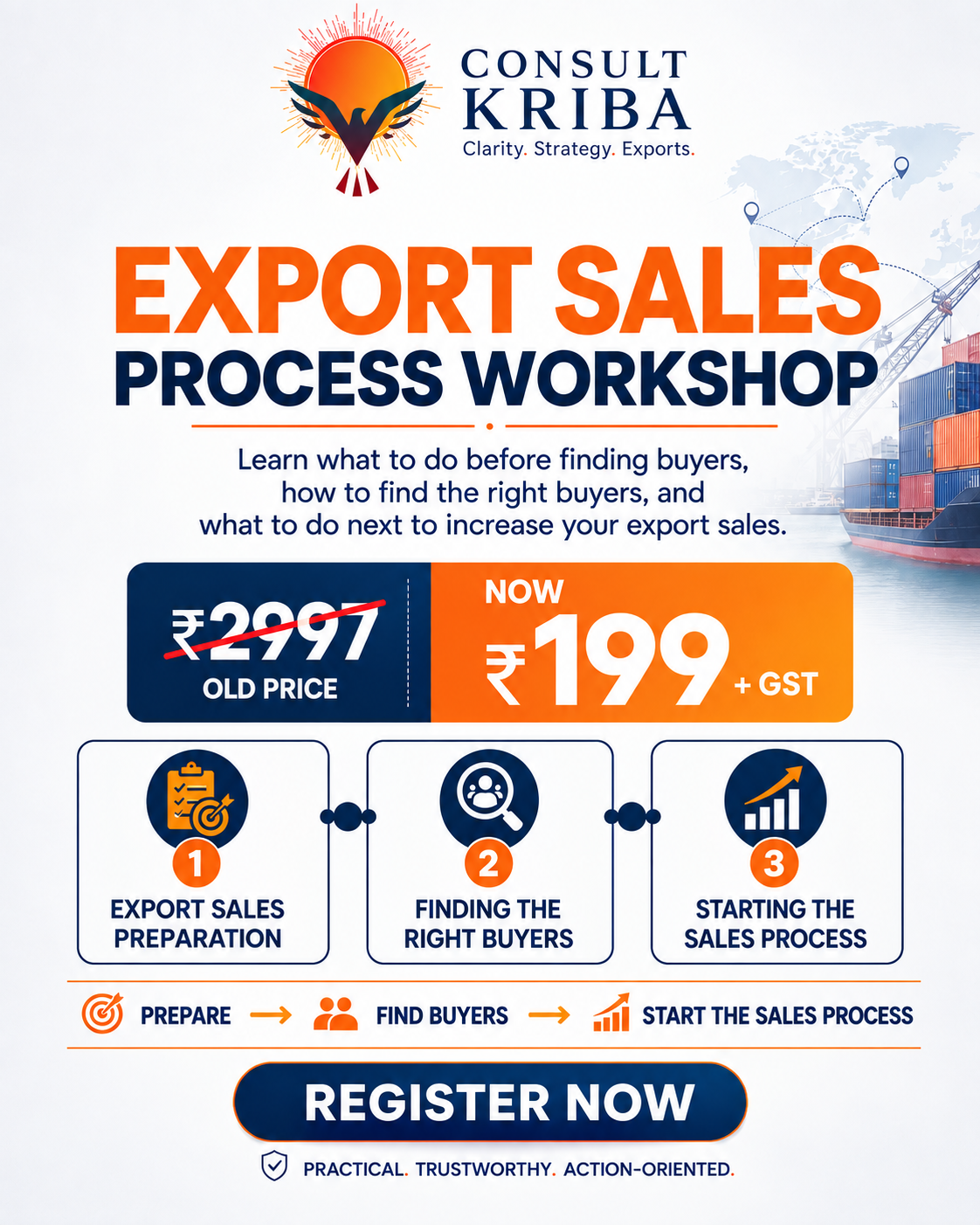
Export Sales Process Workshop
The Export Sales Process Workshop helps participants understand three connected activities:
Prepare for export sales: Understand product readiness, business credibility and information buyers require.
Find the right buyers: Identify suitable companies and relevant people instead of collecting unrelated contact information.
Start the sales process: Understand how to develop buyer conversations, clarify requirements, follow up and move towards quotations and sales.
For an IT professional who already has a product direction or a manufacturing partner, this can help clarify the next practical actions.
It is intended as a working export sales experience, rather than a promise of instant buyers or orders.
Exports Mastery
For suitable participants ready to develop their export sales capabilities further, Consult Kriba offers Exports Mastery, a three-month guided programme based on the six RSM areas.
It includes structured RSM learning, practical exercises and guided sessions covering product understanding, market direction, compliance, marketing, sales conversion and shipment-related decisions.
The purpose is to develop the exporter's ability to handle real business opportunities.
Participants remain responsible for their own product information, supplier relationships, buyer communication, commercial decisions and regular execution.
How do we measure business progress?
Instead of looking only at the number of buyer contacts collected, the RSM approach examines meaningful commercial progress.
That includes suitable buyer connections, buyer conversations, clear requirements, quotations, negotiations, accepted orders and repeat business.
Profitability must also be reviewed through cost, margin, payment security and reliable execution.
This is how export sales activity can become a disciplined business process.
12. Your First 90 Days: A Practical Export Business Starting Plan
Karthik now has enough direction to begin serious preparation.
He decides to use the next three months to study and test his proposed business.
This is an illustrative plan. The duration of actual product approvals, buyer development and orders will vary.
Period | Priority | What should become clear |
|---|---|---|
Days 1–15 | Business direction | Available time, capital, strengths and possible products |
Days 16–30 | Product Mastery | Product specifications, manufacturers, quality and cost |
Days 31–45 | Market Genius | Priority markets, suitable buyer categories and competition |
Days 46–60 | Commercial preparation | Feasibility, legal requirements, credibility and working capital |
Days 61–75 | Buyer development | Suitable companies, relevant decision-makers and communication |
Days 76–90 | Sales execution | Early buyer conversations, requirements, follow-ups and next actions |
At the end of 90 days, Karthik should review whether the business opportunity has become clearer.
Can he supply the exact product?
Does he know which buyers are relevant?
Can he explain why those buyers should consider his company?
Has he identified suitable companies and started meaningful discussions?
Are the likely margins, payment conditions and operational responsibilities manageable?
If important questions remain unanswered, he can continue researching and testing the business before making larger financial commitments.
The purpose of the first 90 days is to build and test a serious business direction, not to assume that export orders must arrive within that period.
Frequently Asked Questions
Can an IT employee start an export business without leaving their job?
Yes. An IT employee can begin preparing and developing an export business while employed, subject to employment terms and the ability to manage business responsibilities. A merchant export model may allow the person to work with existing Indian manufacturers rather than invest immediately in manufacturing.
Which export products are suitable for IT professionals?
There is no single best product. Technical, processed, customised or value-added products may be worth investigating when the person has relevant knowledge, dependable supplier access and a clear commercial advantage. Product demand, compliance, capital and buyer requirements must be assessed before deciding.
How much capital is required to start an export business in India?
Capital requirements vary with the product, business model, order size, supplier payment terms and shipment responsibilities. A proper estimate should include preparation expenses, samples, business setup, working capital and a provision for risks.
Can I start an export business from home?
Yes, research, marketing and many sales activities can be managed from home, provided the business has appropriate registrations and arrangements. Physical product inspection, supplier coordination and shipping activities must still be managed reliably.
How many hours should I spend on exporting while working in IT?
A starting routine of 1–2 hours on working days and 3–4 hours during weekends may be practical for early research and buyer development. Active orders, international meetings and shipments may require additional time and daytime availability.
How can I find genuine overseas buyers?
Identify the companies that actually use or purchase your exact product. Check their business activity, find relevant purchasing contacts, understand their possible requirements and develop suitable conversations. Consult Kriba's RSM follows the progression from suitable company to relevant person, buyer conversation and qualified sales opportunity.
Can an AI Export Team find buyers and close export orders?
AI can support research, buyer identification, communication preparation and follow-up management. Buyer suitability, pricing, negotiation, compliance and order execution still require human responsibility and verification. AI cannot guarantee export orders.
What is the Reverse Sourcing Method in exporting?
The Reverse Sourcing Method is Consult Kriba's export sales framework. It prepares the product, market, compliance, business proof and commercial information before buyer connection, then guides the work from buyer conversations to quotations, negotiation, shipment and repeat business.
How long does it take to get the first export order?
There is no fixed timeline. It depends on product readiness, buyer requirements, competition, approvals, pricing, trust and the purchasing cycle. Progress should be measured through meaningful conversations, qualified requirements and commercial decisions.
When should I leave my IT job and become a full-time exporter?
Consider the transition after reviewing consistent net profit, cash flow, repeat demand, supplier reliability, personal savings and the business need for full-time management. One successful order is not enough evidence to establish long-term income.
Build Your Export Business with a Clear Sales Process
Your IT experience can give you useful strengths in technology, project management, research and international communication.
Those skills can support your export business.
The next step is to apply them to a real product, a suitable overseas market and a reliable supply arrangement.
Learn what the buyer needs. Prepare the information that builds trust. Understand your costs and payment risks. Then develop buyer conversations through a proper sales process.
A profitable export business requires more than a buyer list. It requires the right product, market, commercial decisions and consistent execution.
Consult Kriba's Reverse Sourcing Method helps exporters work through these connected decisions.
If you already have a product or manufacturing direction and want to understand how to start developing export sales, begin with our Export Sales Process Workshop.
Explore the Consult Kriba Export Sales Process Workshop
Consult Kriba — From Finding the Right Overseas Buyers to Closing Export Sales.
Sources and Further Reading
Consult Kriba — Reverse Sourcing Method Levels Knowledge Base. Source for RSM's core principle, six connected areas, buyer-development process and commercial decision approach.
Consult Kriba — RSM Product Mastery. Source for product specifications, sourcing capability, international demand, competition and the four product advantages.
Directorate General of Foreign Trade — Official Indian export and import procedures, including IEC guidance.
Central Board of Indirect Taxes and Customs — Official GST and export tax guidance.
Government of India Trade Statistics — India's merchandise trade statistics.
International Trade Centre Trade Map — International trade information for preliminary market research.
Editorial note: Karthik's situation, the product comparison, the ₹6 lakh order and the suggested work schedules are illustrative examples. They explain how to evaluate business decisions and are not income forecasts or claims of actual customer performance.
