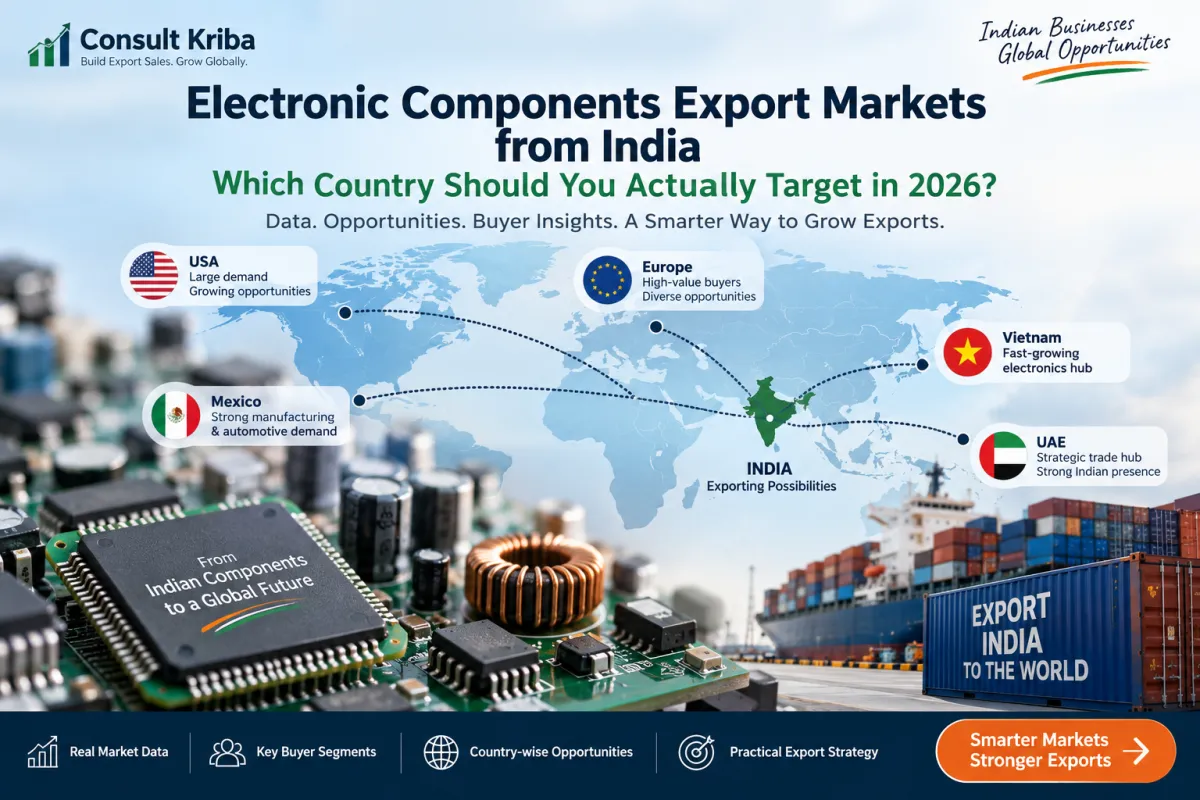
Electronic Components Export Markets from India: Which Country Should You Actually Target?
If you manufacture PCBs in India, where should you start?
The United States, where India already exported more than US$30 million of printed circuits in 2024?
Mexico, which imported about US$3.3 billion of printed circuits in the same year?
Vietnam, where imports of electronics, computers and components reached US$161.63 billion in the first eight months of 2026?
Or the UAE, where India was already the second-largest reported PCB supplier in 2024 after China?
All four markets can look attractive.
They are attractive for very different reasons.
And that is exactly why market selection should come before collecting hundreds of buyer names.
In Consult Kriba's Reverse Sourcing Method, Product Mastery asks:
What exactly can we sell, for which application, and with what strength?
Market Genius asks the next question:
Where does that exact product have the best commercial fit, which type of buyer should we approach, and how does that market buy?
The current RSM Market Genius framework looks at demand, competition, India's position, buyer categories, route to market, substitute products, buying cycles, commercial patterns and market risk. A large import figure is therefore one input, rather than the final market decision.
Related reading: Electronic Components Export from India: From Part Number to Buyer Approval
India has a great vision: USD 2 Trillion by 2030.
Consult Kriba has our free WhatsApp community to support this mission: India 2030: USD 2 Trillion
It has dedicated sector-wise groups for:
Market intelligence
Policy updates
Exporter networking
To join the community, fill out this form:
https://www.consultkriba.com/india2030

Is the global electronic-component market growing in 2026?
Yes, but the growth is uneven across component families and markets.
ZVEI estimated the worldwide electronic-components market at about US$900 billion in 2025, with semiconductors accounting for roughly 80% of that market. Asia-Pacific and the Americas were among the stronger regions, while European growth was more moderate.
The latest ECIA Industry Pulse also shows a positive electronic-component market in 2026. Its August 2026 component index stood at 136.7, well above the 100-point threshold that separates positive and negative sales sentiment, even after easing from the June peak.
For an Indian exporter, the important conclusion is more specific:
A growing global electronics market does not mean every component should be sold to the same country.
A semiconductor supplier, PCB manufacturer, connector company and wire-harness manufacturer participate in different parts of the electronics supply chain.
Market Genius therefore starts with:
Exact component × Exact application × Exact buyer × Exact market.
Why can the biggest importing country still be a difficult market?
Printed circuits provide a good example.
In 2024, the world's largest reported PCB import markets under HS 853400 included:
Hong Kong at about US$7.83 billion, China at US$7.66 billion, the European Union at US$5.44 billion, Mexico at US$3.30 billion, South Korea at US$2.93 billion, Thailand at US$2.71 billion and the United States at US$2.67 billion.
Now compare this with India's own PCB export destinations.
India exported about US$125.3 million of printed circuits in 2024. Its leading reported destinations were the United States, Austria, France, UAE and the Netherlands.
That difference is important.
Some of the world's largest PCB import markets are not India's largest current export destinations.
And some comparatively smaller markets already buy meaningful quantities from India.
So the real market question is not:
“Which country imports the most PCBs?”
It is:
“Where does our type of PCB have a realistic position against the existing suppliers serving the buyer?”
That is a completely different research exercise.
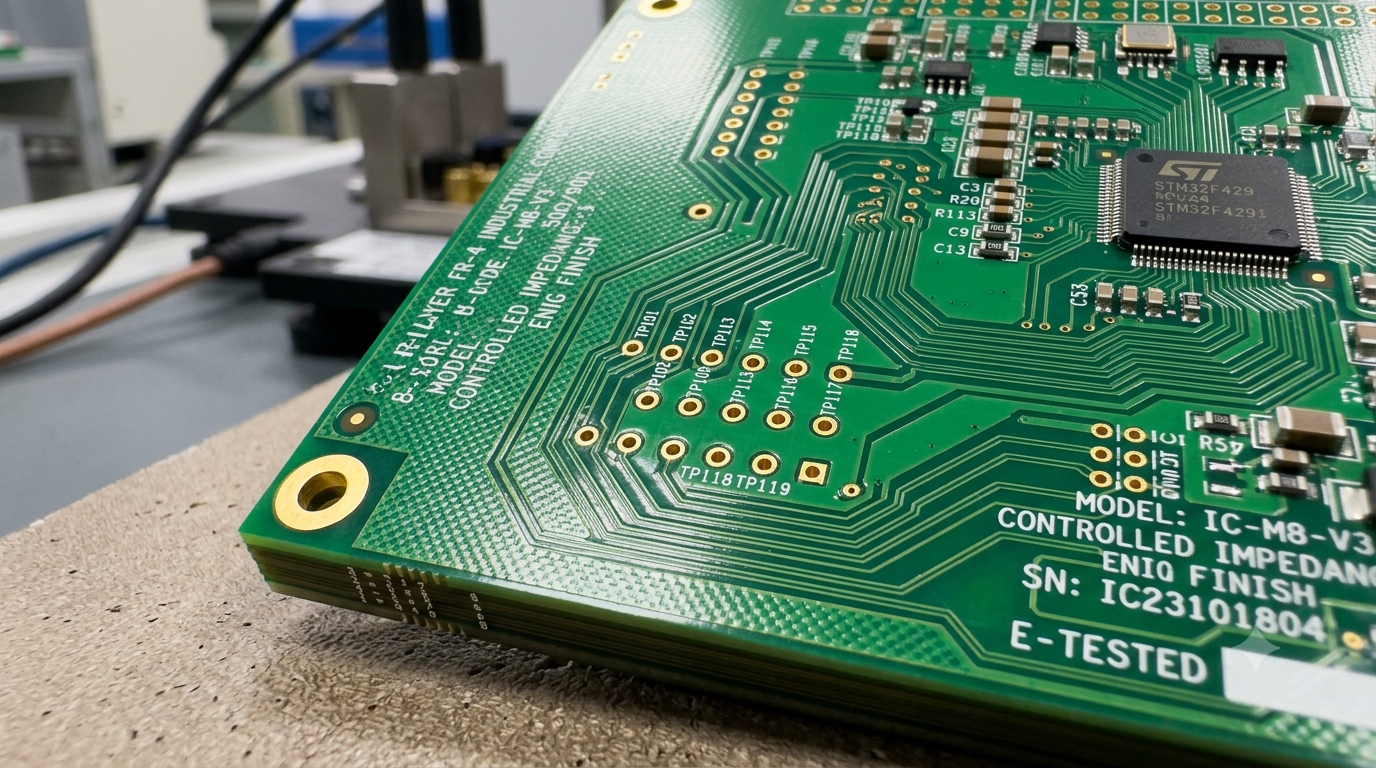
Market 1: United States — large demand with an existing Indian supply position
The United States imported about US$2.67 billion of printed circuits in 2024. India supplied about US$30.1 million, making the US India's largest reported PCB export destination that year.
This gives Indian PCB suppliers something valuable: evidence that Indian supply already exists in this market.
The opportunity still needs to be narrowed.
The United States buys electronic components for a wide range of applications such as industrial electronics, communications, automotive, aerospace, medical equipment, energy systems and consumer products.
A manufacturer producing specialised low-volume industrial PCBs may need a different buyer list from a manufacturer producing high-volume boards.
The buyer may also be an OEM, an Electronics Manufacturing Services company, a contract manufacturer, a distributor or a specialised product developer.
Consult Kriba Market Genius view
For the US, market research should move from:
USA → electronics companies
to something like:
USA → industrial automation → control-equipment manufacturers → multilayer PCB requirement → engineering/procurement decision-makers
That is much closer to an actual export-sales direction.
The relevant advantage may then be customisation, technical support, prototype capability, traceability, production flexibility or competitive manufacturing.
Market 2: Mexico — very large PCB demand, but strong Asian competition
Mexico deserves serious attention from electronics exporters because it combines electronics manufacturing with one of the world's largest PCB import flows.
Mexico imported around US$3.30 billion of printed circuits in 2024.
China alone supplied approximately US$2.36 billion. Taiwan, South Korea, the United States and Thailand were also major suppliers. Mexico's reported imports from India were much smaller.
This tells an Indian manufacturer two things at the same time:
There is substantial demand.
There is also a well-established supply network.
Mexico becomes even more interesting when the end-use industry is considered.
The US International Trade Administration's 2026 Mexico automotive guide identifies demand for electronic components and specifically mentions opportunities involving printed circuit boards, controllers, telematics, lighting, wire harnesses and other vehicle-related technologies within the Tier supplier network.
So an Indian exporter selling:
“electronic components to Mexico”
is still working too broadly.
A stronger direction could be:
Automotive PCB → Mexican Tier-2/Tier-1 electronics supplier → vehicle control application → buyer-approved specification
or:
Wire harness → vehicle/equipment manufacturer → defined connector and harness specification → regular production requirement
Consult Kriba Market Genius view
Mexico looks attractive where an Indian supplier has a specific reason to replace, complement or become an additional source alongside established Asian supply.
The exporter should therefore understand the buyer's reason for considering another supplier.
Is it price?
Capacity?
Lead time?
Supply-chain diversification?
Engineering support?
A specific technical capability?
A market opportunity becomes much clearer once that question is answered.
Market 3: Europe — one region, several very different buyer markets
Writing “target Europe” is too broad for electronic components.
The European Union imported about US$5.44 billion of printed circuits in 2024.
Germany alone imported about US$1.68 billion.
Germany's wider electrical and digital industry is also substantial. ZVEI reported that Germany's imports of electrical and electronic goods reached €274.9 billion in 2025.
Yet India's PCB export pattern shows another important point.
Austria, France and the Netherlands were all among India's five largest PCB destinations in 2024.
This means an exporter should study European manufacturing clusters and applications rather than treat the EU as one buyer market.
Germany may offer industrial, automotive and engineering-related opportunities.
France may present a different mix of industrial, aerospace and other electronics applications.
Austria may offer opportunities through specialised industrial manufacturing.
The Netherlands adds another dimension.
Statistics Netherlands reported that the Dutch semiconductor sector reached €45.6 billion in turnover in 2025, more than double its 2019 level, with over 300 companies included in the sector analysis.
What should an Indian exporter learn from this?
Europe is better analysed as:
Country → industry → application → buyer type
For example:
Netherlands → semiconductor ecosystem → equipment/component supplier → precision electronics requirement
is much more useful than:
Netherlands → electronics buyers
The quality of the market definition directly affects the quality of the buyer list.
Market 4: Vietnam — a fast-moving electronics production market
Vietnam offers a very different opportunity.
Its National Statistics Office reported that imports of electronics, computers and components reached US$161.63 billion in the first eight months of 2026, an increase of 68.3% compared with the corresponding period. The agency linked this strong import growth with production demand and Vietnam's expanding position in global electronics supply chains.
That is a very strong market signal.
It is also a broad figure.
A PCB exporter should still check PCB demand.
A capacitor manufacturer should check capacitors.
A connector manufacturer should check connectors.
A sensor manufacturer should check sensors.
This difference can be seen in India's trade data.
For multilayer ceramic fixed capacitors under HS 853224, India exported only about US$2.26 million worldwide in 2024. Vietnam was India's second-largest reported destination for the product, at roughly US$266,000.
This is a small export number compared with Vietnam's enormous electronics-sector import value.
And that is precisely why the data is useful.
It says:
Vietnam has a major electronics manufacturing ecosystem. India's actual position must still be checked product by product.
Consult Kriba Market Genius view
For Vietnam, relevant targets may include electronics manufacturers, EMS companies, component procurement teams and specialised distributors depending on the product.
The exporter then has to understand:
Where is the component used?
Which factories use that application?
Who is already supplying them?
What qualification process applies?
What buying quantity and forecast pattern do they follow?
The country is only the beginning of the research.
Market 5: UAE — smaller manufacturing demand can still produce a useful Indian position
The UAE shows why market size should always be read together with India's competitive position.
For printed circuits in 2024, China supplied the UAE about US$11.84 million.
India supplied about US$8.62 million.
That made India the UAE's second-largest reported PCB supplier in the WITS data.
The value is far smaller than Mexico or the United States.
Yet India's relative position is much stronger.
Dubai also remains a major trading and re-export centre. Dubai Chamber members recorded AED356.5 billion of exports and re-exports across all goods in 2025, up 15.1% from 2024. This is a broad trade-hub indicator rather than an electronics-specific demand figure.
For the right Indian electronics company, UAE could therefore play several roles:
a direct buyer market,
a distributor market,
a regional stocking point,
or a route into buyers in surrounding markets.
The useful role depends entirely on the component.
Consult Kriba Market Genius view
A broad-range electronic-component supplier may see more value in distributors.
A customised PCB manufacturer may need direct industrial users.
A replacement-parts supplier may work through stockists.
A high-spec manufacturer may find a smaller set of technical buyers more valuable than a large distributor database.
The market stays the same.
The right buyer type changes.
So which is the best electronics export market for India?
There is no single country that is best for every Indian electronic-component exporter.
The better question is:
Which market best matches our actual strength?
A manufacturer with high-volume, efficient production may look for markets with regular large-volume purchasing.
A manufacturer with strong technical certification and traceability may suit buyers in industrial, automotive or other quality-sensitive applications.
A flexible manufacturer may perform better where buyers need prototypes, special specifications or smaller production quantities.
A trader or distributor with a controlled product range may fit markets where stock availability and multi-product supply matter.
This is why the Product Mastery work should come before the final market choice.
The product tells us what we can supply.
The market tells us where that strength matters.
What does a five-country electronics market study actually check?
Consult Kriba's current Exports Mastery structure uses a five-country comparison before finalising the market direction.
The research compares demand, market trends, supplier countries, market access and buyer purchasing conditions. The exporter then selects one priority market and two backup markets instead of trying to work everywhere at once.
For electronic components, the practical research should cover:
exact product and HS code, including specification where trade data allows;
import value and direction of demand;
major supplier countries and India's present position;
industries and applications driving component demand;
relevant buyer type: OEM, EMS, distributor, Tier supplier, product developer or another route;
competing technology or substitute product;
buyer qualification and proof expectations;
typical production, forecast and purchasing cycle;
market access, duties and major regulatory conditions;
price position, freight, lead time and supply reliability;
why the buyer may consider an Indian supplier;
how easy it is to identify and reach the relevant companies and decision-makers.
The purpose is to reach three decisions:
Priority market.
Priority buyer type.
Reason for the buyer to consider you.
That is far more useful than a spreadsheet containing 5,000 electronics companies.
How does the buyer's production cycle change market selection?
Electronics has another important market factor: timing.
Buying can begin during:
design,
technical evaluation,
prototype,
supplier qualification,
forecasting,
regular purchasing,
or an additional-supplier requirement.
A market can have excellent demand while the exporter approaches companies at the wrong point in their sourcing cycle.
For example, a buyer finalising a product design may value prototype and engineering support.
A factory entering mass production may care more about capacity, supply continuity and lead time.
A company already dependent on one supplier may be evaluating an additional source.
A distributor may be responding to stock shortages or customer demand.
The relevant Market Genius question becomes:
Why might this buyer consider a supplier now?
That question can improve buyer communication far more than simply knowing the country's import value.
What should the Buyer-Market Map contain?
The current RSM Market Genius programme moves from country research into buyer mapping.
The output is a Buyer-Market Map, an Ideal Buyer Profile and clear Priority Account Criteria. The process includes buyer types, relevant decision-makers, buyer data, competition, regulation shifts, purchasing frequency, volume, timing and business expectations.
For an Indian PCB exporter, an Ideal Buyer Profile could become:
Industrial equipment manufacturer in the US or Europe using low-to-medium volume multilayer PCBs, requiring controlled impedance, traceability and flexible prototype-to-production support.
For a harness manufacturer:
Mexican automotive or equipment Tier supplier sourcing customised wire harness assemblies with specified connectors, crimp requirements and regular production schedules.
For a capacitor manufacturer:
Vietnamese electronics manufacturer or EMS company sourcing capacitors against approved specifications for regular assembly production.
These descriptions can actually guide research.
“Electronic component importer” usually cannot.
What should an Indian electronic-component exporter do next?
The market-selection process can be kept simple.
Start with one exact component family.
Understand the applications.
Select five countries with evidence of demand.
Compare supplier countries and India's position.
Map the industries using the component.
Identify the correct buyer types.
Study how those buyers purchase and qualify suppliers.
Then choose one priority market and two backup markets.
Only after that should large-scale buyer finding begin.
This follows the RSM Market Genius rule: a market should fit the product, buyer, competition, compliance, price, supply capability and commercial conditions, not simply have a high import value.
Frequently Asked Questions
Which country is the biggest market for printed circuit boards?
In 2024 WITS data, Hong Kong and China were the largest reported PCB import markets, followed by the European Union. Mexico, South Korea, Thailand and the United States were also major markets. The most suitable country for an Indian PCB exporter depends on the exact PCB specification, application, competition and buyer type.
Is the United States a good market for Indian PCB exporters?
The US is already India's largest reported PCB export destination in 2024 data, with Indian exports of about US$30.1 million. It is therefore a proven market for Indian supply, though individual manufacturers still need to identify the correct application and buyer segment.
Is Mexico a good market for Indian electronic components?
Mexico has substantial electronics and automotive manufacturing demand. It imported about US$3.3 billion of PCBs in 2024, and official US trade guidance identifies opportunities in PCBs, controllers, harnesses and other automotive electronics. Existing Asian competition is strong, so Indian suppliers need a clear application and buyer advantage.
Why is Vietnam important for electronic-component exporters?
Vietnam's imports of electronics, computers and components reached US$161.63 billion during the first eight months of 2026, reflecting its large production-oriented electronics sector. Product-level research is still required because broad electronics demand can differ greatly from the demand for one specific component.
How many export markets should an electronic-component exporter target first?
Consult Kriba's current RSM execution structure starts by comparing five countries, then choosing one priority market and two backup markets after the assumptions are validated. This creates enough comparison while keeping sales activity focused.
Market data tells you where trade exists. Market Genius tells you where your business fits.
The US can be a proven market.
Mexico can offer huge production demand.
Europe can offer specialised industrial buyers.
Vietnam can offer access to one of Asia's fastest-moving electronics manufacturing ecosystems.
UAE can offer a surprisingly strong Indian position and regional trading connections.
Each market tells a different story.
The important work is to connect:
Product → Application → Country → Competition → Buyer Type → Buying Cycle → Reason to Choose India
That is the Market Genius stage of Consult Kriba's Reverse Sourcing Method.
The aim is simple:
Find the market where your product strength gives the right buyer a sensible reason to start a business conversation.
Join 3-Day Export Sales Process Workshop
https://consultkriba.com/2tnexports