India’s Steel Demand Stays Strong in 2026. What Does It Mean for Indian Steel Exporters?
India consumed 70.5 million tonnes of finished steel between April and August 2026, up 7.4% from the same period last year.
During the same five months, India exported 2.986 million tonnes of finished steel, up 34.1%.
And India still remained a net importer of finished steel by quantity.
These numbers tell us something important.
There is no single story called the “Indian steel market”.
Domestic consumption is growing. Production is increasing. Imports are rising. Exports are rising. Alloy steel is showing strong export growth, while stainless steel is moving differently.
For an Indian steel manufacturer or exporter, therefore, the useful question is not:
“Is steel a good product for export?”
It is:
“Which steel product, specification, buyer and market combination gives us a realistic export opportunity?”
That is where the data becomes useful for export sales.
Get Regular Export Market Updates
Join our India 2030: USD 2 Trillion Exports WhatsApp Community for export updates, market opportunities, sector discussions and overseas business initiatives.
Join the India 2030 WhatsApp Community

What Happened in India’s Steel Sector During April–August 2026?
According to provisional Joint Plant Committee data released by the Ministry of Steel on 24 September 2026, India produced:
71.0 million tonnes of crude steel, up 2.8%
68.3 million tonnes of finished steel, up 4.1%
40.4 million tonnes of hot metal, up 2.9%
25.4 million tonnes of sponge iron, up 1.9%
The more interesting number is consumption.
Finished steel consumption increased from 65.7 million tonnes during April–August 2025 to 70.5 million tonnes during April–August 2026, a growth of 7.4%.
Consumption therefore grew faster than finished steel production during this period.
At the same time, India imported 3.487 million tonnes of finished steel, compared with exports of 2.986 million tonnes.
India was therefore a net importer of finished steel by quantity during April–August 2026.
But exports were far from weak.
Finished steel exports increased 34.1% in quantity, from 2.226 million tonnes to 2.986 million tonnes. Export value increased 32% to ₹23,646.6 crore.
So two things were happening together:
India needed substantial imported steel, while Indian steel was also finding growing demand overseas.
For an exporter, the next question is where these movements are happening at the product level.
India Is Importing and Exporting Some of the Same Steel Categories
India's finished steel imports increased 29.5% during April–August 2026.
The main supplying countries were:
China: 1.110 million tonnes, 31.8%
Korea: 1.039 million tonnes, 29.8%
Japan: 496,600 tonnes, 14.2%
Indonesia: 226,100 tonnes, 6.5%
Vietnam: 157,500 tonnes, 4.5%
China, Korea and Japan together accounted for more than three-fourths of India's finished steel imports.
Now look at what India was importing.
The five largest categories were:
Product | Import Quantity | Share |
|---|---|---|
HR Coil/Strip | 1.276 Mt | 36.6% |
CR Coil/Sheets | 624,100 t | 17.9% |
GP/GC Sheets/Coil | 555,500 t | 15.9% |
Plates | 290,100 t | 8.3% |
Bars & Rods | 253,500 t | 7.3% |
Here is where it gets interesting.
India was also exporting HR Coil/Strip, GP/GC Sheets/Coil, plates and bars & rods.
HR Coil/Strip was actually India's largest finished steel category on both sides of trade.
Why would India import and export the same broad steel product?
Because HR Coil is not one uniform commercial product.
Different buyers can require different grades, chemistry, thickness, width, tolerance, surface condition, international standard, application, quantity and delivery condition.
The same applies to most steel categories.
This is why an HS code or the words “HR Coil”, “steel plate” or “alloy steel” are not enough to understand an export opportunity.
The exporter needs to know exactly what is being manufactured and exactly what the overseas buyer needs.
Where Was Indian Finished Steel Going?
India's five largest finished steel export destinations during April–August 2026 were:
Vietnam: 416,000 tonnes, 13.9%
UAE: 389,200 tonnes, 13.0%
Italy: 289,000 tonnes, 9.7%
Belgium: 248,700 tonnes, 8.3%
Nepal: 194,700 tonnes, 6.5%
These five countries are useful starting points for market research.
But they should not automatically become your five target markets.
Suppose you manufacture a particular steel plate.
Knowing that Italy imported Indian steel does not yet tell you:
What steel products did Italy buy from India?
Which grades and specifications?
Who bought them?
Were the buyers distributors, steel service centres, manufacturers or another buyer type?
Which industries use those products?
Who are India's competing supplier countries?
What standards and certifications apply?
What prices and commercial terms are acceptable?
Can your production capability meet those requirements?
Only after answering these questions does a country-level trade number start becoming an export sales opportunity.
The better research path is:
Exact Steel Product → Specification → Application → Buyer Type → Country → Competition → Commercial Fit
Which Steel Products Is India Exporting?
The product mix provides another useful clue.
During April–August 2026, India's five largest finished steel export categories were:
Product | Export Quantity | Share |
|---|---|---|
HR Coil/Strip | 1.170 Mt | 39.2% |
Pipes | 431,500 t | 14.4% |
Bars & Rods | 384,400 t | 12.9% |
GP/GC Sheets/Coil | 381,500 t | 12.8% |
Plates | 269,800 t | 9.0% |
HR Coil/Strip alone accounted for almost four out of every ten tonnes of finished steel exported during the period.
But export volume should not be the only factor an MSME manufacturer considers.
A specialised pipe, engineering steel product, certified alloy grade or customised steel product can have a very different buyer base from bulk steel.
An Indian manufacturer may be able to compete through:
specific grades
technical manufacturing capability
certification
testing facilities
custom dimensions
flexible quantities
processing capability
quality consistency
application knowledge
delivery reliability
The right opportunity depends on the manufacturer's actual strength.
Alloy Steel Is One of the Most Interesting Signals in the 2026 Data
The broader steel numbers hide a significant movement in alloy steel.
During April–August 2026:
Production: 4.804 million tonnes, up 30.9%
Consumption: 5.124 million tonnes, up 24.5%
Imports: 513,800 tonnes, up 5.5%
Exports: 178,700 tonnes, up 182.1%
August itself showed an even sharper export comparison.
India exported 56,500 tonnes of alloy steel in August 2026, compared with only 14,600 tonnes in August 2025.
That is a 287% year-on-year increase for the month.
These percentages need to be read carefully because exports were growing from a relatively small base.
It would therefore be wrong to conclude that every alloy steel grade now represents a major export opportunity.
The better conclusion is:
The sharp increase in alloy steel exports gives Indian manufacturers a reason to investigate specific alloy steel product and market combinations more closely.
For example, an alloy steel exporter should be able to clearly answer:
What exact grade do we manufacture?
What are its international equivalents?
What is its chemical composition?
What mechanical properties can we guarantee?
What heat treatment condition is supplied?
What dimensions and tolerances can we manufacture?
What applications use this grade?
What test certificates can we provide?
What is our MOQ?
What is our production capacity?
Which countries buy this exact product?
Which industries use it?
Who are the existing supplier countries?
What buyer approvals are normally required?
A buyer sourcing steel for automotive components may evaluate suppliers differently from a buyer purchasing steel for tooling, industrial machinery or general engineering.
This is where product knowledge becomes export sales knowledge.
https://consultkriba.com/post/alloy-steel-exports-india-grades-hs-codes-buyers-markets-2026
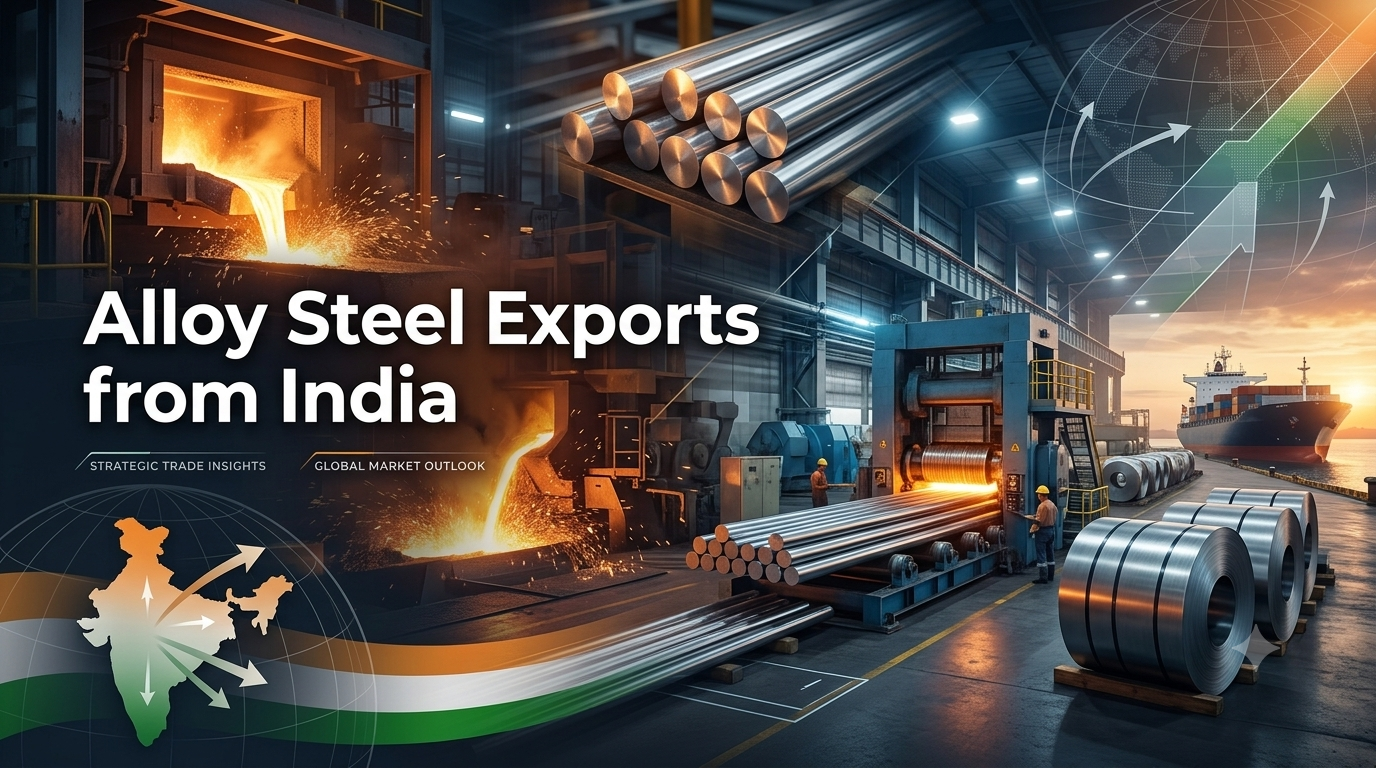
We have covered alloy steel separately, including grades, HS codes, applications, buyers, export markets and what Indian exporters should understand before approaching overseas buyers.
Read: Alloy Steel Exports from India — Grades, HS Codes, Buyers & Markets 2026
Stainless Steel Is Telling a Different Story
Stainless steel moved very differently from alloy steel during the same period.
Between April and August 2026:
Production: 1.617 million tonnes, down 11.7%
Imports: 642,900 tonnes, up 100.7%
Exports: 213,700 tonnes, down 24.4%
Consumption: 2.076 million tonnes, up 12.3%
Look at those four numbers together.
Domestic consumption increased.
Production declined.
Imports more than doubled.
Exports declined.
This does not tell us exactly why these changes happened. The data supplied by the Ministry does not give enough information to make that conclusion.
But it gives manufacturers a clear direction for the next level of research.
Instead of asking:
“Is stainless steel a good market?”
Ask:
Which stainless steel grades and product forms account for the increased imports?
Which user industries are buying them?
Which countries are supplying those products to India?
What specifications or commercial advantages do those suppliers have?
Can Indian manufacturers competitively produce those exact products?
And for exports:
Which stainless steel products lost export volume?
In which markets?
Against which competing countries?
This is the difference between reading industry statistics and using industry statistics for business decisions.
Steel Prices Have Changed Sharply Too
Export volume is only one part of the business.
Price can change the commercial decision completely.
The Ministry's September 2026 data shows the following average prices across Kolkata, Delhi, Mumbai and Chennai:
Product | Aug 2026 | Sep 2026 | Monthly Change |
|---|---|---|---|
TMT 10 mm | ₹58,002/t | ₹65,298/t | +12.6% |
HR Coil 2 mm | ₹70,448/t | ₹76,085/t | +8.0% |
CR Coil 0.63 mm | ₹76,462/t | ₹84,972/t | +11.1% |
GP Sheet 0.63 mm | ₹86,668/t | ₹94,148/t | +8.6% |
Compared with September 2025, these prices were approximately 21% to 29% higher, depending on the product.
Raw materials were moving too.
HMS II scrap increased from ₹39,970 per tonne in August to ₹43,810 in September, a rise of 9.6%.
For a steel exporter, these are not merely industry statistics.
They affect quotations and margins.
Imagine sending an overseas buyer a quotation and receiving confirmation three weeks later.
If steel input prices have moved substantially during those three weeks, the margin calculated when the quotation was prepared may no longer exist.
A steel export quotation therefore needs clarity on:
Material Cost + Processing Cost + Packing + Inland Cost + Freight + Currency + Payment Terms + Margin + Quotation Validity
This is why sending a price immediately after receiving an enquiry is not always good selling.
First understand the buyer's exact requirement.
Then calculate whether you can supply it profitably and reliably.
Green Steel Is Becoming Another Factor to Watch
The September 2026 Ministry update also highlights India's Green Steel Initiative.
According to the update, 99 distinct steel producers had been issued Green Steel Certificates across the lists issued up to September 2026.
Products covered included:
TMT bars
HR and CR coils
plates
wire rods
pipes
other steel products
A large majority of certified products reportedly received five-star ratings.
For exporters, however, the important question is not simply:
“Do we have green steel?”
It is:
“Does our target buyer or market consider carbon emissions and green steel certification when selecting suppliers?”
If the answer is yes, environmental performance can become part of supplier qualification.
The exporter may then need to prepare evidence around:
carbon-emission performance
relevant certification
energy sources
production processes
material traceability
environmental reporting
buyer-specific sustainability requirements
In such markets, sustainability information is no longer only something to add to a company profile.
It can become part of the sales discussion.
What Should an Indian Steel Exporter Do With This Data?
The April–August 2026 numbers give several signals.
Finished steel consumption increased 7.4%.
Finished steel imports increased 29.5%.
Finished steel exports increased 34.1%.
Alloy steel exports increased sharply.
Stainless steel showed rising consumption and imports but lower production and exports.
Steel prices moved substantially.
Green steel certification continued to expand.
But none of these signals alone tells an individual manufacturer where to sell.
There are many smaller opportunities hidden inside the broad steel numbers.
The practical work starts by narrowing them.
1. Define Exactly What You Manufacture
Do not begin with “we manufacture steel”.
Document:
Grade.
Specification.
Dimensions.
Tolerance.
Surface finish.
Mechanical properties.
Chemical composition.
Application.
Production capacity.
MOQ.
Testing capability.
Certifications.
Available test reports.
This is your starting point.
2. Find Markets for That Exact Product
Do not select a country only because its total steel imports are high.
Find out whether the country imports your steel product in the specification or application you can supply.
Then examine demand, competing supplier countries, price conditions and market requirements.
3. Identify Who Actually Buys It
Depending on the product, your buyer could be a:
Steel importer.
Distributor.
Stockist.
Steel service centre.
Fabricator.
Engineering company.
OEM.
Construction supplier.
Project buyer.
Industrial manufacturer.
The right buyer depends on what you manufacture and how it is used.
4. Understand What the Buyer Will Ask Before You Contact Them
A serious steel buyer may want to know:
Which standard do you manufacture to?
Can you supply the required grade?
What tolerances can you maintain?
Can you provide a mill test certificate?
What testing is available?
What quantity can you supply?
What is your normal lead time?
What is the MOQ?
What packing is available?
Which countries have you supplied previously?
If the exporter cannot answer basic commercial and technical questions, simply finding more buyer contacts will not solve the problem.
5. Know Why the Buyer Should Consider You
Lowest price is one possible advantage.
It is not the only one.
Your strength may be:
A particular grade.
Technical capability.
Certification.
Custom sizes.
Flexible MOQ.
Processing capability.
Testing facilities.
Shorter production time.
Quality consistency.
Application knowledge.
Supply reliability.
The buyer needs a commercial reason to consider changing or adding a supplier.
6. Then Find the Right Companies and People
The process should move from:
Company → Suitable Buyer → Relevant Person → Buyer Conversation → Qualified Sales Opportunity
A database of thousands of steel companies is therefore not the end result.
The objective is to identify companies that can actually buy what you manufacture, reach the people involved in the purchase decision and start a relevant business conversation.
The Question Steel Exporters Should Ask in 2026
India's steel numbers are encouraging.
But a growing industry does not automatically create an export order for an individual manufacturer.
Before searching for overseas buyers, answer these questions:
What exactly can we supply?
Where is this exact product being imported?
Which industries use it?
What type of companies buy it?
Which specifications do they require?
Who supplies them today?
What certifications and proof will they ask from us?
Why should they consider our company?
Can we supply at the price, payment terms and delivery conditions expected in that market?
Once these questions are clear, finding buyers becomes much more focused.
This is the principle behind Consult Kriba's Reverse Sourcing Method.
Do the important product, market, compliance and commercial preparation before connecting with buyers, so that when the right buyer is identified, the conversation can focus on selling.
Want to Find the Right Buyers and Build Your Export Sales Process?
Understanding your product is only the first step.
You also need to identify suitable markets, find the right overseas buyers, start relevant buyer conversations, follow up, prepare quotations and move genuine opportunities towards export sales.
This is what we cover through Consult Kriba's Export Sales Process Workshop, based on the Reverse Sourcing Method.
Join the Export Sales Process Workshop