Alloy Steel Exports from India: What Exporters Must Know Before Finding Overseas Buyers
Exporting alloy steel from India starts with defining the exact grade, form, standard, size and application not with finding a country or buying a buyer list.
A buyer looking for 42CrMo4 peeled round bars is not looking for the same supplier as a buyer purchasing bearing steel, spring steel, high-speed steel or alloy-steel wire. For an Indian exporter, the useful question is therefore not “Where can I export alloy steel?” It is:
Product × Specification × Buyer × Market.
India’s alloy-steel production and exports are growing strongly. Provisional Joint Plant Committee data published by the Ministry of Steel on 25 August 2026 shows alloy-steel production of about 3.711 million tonnes during April–July 2026, up 26.7% from the same period in 2025. Exports rose from 48.7 thousand tonnes to 122.2 thousand tonnes, an increase of 150.7%.
That is encouraging, but it does not mean every alloy-steel exporter has an easy opportunity. The real opportunity depends on the exact grade, size, delivery condition, buyer application, technical proof, landed cost and destination-market rules.
This is why Product Mastery is the first area of Consult Kriba’s Reverse Sourcing Method. The important preparation should happen before connecting with buyers, so the buyer conversation can be used for selling rather than for learning the product after the buyer replies.
For more sector-wise export intelligence, market updates and networking opportunities, join our free WhatsApp community:
India 2030 – USD 2 Trillion Exports

Connect with Indian exporters, manufacturers and industry professionals across different sectors.
To join the community, fill out this form:
https://www.consultkriba.com/india2030
What exactly is alloy steel for export from India?
“Alloy steel” is too broad for serious market research.
Alloy steel can be exported as billets, blooms, flat products, bars, rods, wire rods, forged products, bright bars, wire and other forms. Within each form, the grade, chemistry, dimensions, surface condition, heat treatment and end use can change the buyer completely.
For export research, the product definition should become specific enough to say something like:
42CrMo4 alloy steel round bar, EN grade, 60–120 mm diameter, hot rolled or peeled, supplied in the agreed delivery condition for engineering applications.
That gives the exporter a product that can be researched, priced, compared and sold.
“Steel” does not.
“Alloy steel” is still not enough.
“42CrMo4 round bars, 60–120 mm, hot rolled or peeled” is much closer to a commercial product.
Which HS headings cover alloy steel?
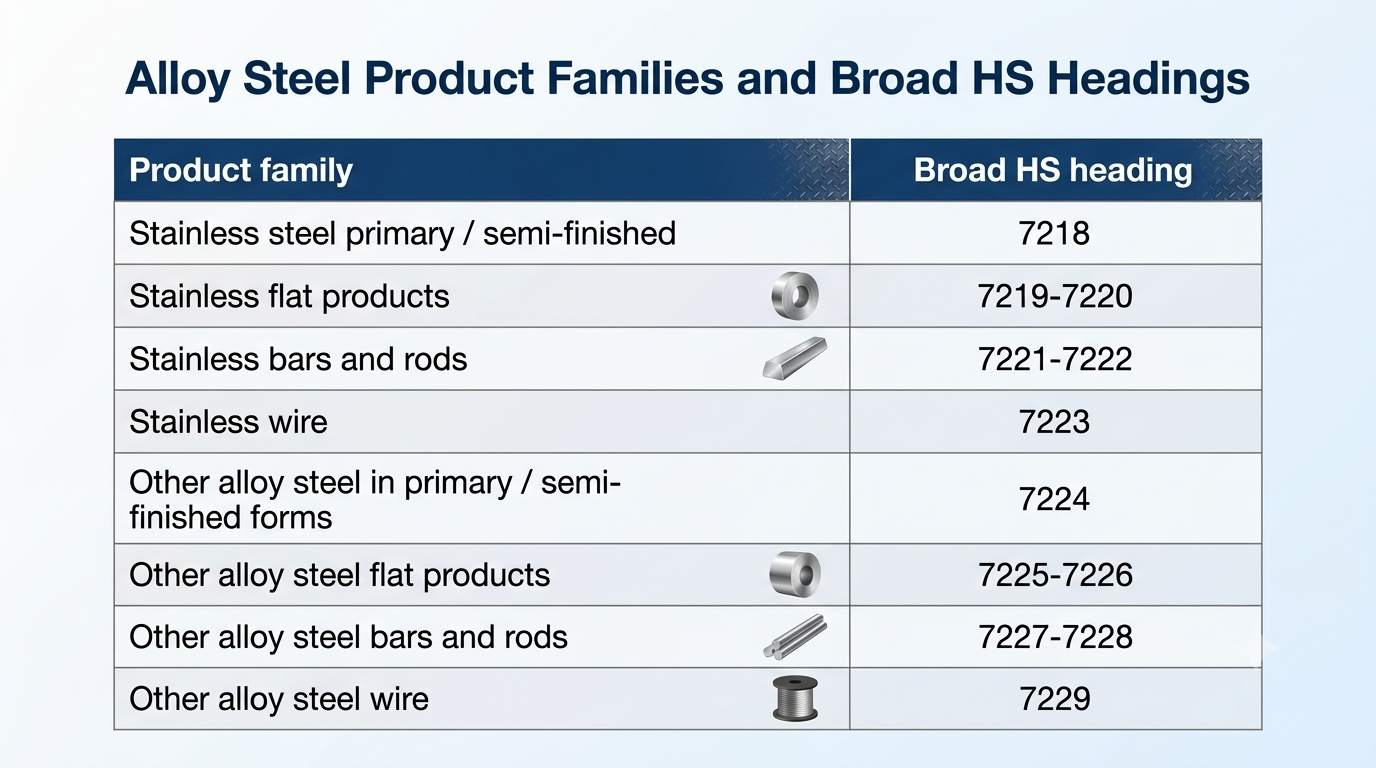
Chapter 72 separates stainless steel and other alloy steel into different tariff families.
Important text below the visual for search and AI visibility:
• HS 7218 — stainless steel in primary or semi-finished forms.
• HS 7219–7220 — stainless steel flat products.
• HS 7221–7222 — stainless steel bars, rods, angles, shapes and sections.
• HS 7223 — stainless steel wire.
• HS 7224 — other alloy steel in primary or semi-finished forms.
• HS 7225–7226 — other alloy steel flat products.
• HS 7227–7228 — other alloy steel bars and rods, including several long-product categories.
• HS 7229 — other alloy steel wire.
The practical point is more important than memorising the headings.
An exporter should confirm the correct 8-digit ITC-HS classification for the exact product being exported. The broad six-digit HS code is useful for international trade comparison, but quotation, customs, duty, regulation and destination-market decisions may require a more detailed classification.
Do not choose the HS code only because another exporter uses it for a similar-looking product.
Which alloy steel grades and forms can India supply?
India has a large steel industry, but total national steel capacity does not tell a buyer whether your exact grade, diameter and delivery condition are available.
Alloy and special-steel capability is spread across several manufacturing clusters.
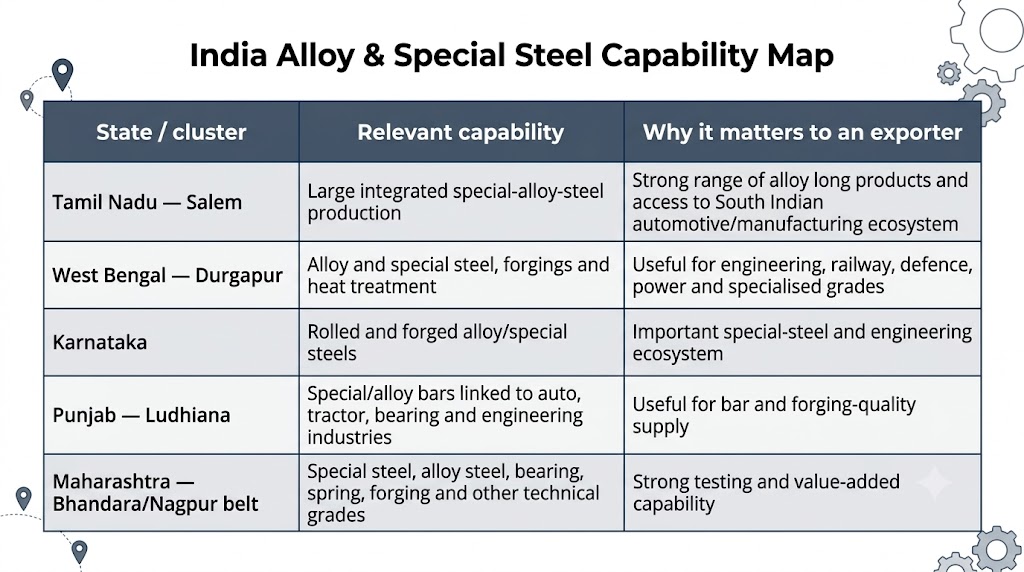
• Salem, Tamil Nadu —0 integrated special-steel capability with access to South Indian automotive and engineering manufacturing.
• Durgapur, West Bengal — alloy and special steel, forgings, heat treatment and engineering-linked production.
• Karnataka — long-established rolled and forged alloy/special steel production.
• Ludhiana, Punjab — special and alloy steel bars connected with automotive, tractor, bearing and engineering applications.
• Maharashtra — special steel, alloy steel, bearing steel, spring steel, forging-quality and other specialised grades.
This is only a starting map. The exporter must build a product-specific supply map.
If the buyer needs 20MnCr5, for example, it is not enough to find a mill that says “we manufacture alloy steel”.
The exporter must confirm:
• Can the mill produce the required chemistry?
• Is the required diameter part of its normal rolling range?
• What tolerance can be maintained?
• What delivery condition is available?
• Is the quantity commercially workable?
• Which tests can be supplied?
• Can heat-wise traceability be maintained?
• What is the normal production and finishing lead time?
That becomes the real supply capability behind the quotation.
What do India’s latest alloy-steel numbers show?
The latest official provisional data available for April–July 2026 shows:
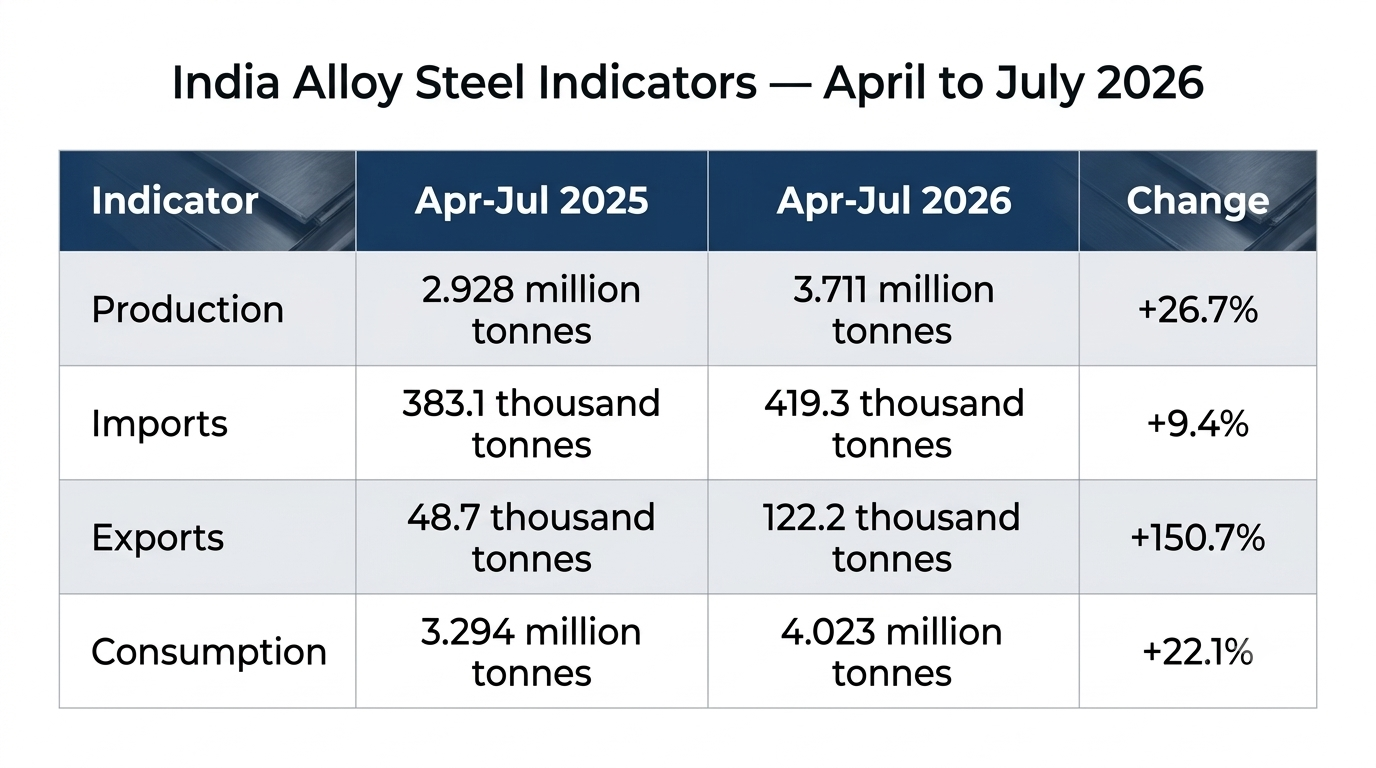
• Production: 3,710.8 thousand tonnes in Apr–Jul 2026 versus 2,927.9 thousand tonnes in Apr–Jul 2025 — up 26.7%.
• Imports: 419.3 thousand tonnes versus 383.1 thousand tonnes — up 9.4%.
• Exports: 122.2 thousand tonnes versus 48.7 thousand tonnes — up 150.7%.
• Consumption: 4,022.9 thousand tonnes versus 3,294.0 thousand tonnes — up 22.1%.
Official source: Ministry of Steel / PIB, 25 August 2026. Data stated as provisional JPC data.
https://www.pib.gov.in/PressReleasePage.aspx?PRID=2303018&lang=1®=3
What this means for an Indian exporter:
India has manufacturing strength and export momentum, but domestic consumption is also large. An exporter should not promise repeat supply merely because national production is growing.
The business question is:
How much of my exact grade, size and condition can I reliably supply when an overseas buyer places a repeat order?
That is a much stronger question than “Is India good at alloy steel?”
What controls the availability of a particular grade?
Alloy-steel availability can change because of:
• the mill’s production programme;
• minimum heat quantity;
• rolling schedule;
• alloying input availability;
• required size;
• heat-treatment capacity;
• peeling, grinding or other finishing capacity;
• testing requirement;
• order quantity;
• production economics.
One source may produce the chemistry but not regularly roll the required diameter.
Another may make the required diameter but only at a high minimum heat quantity.
A third may supply the material but not the surface condition, test or documentation the buyer needs.
Therefore, the exporter should know the complete supply route: steelmaking, rolling or forging, heat treatment where required, finishing, testing, packing and final inspection.
This becomes especially important when a buyer asks:
“Can you supply 10 tonnes for a trial?”
The answer cannot come only from an Excel price list.
What specifications do overseas alloy-steel buyers check?
The buyer usually does not purchase “alloy steel” as a general category. The buyer purchases material against an agreed requirement.
The requirement can include:
• grade;
• governing standard;
• chemical composition;
• dimensions;
• tolerance;
• length;
• surface condition;
• delivery condition;
• mechanical properties;
• testing;
• traceability;
• quantity;
• packing;
• lead time.
Which standards may buyers use?
Depending on the market and application, buyers may refer to EN, DIN, SAE/AISI, JIS, ASTM, BS, IS or their own internal specification.
Equivalent-grade charts are useful for comparison, but they should be handled carefully.
A grade shown as an “equivalent” in another standard is not automatically chemically, mechanically or technically identical for every buyer application.
For an actual order, the buyer’s agreed specification should control the discussion.
Why does chemistry matter in a sales conversation?
Depending on the steel grade, the important elements may include carbon, manganese, silicon, chromium, nickel, molybdenum, vanadium, boron, sulphur and phosphorus.
The exporter does not need to become a metallurgist.
But the exporter should understand enough to know when a buyer is asking for a normal standard requirement and when the buyer is asking for a special production condition.
For example, a buyer may ask for tighter sulphur, phosphorus or another chemistry limit than the normal range.
That can affect:
• whether the mill can make it;
• minimum production quantity;
• cost;
• testing;
• lead time;
• whether a special heat is required.
A technical question can therefore become a commercial question very quickly.
Why does form matter as much as grade?
Two companies can both sell 42CrMo4 and still serve very different buyers.
One may supply hot-rolled round bars.
Another may supply peeled bars.
Another may supply forged bars.
Another may supply quenched-and-tempered material.
Another may supply billets only.
These businesses are not automatically competing for the same order.
For each grade, the exporter should know:
• available form;
• available diameter or section range;
• tolerances;
• standard lengths or cut lengths;
• surface condition;
• delivery condition;
• finishing options;
• testing capability.
Commercial descriptions may include hot rolled, annealed, spheroidise annealed, normalised, quenched and tempered, peeled, drawn or ground. The buyer’s manufacturing process decides which condition matters.
What does the steel do inside the buyer’s product?
This is one of the most useful questions in Product Mastery.
Do not stop at:
“42CrMo4 is an alloy steel.”
Ask:
Where is it used, and why does the buyer use it?
Different alloy-steel families may be selected for strength, hardness, hardenability, toughness, fatigue resistance, wear resistance or performance under demanding operating conditions.
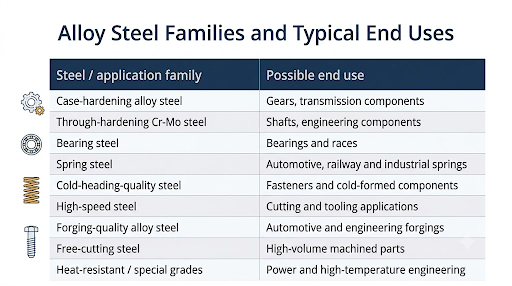
• Case-hardening alloy steel — gears and transmission components.
• Through-hardening chromium-molybdenum steels — shafts and high-strength engineering components.
• Bearing steel — bearings and races.
• Spring steel — automotive, railway and industrial springs.
• Cold-heading-quality steel — fasteners and cold-formed components.
• High-speed steel — cutting and tooling applications.
• Forging-quality alloy steel — automotive and engineering forgings.
• Free-cutting steel — high-volume machined parts.
• Heat-resistant and special grades — power and high-temperature engineering.
Once the application is understood, the correct buyer category becomes much clearer.
Who buys alloy steel from India?
The buyer should be identified from the application, not from a generic “steel importer” list.
If you export forging-quality alloy steel, suitable buyers may include:
• forging manufacturers;
• automotive-component manufacturers;
• engineering-component manufacturers;
• distributors supplying forging companies;
• specialist steel stockholders.
If you supply bearing-quality steel, bearing manufacturers and companies supplying the bearing industry become more relevant.
If you supply high-speed steel, the buyer category changes again.
Consult Kriba’s Reverse Sourcing Method uses the following buyer-development path:
Company → Suitable Buyer → Relevant Person → Buyer Conversation → Qualified Sales Opportunity.
A company appearing in an import database is not automatically a suitable buyer.
The product must fit what that company actually manufactures, processes, distributes or regularly purchases.
Who inside the buyer company may influence the decision?
Technical industrial sales may involve more than a purchase manager.
Depending on the company and product, the decision may involve:
• sourcing;
• procurement;
• metallurgy;
• supplier quality;
• engineering;
• production;
• management.
An exporter may start with procurement but later need approval from engineering or quality.
That is normal.
Collecting email addresses alone is therefore weak buyer development.
What technical information should be ready before contacting buyers?
For every major alloy-steel product, prepare a technical-commercial profile covering:
• exact grade;
• standard;
• available chemistry;
• product form;
• dimensional range;
• tolerance;
• delivery condition;
• available testing;
• traceability;
• realistic MOQ;
• realistic lead time;
• packing;
• typical applications;
• supply limitations.
If something changes order by order, say that clearly.
Do not publish a capability that the manufacturing source cannot repeatedly meet.
The objective is not to make the catalogue look impressive.
The objective is to reduce mismatch after the buyer shows interest.
What testing may alloy-steel buyers ask for?
The exact test depends on the grade, application and specification.
Possible requirements can include:
• chemical analysis;
• tensile properties;
• hardness;
• impact values;
• hardenability;
• grain-size checks;
• microstructure examination;
• inclusion rating;
• decarburisation control;
• ultrasonic testing;
• other agreed technical evidence.
Not every grade needs every test.
This distinction matters.
Do not copy every possible test onto the website. That can create expectations your actual supply route cannot meet.
Understand which tests normally matter for the product, then confirm the buyer’s actual requirement.
Why is the Material Test Certificate important?
For alloy steel, the Material Test Certificate can be one of the strongest pieces of buyer proof.
The buyer may use it to check:
• heat number;
• chemistry;
• mechanical properties;
• test results;
• agreed specification;
• traceability.
An exporter should understand the certificate instead of simply forwarding it.
Technical proof is usually stronger than vague claims such as:
“Best quality.”
“Premium quality.”
“World-class steel.”
A traceable certificate gives the buyer something that can be checked.
What quality problems should an alloy-steel exporter understand?
Depending on the process, possible concerns may include:
• surface cracks;
• laps;
• seams;
• decarburisation;
• internal inclusions;
• segregation;
• dimensional variation;
• incorrect hardness;
• chemistry deviation;
• surface damage;
• corrosion during storage or transit.
The exporter does not need to say every product has every risk.
The important point is to understand what can reasonably go wrong with the exact product and what production or testing step controls that risk.
A more credible buyer explanation is:
“This parameter is controlled during production, this test is carried out, and this evidence is supplied with the material.”
That is stronger than saying:
“We guarantee 100% quality.”
Why do traceability and packing matter?
For technical steel, the buyer may need the delivered material to remain connected to its production heat or batch.
The exporter should understand:
• heat number;
• batch identification;
• bundle marking;
• connection between the material and MTC;
• marking retention during packing and transit.
If a complaint occurs, traceability allows the buyer and supplier to isolate the affected batch.
Packing should also match the product condition and shipment route.
Hot-rolled bars, bright bars, precision bars, wire rods and coils do not all need the same packing.
Surface-finished material can be scratched.
Material can corrode during long sea transit.
Labels can be lost.
Different heats can be mixed.
Packing is therefore not only a logistics issue. It protects the product and its identification.
Which Indian quality rules should an alloy-steel exporter check in 2026?
Do not rely on an old statement such as “151 steel products are under QCO” as if that alone answers the exporter’s compliance question.
The Ministry of Steel published a Steel and Steel Products (Quality Control) Amendment Order 2026 dated 23 June 2026. It also lists 2026 exemption orders for specific products and HS codes.
Current official source:
https://steel.gov.in/quality-control-orders
The practical exporter questions are:
1. Does the exact Indian product fall under a current Steel Quality Control Order, amendment or exemption?
2. Which BIS/Indian Standard applies where relevant?
3. What standard has the overseas buyer specified?
4. What mandatory rule applies in the destination country?
5. Is any test, certificate, registration or supplier approval required before shipment?
These are separate questions.
Having BIS does not automatically mean the product can be sold in every overseas market.
A buyer asking for an EN specification is not automatically satisfied because an Indian Standard exists.
Product Mastery means knowing which requirement controls the transaction.
What policy support exists for specialty steel in India?
India’s Production Linked Incentive Scheme for Specialty Steel has an overall budget of ₹6,322 crore.
The Ministry of Steel states that the second round, PLI 1.1, was launched on 6 January 2025 and that 42 MoUs were signed with 25 companies on 24 March 2025.
The Ministry’s 2025–26 annual report says the scheme covers five broad product categories, including Alloy Steel Products & Steel Wires.
Current official source:
This tells exporters that India is encouraging higher-value steel manufacturing.
It should not be turned into a buyer claim such as:
“Indian alloy steel is government-supported, so buyers should purchase from India.”
The buyer still decides on technical fit, consistency, price, delivery, commercial terms and supplier confidence.
Which countries are real opportunities for Indian alloy-steel exporters?
There is no single “best country for alloy steel exports”.
The answer changes when the product changes.
A country can be a large importer of one alloy-steel category and a weak market for another.
The correct market-research unit is:
Product × Specification × Buyer Category × Country.
What does HS 722830 show?
HS 722830 covers other bars and rods of other alloy steel, not further worked than hot rolled, hot drawn or extruded.
For this specific HS-6 product, World Bank WITS / UN Comtrade data for 2024 shows Germany imported about US$585.9 million.
Mexico imported about US$578.4 million.
These are large markets, but size alone does not tell an Indian exporter where to start.
World Bank WITS source for Germany, 2024:
World Bank WITS source for Mexico, 2024:
Why is India’s own export pattern important?
Under HS 722830, India exported about US$74.9 million in 2024.
The largest reported destinations were:
• Italy — about US$23.26 million.
• UAE — about US$11.76 million.
• Israel — about US$4.96 million.
• Mexico — about US$3.77 million.
• Brazil — about US$3.75 million.
World Bank WITS source:
Important data note:
These 2024 figures are the latest complete verified annual values used in this guide for these specific WITS/UN Comtrade comparisons. Before a commercial market decision, check the latest available year and the exact HS code in TradeStat, UN Comtrade, WITS or another reliable trade database.
A large global import market should not automatically become your first target.
Ask:
• Does the country import my exact product?
• Does India already supply it?
• Which countries currently dominate supply?
• Which industries consume it?
• Which buyer types purchase it?
• Can my price and technical capability compete?
• What supplier approval is required?
• What compliance or tariff barrier affects the landed cost?
What does high-speed steel show?
India’s export pattern for HS 722810 — high-speed steel bars and rods — is completely different.
World Bank WITS reports India’s 2024 exports under HS 722810 at about US$3.07 million.
South Africa accounted for about US$1.49 million.
Nepal accounted for about US$0.80 million.
Source:
This is why it is misleading to publish a generic claim such as:
“Germany, Mexico and the USA are the best markets for Indian alloy-steel exporters.”
They may be useful markets for one product.
They may be weak targets for another grade, form or specification.
How should supplier-country competition be studied?
Take Mexico’s HS 722830 imports in 2024.
Mexico imported about US$578.4 million.
Its major suppliers included:
• United States — about US$256.8 million.
• Canada — about US$175.1 million.
• China — about US$50.5 million.
• Japan — about US$34.4 million.
• Germany — about US$31.8 million.
India supplied about US$2.0 million to Mexico under the same reported import dataset.
Source:
What does this tell an Indian exporter?
The exporter is not only competing with another Indian quotation.
The buyer may already be comfortable with North American supply chains, Chinese pricing, Japanese technical reputation and German specialist-steel capability.
The sales question becomes:
Why should this buyer introduce an Indian supplier into the approved supplier mix?
Possible reasons could include:
• a more suitable price;
• a required grade or size;
• flexible quantity;
• custom chemistry or processing;
• testing and traceability;
• shorter or more dependable supply for a particular requirement;
• an additional supply source to reduce dependence on one country.
But each claim needs evidence.
“Made in India” alone is not a reason for the buyer to change supplier.
What substitute materials can affect alloy-steel sales?
The buyer may not always need the exact alloy steel being offered.
Depending on the application:
• another alloy grade may meet the requirement;
• a carbon or micro-alloyed steel may reduce cost;
• stainless steel may become relevant where corrosion performance matters;
• another tool material may compete with high-speed steel.
Competition therefore comes from two directions:
1. other supplier countries;
2. alternative grades or materials.
An exporter who understands both is better prepared for price pressure and technical objections.
What does EU CBAM mean for alloy-steel exports in 2026?
The European Union’s definitive Carbon Border Adjustment Mechanism period began in 2026, and iron and steel are among the covered sectors.
On 14 August 2026, the European Commission published a specific iron-and-steel CBAM guidance document for operators outside the EU, along with other guidance covering monitoring, embedded-emissions calculation and implementation.
The Commission also published corrected default values in August 2026.
Current official sources:
https://taxation-customs.ec.europa.eu/carbon-border-adjustment-mechanism/cbam-sectors_en
What should an Indian alloy-steel exporter check before quoting an EU buyer?
• What is the exact CN classification?
• Is the exact product within CBAM scope?
• Which production route was used?
• Can the manufacturer provide the emissions information required for the product?
• Is actual emissions data available, or will default values be relevant?
• Which installation and production information must the EU importer receive?
• Is verification required for the relevant reporting stage?
• Who inside the exporter/manufacturer team will maintain the data?
This does not mean every alloy-steel shipment has the same CBAM requirement.
The exact CN code and current CBAM rules must be checked.
The commercial point is simple:
A market can have demand, but the opportunity is weak if the exporter cannot give the buyer the data needed to import the product.
What does U.S. Section 232 mean for Indian alloy-steel exporters in 2026?
The United States is another example of why import value cannot be read on its own.
Section 232 treatment for steel changed again in 2026.
A U.S. Presidential Proclamation dated 2 April 2026 made the additional Section 232 tariff apply to the full customs value of listed steel articles from 6 April 2026. For steel articles listed in Annex I-A, the proclamation set a 50% additional ad valorem rate unless a stated lower rate applies.
The annex includes steel headings 7224, 7225, 7226, 7227, 7228 and 7229 — the main “other alloy steel” product families discussed in this guide.
Official source:
Important exporter action:
Before quoting a U.S. buyer, confirm:
• the exact U.S. HTS classification;
• whether the product is in the current Section 232 scope;
• the applicable Section 232 rate and any later modification;
• normal customs duty;
• anti-dumping or countervailing duty exposure where relevant;
• freight;
• inland delivery;
• buyer’s final landed cost.
Do not assume that a large U.S. import market automatically means your product is commercially competitive there.
If the landed cost does not work for the buyer, the size of the U.S. market does not create a sale.
Why should an overseas buyer choose your alloy steel?
Instead of starting with the word “USP”, ask a simpler question:
What real reason does the buyer have to choose you?
Consult Kriba’s Product Mastery framework groups this into four broad directions.
1. Competitive pricing
This can suit businesses with:
• scale;
• strong mill relationships;
• working capital;
• efficient logistics;
• good cost control.
But price alone is fragile. Another supplier can always quote lower.
2. Certification and quality capability
This can be stronger in technically demanding applications.
The advantage may come from:
• testing;
• traceability;
• quality systems;
• consistent chemistry or mechanical properties;
• buyer approval readiness;
• reliable documentation.
3. Customisation
This can be valuable in special steel when the exporter or manufacturer can support:
• special sizes;
• tighter chemistry;
• specific heat treatment;
• special testing;
• surface finishing;
• smaller production batches;
• buyer-specific packing or marking.
4. Range of products
This can work for a strong distributor, service centre or multi-product supplier when the buyer can consolidate several requirements through one dependable source.
“We supply every grade” is not a reason by itself.
The buyer must see a practical benefit.
What does Product Mastery look like for 42CrMo4?
A weak product profile says:
Alloy Steel — 42CrMo4
Premium Quality
Competitive Price
Available for Export
Almost any exporter can say this.
A stronger product profile establishes:
• exact 42CrMo4 standard;
• available diameter range;
• hot-rolled, peeled or other available condition;
• delivery condition;
• chemistry and mechanical requirements that can be supplied;
• testing capability;
• traceability;
• MOQ;
• realistic production lead time;
• packing;
• sample MTC or technical documentation where appropriate;
• applications;
• clear supply limitations.
The buyer can now judge whether the exporter fits the requirement.
The exporter can also confidently say:
“We cannot meet this specification.”
That is equally important.
A bad order is not better than no order.
What should an Alloy Steel Product Master contain before buyer search?
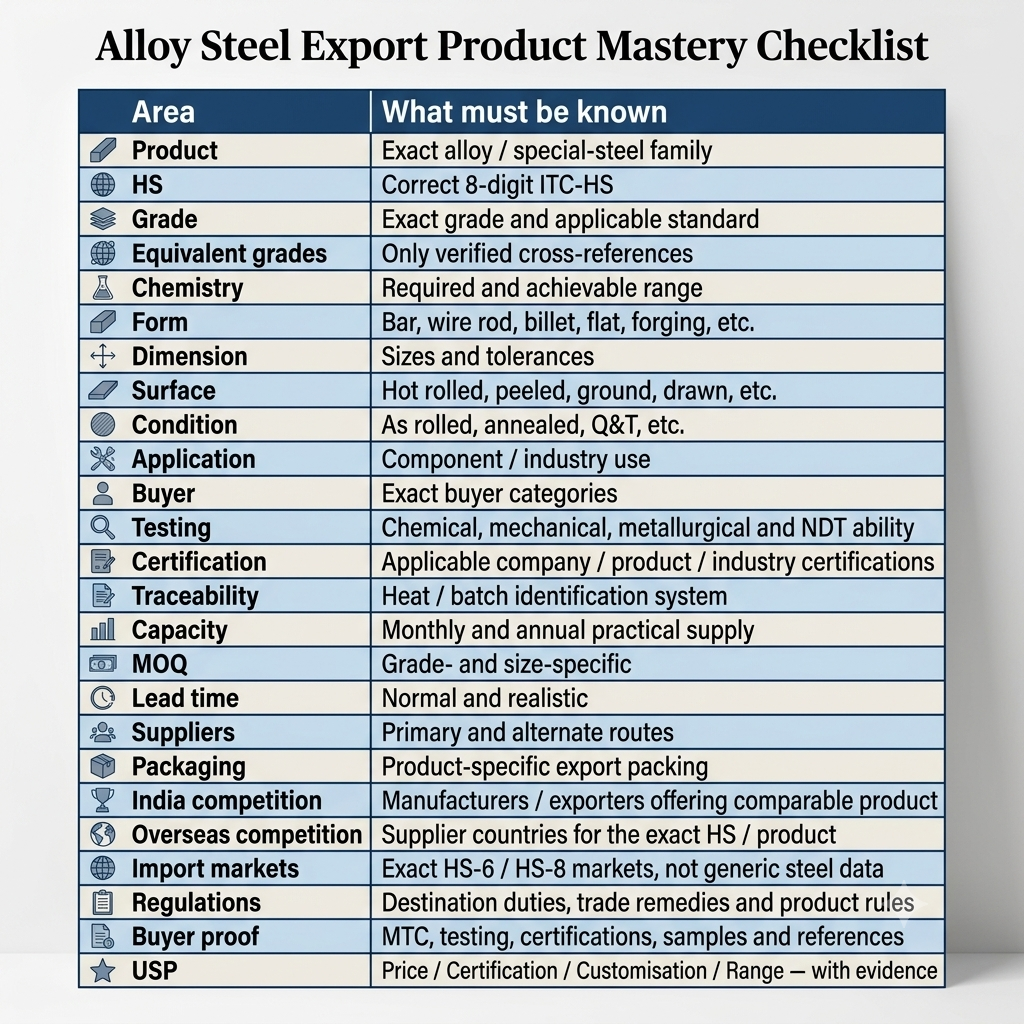
Before spending heavily on databases, LinkedIn, email campaigns, buyer-seller meets, trade fairs or overseas visits, confirm:
• Product — exact alloy/special-steel family.
• HS classification — correct code at the level needed for the decision.
• Grade — exact grade and applicable standard.
• Equivalent grades — only verified cross-references.
• Chemistry — required and achievable range.
• Form — bar, wire rod, billet, flat, forged product or another form.
• Dimensions — sizes and tolerances.
• Surface — hot rolled, peeled, ground, drawn or another condition.
• Delivery condition — as rolled, annealed, normalised, quenched and tempered or another agreed condition.
• Application — component or industry use.
• Buyer — exact buyer categories.
• Testing — chemical, mechanical, metallurgical and NDT capability where relevant.
• Certification — applicable company, product or industry certifications.
• Traceability — heat/batch identification system.
• Capacity — realistic monthly and annual practical supply.
• MOQ — grade- and size-specific minimum.
• Lead time — normal and realistic.
• Suppliers — primary and alternate supply routes.
• Packing — product-specific export packing.
• Indian competition — manufacturers/exporters offering comparable product.
• Overseas competition — main supplier countries for the exact HS/product.
• Import markets — exact HS-6/HS-8 markets, not general “steel” data.
• Regulations — destination duties, trade remedies, product rules and import requirements.
• Buyer proof — MTC, testing, certifications, samples, capacity proof and references where verified.
• Reason to choose you — price, certification, customisation, range or another evidence-backed advantage.
If several of these points are unclear, contacting more buyers can actually make the sales problem worse.
You may get a reply but not know how to qualify it.
You may quote the wrong product.
You may promise an unrealistic lead time.
You may compete only on price.
Or you may contact companies that do not use your particular steel.
What should happen before contacting an overseas alloy-steel buyer?
A serious alloy-steel exporter should follow this sequence:
1. Define the exact product.
2. Understand what the material does.
3. Know the industries and applications that use it.
4. Confirm what can be reliably manufactured or sourced.
5. Confirm the relevant standard, chemistry, form, dimensions and delivery condition.
6. Know the available testing, MTC and traceability.
7. Identify the suitable buyer categories.
8. Study the exact product’s trade markets.
9. Study the competing supplier countries and substitute materials.
10. Check destination duties, regulations and landed-cost barriers.
11. Decide what real reason the buyer has to consider your business.
12. Prepare technical and trust proof.
13. Then start building buyer relationships.
This is what Consult Kriba means when we say that finding buyers alone is not an export sales strategy.
The buyer connection is valuable.
Do not waste it trying to learn your own product after the buyer responds.
From alloy-steel product knowledge to export sales
India’s latest alloy-steel indicators are encouraging.
Production grew strongly during April–July 2026.
Exports also increased sharply.
But this is a sector signal — not a promise that every alloy-steel exporter has an easy international opportunity.
The actual opportunity may be much narrower:
A particular grade.
A particular diameter.
A particular delivery condition.
A particular buyer industry.
A particular country.
A particular technical requirement.
And a particular reason the buyer should consider your business.
Instead of asking:
“Where can I find alloy-steel buyers?”
start by answering:
“Exactly what can we supply, who needs it, why would they buy it from us, and what proof can we give them?”
Once these answers are clear, buyer finding becomes more focused.
Buyer communication becomes more technical.
Quotation becomes more accurate.
And the exporter is better prepared to move from a buyer contact towards a genuine sales opportunity.
Want to prepare properly before contacting more overseas buyers?
Consult Kriba’s 3-Day Export Sales Process Workshop helps manufacturers, traders and existing exporters work through three connected steps:
Prepare → Find Buyers → Start the Sales Process.
If you want to understand what should be ready before buyer search, which buyers are suitable for your business and how to start moving buyer conversations towards export sales, start with the 3-Day Export Sales Process Workshop:
https://www.consultkriba.com/2tnexports
Related Consult Kriba reading:
How to Find Buyers for Export from India using the Reverse Sourcing Method:
https://www.consultkriba.com/post/how-to-find-buyers-for-export-from-india-rsm
Consult Kriba — From Finding the Right Overseas Buyers to Closing Export Sales:
Sources and freshness notes
1. Ministry of Steel / PIB — India’s Steel Sector Continues Its Upward Trajectory in Apr–Jul 2026, published 25 August 2026.
https://www.pib.gov.in/PressReleasePage.aspx?PRID=2303018&lang=1®=3
2. Ministry of Steel — Quality Control Orders. Includes Steel and Steel Products (Quality Control) Amendment Order 2026 dated 23 June 2026 and 2026 exemption orders.
https://steel.gov.in/quality-control-orders
3. Ministry of Steel — Production Linked Incentive Scheme for Specialty Steel.
4. European Commission — CBAM sectors and 14 August 2026 iron-and-steel guidance.
https://taxation-customs.ec.europa.eu/carbon-border-adjustment-mechanism/cbam-sectors_en
5. The White House — Strengthening Actions Taken to Adjust Imports of Aluminum, Steel, and Copper Into the United States, 2 April 2026.
6. World Bank WITS / UN Comtrade — HS 722830 and HS 722810 trade comparisons, 2024. These are used as product-specific examples; check the latest complete year before a commercial market decision.
7. Government of India TradeStat — current India export/import data portal.
https://tradestat.commerce.gov.in/eidb/commodity_wise_export
