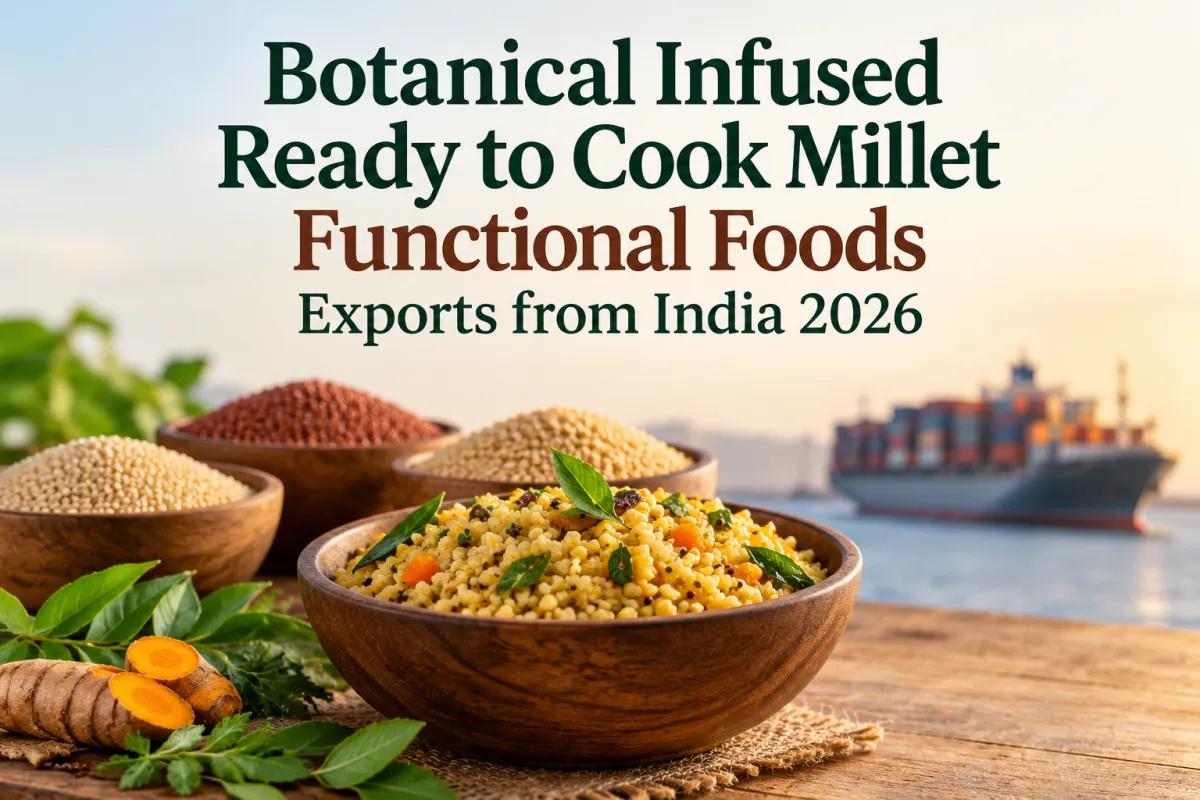
Botanical Infused Ready to Cook Millet Functional Foods from India: Product Mastery Guide for Exporters in 2026
On 3 June 2026, something more interesting than another shipment of millet left India.
A one metric tonne sea shipment of botanical infused, ready to cook millet functional foods went from Karnataka to New Zealand. APEDA described it as the first such shipment facilitated from India. Bengaluru based Infini Agrotek LLP secured the order after participating in World Food India 2025, Indus Food 2025 and Gulfood 2026.
The important word here is not millet.
It is value added.
India already exported 138.69 thousand MT of millets worth about US$61.57 million in 2025 to 26. The leading destinations were UAE, Saudi Arabia, Nepal, USA and Morocco.
But selling millet grain and selling a ready to cook millet khichdi, pongal or dosa formulation with carefully selected botanical ingredients are two very different export businesses.
For Indian food manufacturers, that difference deserves attention.
Consult Kriba's Reverse Sourcing Method starts Product Mastery by asking exporters to understand the exact product, specification, variants, application, proof, supply ability and factors affecting quality, cost and delivery. Product Mastery should go much deeper than a product name or HS code. Reverse Sourcing Method Levels …
For this product category, that distinction is particularly important.
What exactly is a botanical infused millet functional food?
There is no single standard product called botanical infused millet food.
It is better understood as a product format.
The base may contain ragi, jowar, bajra, foxtail millet, little millet, kodo millet or another millet, individually or as a blend. The manufacturer then develops it into a convenient food formulation and adds permitted botanical ingredients according to the intended recipe and regulatory classification.
The finished product may therefore look very different from raw millet.
Think of the product as:
Millet + Recipe + Botanical Ingredient + Processing + Convenient Preparation + Packaging
A useful real example is Aaahara, the consumer brand of Infini Agrotek. Its reported range includes ready to cook products based on familiar Indian foods such as idli dosa, protein adai, khichdi, pongal, kanji and payasam.
This is where the export opportunity becomes more interesting.
An overseas distributor is no longer deciding whether to buy another bag of Indian millet.
The buyer is evaluating a finished consumer product.
Can I put this on my shelf?
Will my customers understand it?
Does it meet local food regulations?
Does it have enough shelf life?
Can I make a reasonable margin?
Can this Indian manufacturer supply the same quality repeatedly?
These become the real product questions.
Are you an Indian manufacturer or exporter looking for practical export opportunities?
Join our India 2030: USD 2 Trillion Exports WhatsApp Community for export updates, market opportunities, sector discussions and overseas business initiatives.
Join the India 2030 WhatsApp Community:

https://www.consultkriba.com/india2030
1. Start with the exact millet
The word millet itself is too broad for Product Mastery.
APEDA's millet category covers sorghum or jowar, pearl millet or bajra, finger millet or ragi, and smaller millets including barnyard, proso, kodo and foxtail millet.
For a ready to cook food manufacturer, these grains are not automatically interchangeable.
Consider:
Ragi dosa mix
and
Foxtail millet khichdi with botanical ingredients
Both may be sold internationally as millet based foods. But their texture, taste, colour, processing, preparation method, nutritional composition and likely consumer acceptance can differ.
This is why an exporter needs a specification for the finished SKU, not merely a specification for the millet used inside it.
Consult Kriba's Product Mastery framework specifically requires exporters to understand exact specifications, product variations, quality standards, shelf life, storage and packaging. Product Mastery
For a millet food manufacturer, the finished product specification may need to cover the exact millet variety, percentage of millet, other grains or pulses, botanical ingredients, ingredient levels, particle size, processing method, nutritional values, allergens, preparation instructions, serving size, pack size, shelf life and storage conditions.
That information becomes useful when an importer starts asking technical questions.
2. India has a large millet base, but sourcing needs to be product specific
India's estimated Shree Anna and Nutri Cereals production was 18.59 million tonnes in 2024 to 25.
APEDA reports major producing states including Rajasthan, Maharashtra, Karnataka, Uttar Pradesh, Gujarat, Haryana, Madhya Pradesh, Tamil Nadu, Andhra Pradesh and Telangana.
For a food manufacturer, however, India's total production number is only the starting point.
The commercially useful question is:
Can you repeatedly source the exact millet quality required for your formulation?
Consider a manufacturer exporting foxtail millet pongal.
A buyer placing the second or third order expects substantially the same cooking behaviour, texture, appearance and taste as the first shipment.
Changing raw material sources purely because another supplier offers a lower price may affect the finished product.
The manufacturer should therefore know the sourcing locations, harvest periods, approved suppliers, raw material specifications, expected price movements and alternative sources.
Consult Kriba's Product Mastery framework asks exporters to understand production regions, seasonality, alternative sourcing areas and factors affecting availability. Product Mastery
For a processed food exporter, having two or three technically approved suppliers for important ingredients can be more valuable than simply knowing where millet is grown.
3. Processing technology can become part of the export advantage
There is a major difference between exporting millet and exporting a food made from millet.
ICAR CIAE has developed processed millet foods including ready to cook fermented millet instant dalia, millet herbal soup, health mixtures, beverages and other value added formulations. It has also reported commercialisation of some of these technologies to millet processing industries.
This shows an important direction for Indian manufacturers.
The product proposition can combine:
Traditional grain + Familiar food + Modern processing + Convenience
Processing can affect cooking time, texture, microbial safety, taste and storage stability.
Botanical formulations add another layer.
A manufacturer needs to understand what processing does to the complete formulation.
Adding a botanical ingredient into a laboratory recipe is one thing.
Maintaining a commercially acceptable finished product after processing, packing, storage, sea transport, distribution and preparation by the consumer is another.
A serious overseas buyer may therefore need much more than a catalogue.
They may ask for ingredient specifications, nutritional analysis, microbiological test reports, shelf life evidence, allergen information, batch traceability, manufacturing information and samples.
These are not only compliance documents.
They are also buyer trust proof.
4. Shelf life can become a serious commercial issue
One technical issue deserves special attention in millet foods: rancidity.
ICAR research notes that pearl millet flour can develop undesirable odour and taste after milling because of its lipid content and lipolytic activity. Processing methods including heat treatment, blanching and malting have been studied for improving storage stability.
For exporters, this has a very practical meaning.
Imagine the complete journey.
Manufacturing in India.
Transport to the port.
Sea shipment.
Import clearance.
Importer warehouse.
Distributor warehouse.
Retail shelf.
Consumer purchase.
The product has to remain commercially acceptable through this entire period.
Simply printing a shelf life because competing products show the same number is not enough.
The manufacturer should establish shelf life for the actual formulation in the actual packaging.
Packaging may therefore need to address moisture, oxygen, light exposure and sealing integrity according to the characteristics of the product.
The exporter needs to know what the product is like not only immediately after manufacturing, but also towards the end of its declared shelf life.
5. Botanical ingredients make the product interesting, but also make Product Mastery harder
This is probably the most important part of this category.
The word botanical can sound attractive in marketing.
From a regulatory perspective, the exact ingredient matters.
FSSAI's framework covering health supplements, nutraceuticals and related products includes specialty foods containing plant or botanical ingredients along with other regulated categories.
An exporter therefore needs precise answers to questions such as:
What botanical ingredient is being used?
Which part of the plant is being used?
What is its form?
How much is being added?
Why is it being added?
How is the finished food classified?
What claims will appear on the package?
The answers become even more important when the product is exported.
An ingredient permitted in one country should not automatically be assumed to be acceptable in another country.
For example, the European Union has a specific authorisation framework for novel foods. Depending on the ingredient and intended use, an authorisation can specify composition, permitted uses and labelling requirements.
The United States also distinguishes between different types of claims made for conventional foods and dietary supplements.
Therefore, a formulation developed for the Indian market should not simply receive an English label and be offered worldwide.
The exporter needs to check:
Botanical ingredient + Quantity + Product category + Claims + Destination country
That is Product Mastery.
6. Functional food does not automatically mean medicinal food
There is another important distinction.
The nutritional or functional characteristics of a product do not automatically allow the manufacturer to make any health claim it wants.
Statements such as:
"Controls diabetes"
"Reduces cholesterol"
"Treats digestive problems"
"Prevents disease"
need careful regulatory review.
A manufacturer may have research supporting the nutritional characteristics of millet or a botanical ingredient. That is different from being legally permitted to place a specific health or disease claim on the finished product.
This creates an important Product Mastery distinction:
Scientific evidence about an ingredient is not automatically an approved marketing claim for the finished food.
The exact destination market regulations need to be checked before finalising the label, catalogue and buyer presentation.
7. Ready to cook foods can have very different buyers from raw millet
Raw millet mainly enters grain and ingredient supply chains.
A finished ready to cook product can enter a much wider commercial system.
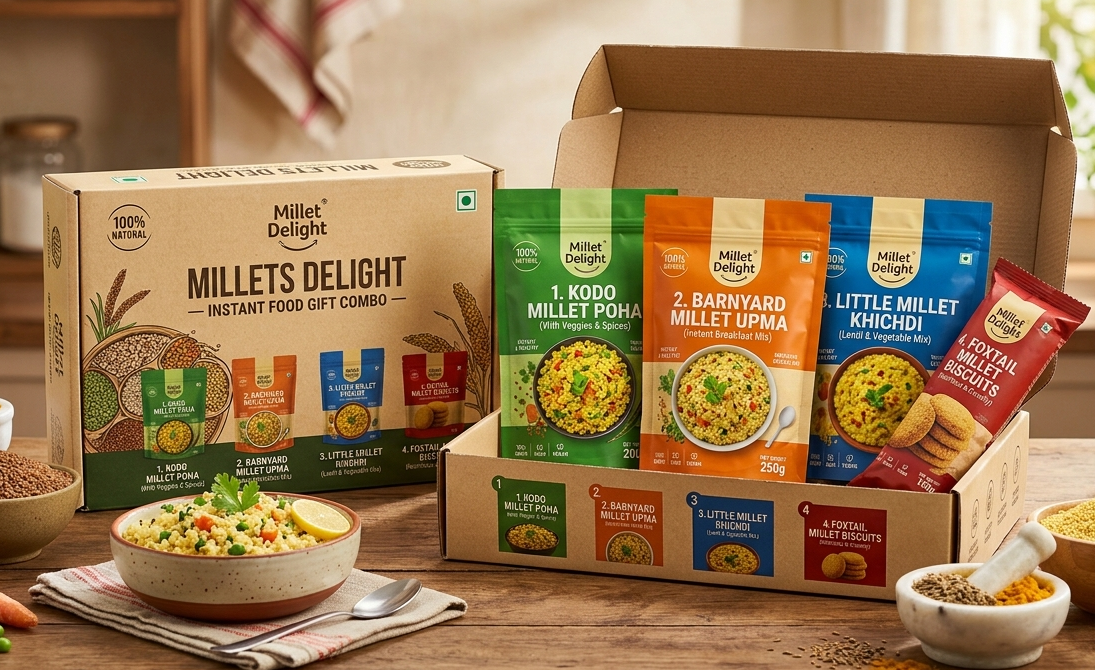
Potential buyers can include ethnic food importers, health food distributors, supermarket distributors, Indian grocery chains, natural food retailers, private label food companies, online food retailers, HoReCa suppliers and institutional buyers.
But these buyers do not evaluate the product in the same way.
An ethnic food importer may be interested in familiar foods such as pongal, dosa or khichdi.
A health food distributor may look more closely at ingredients, nutritional positioning and formulation.
A private label company may ask whether the Indian manufacturer can change the recipe, pack size, branding or formulation.
A supermarket distributor may focus heavily on consumer acceptance, packaging, compliance, shelf life and margin.
Therefore, before searching for importers, the manufacturer needs to decide:
Who is the right buyer for this exact SKU?
RSM's buyer finding ladder moves from company to suitable buyer to relevant person to buyer conversation to qualified sales opportunity. Reverse Sourcing Method Levels …
Product Mastery helps determine which companies should enter that process.
8. Do not develop twenty products simply because you can
This category can quickly become complicated.
A manufacturer could create:
Ragi dosa mix
Foxtail millet khichdi
Little millet pongal
Millet idli dosa mix
Millet kanji
Protein rich millet adai
Botanical infused millet breakfast mix
Different botanical combinations could create dozens more.
That does not mean every formulation deserves to become an export SKU.
A better question is:
Which formulation solves a clear consumer requirement while remaining practical to manufacture, certify, ship and sell?
This is where customisation can become commercially useful.
Consult Kriba's Product Mastery framework identifies customisation as a potential strength for manufacturers capable of adjusting product variations, packaging and specifications according to buyer requirements. Product Mastery
For a ready to cook millet manufacturer, useful customisation could include pack size, spice level, millet blend, preparation format, serving size, branding and private label production.
The final formulation still needs technical and regulatory validation.
9. India's advantage is stronger when we stop selling only millet
India's opportunity here is not simply that we produce millet.
Other countries can grow grain.
A stronger Indian export proposition can come from combining several capabilities:
Millet sourcing + Indian food knowledge + Food processing + Botanical formulation + Manufacturing quality + Convenient preparation + Customisation + Export compliance
Now the buyer is no longer comparing only the price of millet per tonne.
The buyer can compare complete food products.
This fits Consult Kriba's focus on value added, processed, certified and customised products where Indian businesses have a reason to compete beyond only the lowest price. 00 – Consult Kriba Business Str…
There is also a supporting manufacturing ecosystem in India. Government programmes have supported millet processing and value added millet products.
But the June 2026 New Zealand shipment provides a more useful commercial signal.
It shows that an Indian manufacturer has already taken this type of product from development through international business development to an actual overseas commercial shipment.
One shipment does not prove that every country is a large opportunity.
It proves that this product format has moved beyond theory.
10. Build a Product Master File before finding overseas buyers
Before reaching buyers, a manufacturer in this category should be able to answer the following questions clearly.
Product: What exactly are we selling?
Millet: Which millet or millet combination is used?
Botanical ingredient: What botanical is used, which plant part is used, in what form and at what level?
Recipe: What are the important ingredients and their proportions?
Function: Why is each important ingredient present?
Processing: What processing method is used?
Nutrition: What does laboratory analysis establish about the finished product?
Food safety: What microbiological, contaminant, allergen and other relevant tests are available?
Shelf life: How has the declared shelf life been established?
Preparation: How does the consumer prepare the product?
Packaging: What pack sizes, packaging materials and secondary packing are available?
Supply: What MOQ, production capacity and normal production time can be supported?
Traceability: Can ingredients and finished batches be traced?
Compliance: Is the formulation acceptable in the intended destination country?
Claims: What can legally be stated on the label and marketing material?
Customisation: What can genuinely be changed for an overseas buyer?
Proof: What specification sheets, test reports, certificates, manufacturing information and samples can be shown to the buyer?
This work should happen before sending hundreds of emails to importers.
The Reverse Sourcing Method is built around exactly this principle. Important work on the product, market, competition, compliance, price and buyer is done before connecting with buyers, so the exporter can concentrate on selling when a genuine opportunity appears. Reverse Sourcing Method Levels …
What should Indian food manufacturers learn from the New Zealand shipment?
Do not simply copy the product.
Study the business process behind it.
An Indian company developed value added millet foods, presented them through international food business platforms and eventually converted that activity into an overseas order.
The lesson is therefore not:
"Millets are booming globally."
That is too broad to help an exporter make a business decision.
The better question is:
Which millet based finished product can we manufacture consistently, prove technically, clear legally, differentiate commercially and match with a specific overseas buyer category?
Once you can answer that properly, finding buyers becomes more focused.
That is the purpose of Product Mastery.
Want to Find the Right Buyers and Build Your Export Sales Process?
Understanding your product is only the first step.
You also need to identify suitable markets, find the right overseas buyers, start relevant buyer conversations, follow up, prepare quotations and move genuine opportunities towards export sales.
This is what we cover through Consult Kriba's Export Sales Process Workshop, based on the Reverse Sourcing Method.
Join the Export Sales Process Workshop:
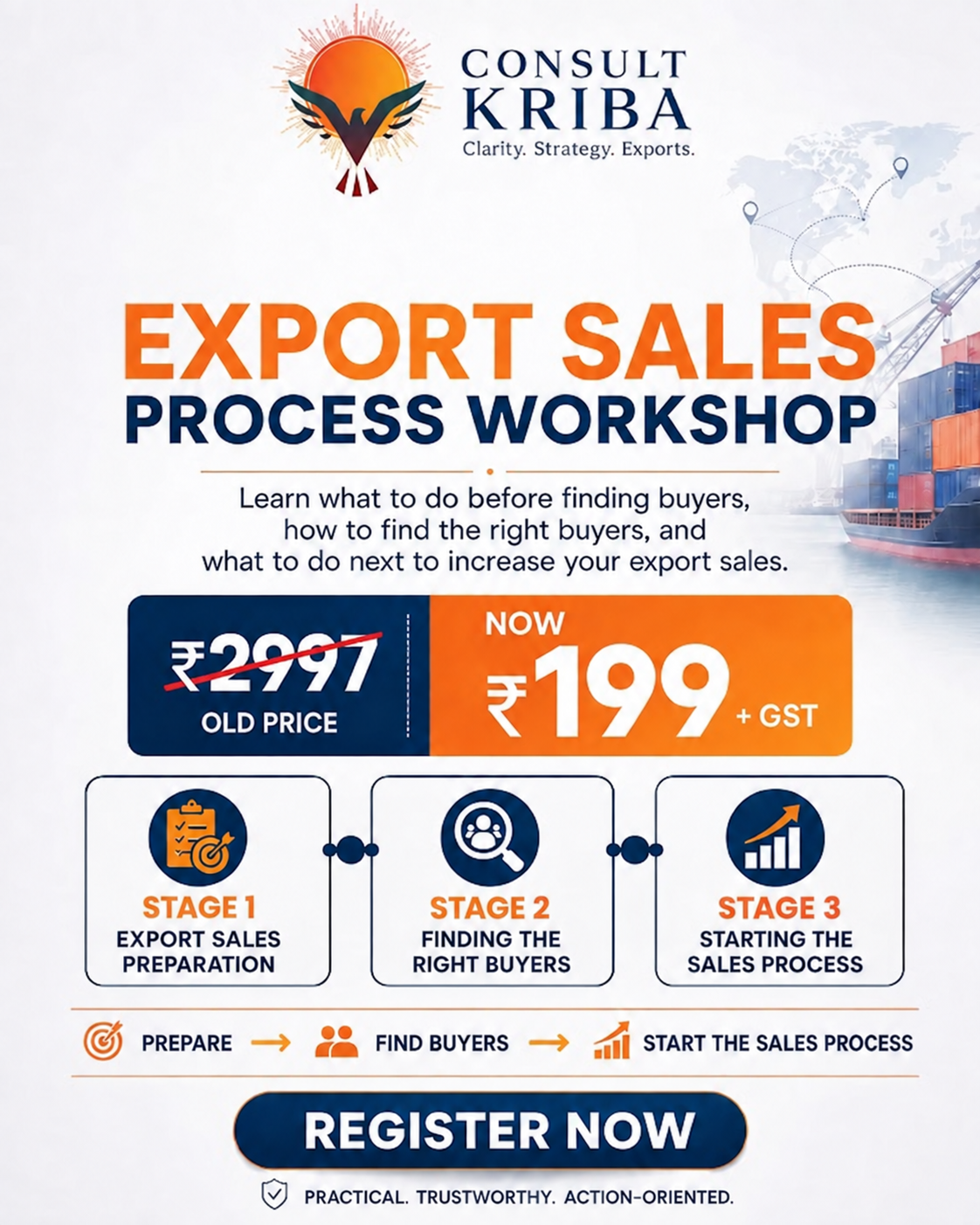
The workshop takes you through the practical process of preparing for export sales, finding the right buyers and starting the sales process. This follows the current RSM approach of doing the important preparation before connecting with buyers, so that the actual buyer connection can be used for selling.
