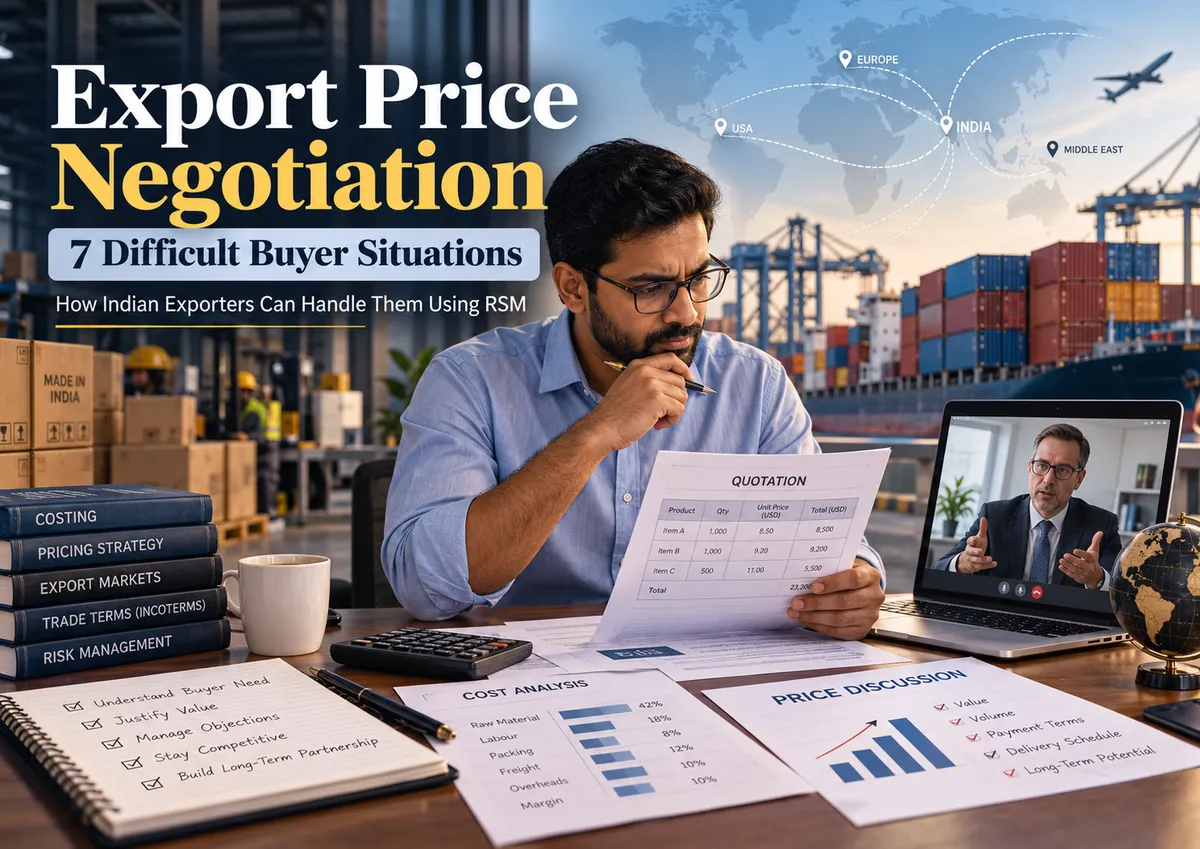
Export Price Negotiation: 7 Difficult Buyer Situations and How Indian Exporters Can Handle Them Using the Reverse Sourcing Method
Real export-industry challenges, practical negotiation calculations, product-level examples and commercial solutions for Indian manufacturers and traders.
How can Indian exporters negotiate with overseas buyers without unnecessarily losing their profit margins?
The answer begins before the buyer asks for a discount. Exporters must understand their product specifications, manufacturing costs, competing supplier countries, buyer requirements, payment conditions and delivery responsibilities. This preparation helps them decide whether to maintain the price, revise the quotation, offer an alternative or decline an unsuitable deal.
This is the central principle of Consult Kriba's Reverse Sourcing Method (RSM):
Do the important work before connecting with buyers, so you can focus on selling when the opportunity comes.
Export negotiation is much more than agreeing on a unit price.
A new buyer may demand 90 days' credit. An existing customer may request a discount after confirming an order. A competitor may offer a cheaper product from another country. Freight charges may increase after production begins. A buyer may demand a deduction after receiving the shipment.
The challenges become more serious when the exporter has already invested money in manufacturing, the buyer represents a large share of annual business, or the payment is still pending.
The findings from international trade research show that difficult export negotiations are not simply about buyers requesting discounts. They involve situations where the exporter may lose an established customer, get stuck with manufactured stock, face an unexpected cost increase or struggle to collect payment.
Export negotiations become easier when you understand the market before the buyer conversation begins.
Join India 2030 – USD 2 Trillion Exports, Consult Kriba's free WhatsApp community for Indian exporters, to stay connected with export market updates, industry discussions and opportunities to connect with fellow exporters.
Join Our Free Exporters WhatsApp Community

Let's examine seven situations and see how the Reverse Sourcing Method can help an Indian exporter make a practical commercial decision.
The first and third scenarios draw on documented market and industry developments. The worked transactions and figures throughout this article are illustrative, not actual Consult Kriba client cases.
Scenario 1: The Overseas Buyer Says Another Country Can Supply the Same Product at a Lower Price
Buyer: New German industrial buyer
Exporter: Indian precision engineering manufacturer
Order stage: Before confirmation
Product: Stainless-steel machined components
An Indian manufacturer receives an enquiry from Germany for 10,000 precision-machined stainless-steel components.
The buyer shares the following requirement:
Requirement | Buyer's specification |
|---|---|
Product | Precision-machined cylindrical component |
Material | Stainless steel 316L, UNS S31603 |
Raw material | Stainless-steel bar meeting ASTM A276/A276M |
Finished diameter | 12.00 ± 0.05 mm |
Inspection | Dimensional inspection against approved drawing |
Material document | EN 10204 Type 3.1 certificate for the raw material |
Quantity | 10,000 pieces |
Delivery | FOB Chennai |
Exporter's quotation | USD 12.00 per piece |
The dimensions and inspection requirements are hypothetical purchase specifications, not universal requirements for 316L components.
The buyer responds:
"We have an offer of USD 11.20 from Vietnam. Can you match it?"
The Indian exporter now faces a price difference of USD 0.80 per piece.
For 10,000 pieces, that is USD 8,000 in total sales value.
RSM Step 1: Product Mastery - Is the Buyer Comparing the Same Product?
A technically prepared exporter should know the difference between stainless-steel grades such as 304, 316 and 316L.
Grade 316L is a low-carbon, molybdenum-containing stainless steel. The molybdenum improves resistance to certain corrosive conditions, including chloride-related corrosion, compared with grade 304.
For the buyer's application, this difference may be important.
For example, if the component is intended for equipment exposed to corrosive chemicals, moisture or chlorides, a different grade may not be acceptable.
The exporter should clarify whether the Vietnamese quotation covers:
316L (UNS S31603) or another grade such as 304 (UNS S30400).
Material manufactured under the applicable ASTM specification.
The same diameter tolerance of ±0.05 mm.
The required material inspection certificate.
The agreed surface finish and dimensional inspection.
Equivalent packing, lead time and commercial terms.
An important technical distinction: ASTM A276/A276M specifies requirements for stainless-steel bars and shapes. It does not, by itself, establish that a finished machined component meets its drawing tolerances.
Likewise, an EN 10204 Type 3.1 material certificate does not replace dimensional inspection of the finished component.
If the competing product uses 304 rather than the specified 316L, the exporter should not treat the two quotations as technically equivalent.
Any proposed material substitution requires the buyer's technical approval.
RSM Step 2: Market Genius - Is the Competitor's Price Actually Lower for the Buyer?
The exporter should compare the buyer's total cost on a common basis.
For example:
Illustrative purchase cost per piece | India | Vietnam |
|---|---|---|
Quoted unit price | $12.00 | $11.20 |
International freight allocation | $1.10 | $1.80 |
Other comparable import handling costs | $0.20 | $0.30 |
Total before applicable duties and taxes | $13.30 | $13.30 |
These are hypothetical costs, not actual freight quotations. Both offers must first be converted to comparable commercial terms, and applicable duties, taxes and other costs must be added separately.
The example demonstrates that a lower unit price may not necessarily produce a lower total purchase cost.
But the exporter must obtain actual freight and handling information before making this argument to the buyer.
RSM Step 3: Sales Conversion Strategy- How Much Discount Can the Exporter Afford?
Consider the exporter's estimated unit cost.
Cost component | USD per piece |
|---|---|
316L raw material and material wastage | 4.10 |
Machining and processing | 3.30 |
Inspection and quality checks | 0.60 |
Packing and applicable local export expenses | 0.80 |
Allocated overhead and finance expenses | 0.70 |
Total estimated cost | 9.50 |
At the original selling price of USD 12:
Profit per piece = USD 12 − USD 9.50 = USD 2.50.
For 10,000 pieces, estimated profit = USD 25,000.
If the exporter matches USD 11.20:
Profit per piece = USD 11.20 − USD 9.50 = USD 1.70.
For 10,000 pieces, estimated profit = USD 17,000.
The price reduction of 6.67% causes a 32% reduction in estimated profit, assuming costs and order conditions remain unchanged.
The exporter can now assess whether matching the price is commercially justified.
What should the exporter actually do?
First, confirm whether the competing product is technically equivalent.
Second, obtain the buyer's expected delivery date and complete commercial requirements.
Third, compare the total purchase cost and any proven technical differences.
Fourth, assess whether a different production quantity, manufacturing arrangement or delivery schedule could genuinely reduce costs.
For example, if a confirmed higher quantity reduces setup and procurement costs by USD 0.30 per piece, the exporter can recalculate the quotation using that verified saving.
A suitable buyer response would be:
"Thank you for sharing the alternative price. Our offer covers 316L material, the agreed machining tolerances and the required inspection documents. Let us compare the complete technical and delivery requirements. We can also examine whether a revised quantity allows us to offer a better price."
If the competing offer is genuinely equivalent and cheaper, the exporter may need to revise the commercial proposal or accept that this particular order is not suitable.
The RSM outcome: The exporter can make a decision using the exact material grade, manufacturing cost, buyer application, competing offer and profit calculation. They are no longer deciding based only on the competitor's quoted price.
Scenario 2: A New Overseas Buyer Accepts Your Product Price but Demands 90 Days' Credit
Buyer: New distributor in the UAE
Exporter: Indian electrical-products manufacturer
Order stage: Before confirmation
Product: Industrial electrical enclosures
An Indian manufacturer receives an enquiry for powder-coated mild-steel electrical enclosures.
The buyer requires enclosures manufactured according to approved drawings, with specified sheet thickness, dimensions, coating and protection requirements.
For example, the enclosure may require 1.5 mm mild-steel sheet, an approved powder-coating specification and an IP54 protection requirement verified through suitable testing.
The buyer accepts the exporter's price of USD 50,000 for the order.
However, the distributor requests payment 90 days after delivery.
The exporter has never supplied this buyer.
Should the exporter accept the credit period to secure the first order?
RSM Step 1: Market Genius -Understand the Buyer Before Deciding Payment Terms
A distributor purchasing electrical products for resale may have different purchasing arrangements from a manufacturer buying components for its own production.
Before deciding, the exporter should establish:
Who are the distributor's customers? Does the distributor maintain stock? Is the purchase linked to a confirmed project? How frequently does the distributor buy? Why is a 90-day period required?
A request for credit is not automatically suspicious. However, the exporter must verify the buyer and assess payment risk.
The required checks may include the company's legal registration, operating history, available financial information, bank references and trading references.
RSM Step 2: Legal Know-How - What Payment Protection Is Available?
The exporter can discuss suitable banking and insurance options.
For an Indian exporter, this may include an appropriate Letter of Credit arrangement or eligible ECGC export credit insurance.
The exact protection depends on the buyer, country, policy, bank, shipment and payment terms.
Insurance does not automatically cover every loss. Credit limits, exclusions, claim conditions and the uncovered portion of the transaction must be understood.
RSM Step 3: Sales Conversion Strategy- Calculate the Actual Cost of Giving Credit
Assume the following order calculation:
Particulars | USD |
|---|---|
Agreed selling price | 50,000 |
Product manufacturing cost | 39,000 |
Packing, freight and other applicable expenses | 4,000 |
Total estimated cost before additional credit expenses | 43,000 |
Estimated profit before additional credit expenses | 7,000 |
Now consider the cost of offering an additional 90 days of credit.
Assume, only for calculation, that the exporter has USD 43,000 financed at an annual rate of 12% for those additional 90 days.
Additional financing cost:
USD 43,000 × 12% × 90 ÷ 365 = approximately USD 1,272.
Assume a hypothetical credit insurance premium of 0.6% of invoice value:
USD 50,000 × 0.6% = USD 300.
Assume another USD 200 in applicable banking expenses.
The revised estimated profit becomes:
USD 7,000 − USD 1,272 − USD 300 − USD 200 = USD 5,228.
The exporter has reduced the estimated profit by USD 1,772 simply by changing the payment arrangement.
This calculation does not eliminate the remaining risk of non-payment. Actual financing periods, bank charges and insurance premiums must be obtained from the relevant providers.
What should the exporter actually do?
Instead of immediately agreeing to unsecured 90-day credit, the exporter can present commercially suitable choices.
For example:
Option A: Existing quotation with a mutually acceptable secured payment arrangement.
Option B: An insured credit arrangement, if eligible, with the applicable financing and insurance costs included in the revised quotation.
Option C: A smaller initial shipment with an exposure and payment structure acceptable to both companies.
The final options should be based on bank and insurer confirmation.
The exporter could say:
"We understand your requirement for 90-day payment terms. We can examine this through an approved credit arrangement. We will share the suitable payment options and the related commercial costs."
The RSM outcome: The exporter can decide whether to extend credit based on buyer verification, available payment protection, actual financing expenses and the resulting profit—not simply on the fear of losing the first order.
Scenario 3: Your Largest Buyer Demands a Discount After Confirming the Order
Buyer: Existing US customer
Exporter: Indian manufacturer
Order stage: After confirmation, before completion
Negotiation challenge: Tariff increase and customer dependency
This situation has occurred in Indian export business.
In August 2025, Reuters reported that American customers were requesting discounts of 15–20% from certain Indian exporters following higher US import tariffs.
Puneet Arya of Finesco International in Moradabad reported that around 60–70% of the company's business depended on the US market.
Some existing orders had also been suspended.
This creates a serious commercial problem.
The exporter may have already purchased raw materials, started production or prepared goods for shipment.
The buyer wants to reduce the purchase price because importing the goods has become more expensive.
RSM Step 1: Market Genius - Establish the Buyer's Actual Additional Cost
The exporter should identify the exact product, relevant HS classification, country of origin and applicable import-duty treatment.
For example, an exporter supplying metal decorative products should not assume that every product faces an identical tariff simply because the buyer is in the United States.
The actual rate and its application must be verified for the product and import date.
The exporter should also establish whether the buyer's requested discount represents the full additional cost, part of the cost or simply a negotiating target.
RSM Step 2: Product Mastery and Shipment & After Sales - What Has Already Been Committed?
The exporter should calculate the order's current position.
For example:
Raw materials purchased: USD 35,000.
Manufacturing expenses committed: USD 30,000.
Other remaining and allocated order costs: USD 23,000.
Total expected cost to complete the order: USD 88,000.
Confirmed selling price: USD 100,000.
The current expected profit is USD 12,000.
Now the buyer requests a 15% discount.
Commercial position | Original | After 15% discount |
|---|---|---|
Order value | $100,000 | $85,000 |
Estimated total cost | $88,000 | $88,000 |
Estimated profit/loss | +$12,000 | −$3,000 |
A full discount would change a profitable order into a loss-making one.
RSM Step 3: Sales Conversion Strategy -Calculate the Negotiable Range
The exporter can calculate what different concessions would mean.
Discount | Revised order value | Estimated profit |
|---|---|---|
0% | $100,000 | $12,000 |
5% | $95,000 | $7,000 |
8% | $92,000 | $4,000 |
10% | $90,000 | $2,000 |
15% | $85,000 | −$3,000 |
The table does not mean an 8% or 10% discount is automatically acceptable.
It shows the financial consequences, so the exporter can decide what is commercially possible.
The next questions concern the contract and buyer relationship.
Is the confirmed order legally binding? Are the goods customised? Could they be sold elsewhere? What would cancellation cost? Is the buyer offering any firm future commitment?
What should the exporter actually do?
The exporter should provide an evidence-based proposal, rather than simply saying that margins are already low.
For instance:
"We have reviewed the additional import cost and our production commitments for this order. We can discuss a limited price adjustment, but the requested 15% reduction would result in a loss. Let us evaluate the actual cost increase and the available commercial options."
The exporter may negotiate a smaller price adjustment, revised delivery arrangement or other mutually agreed change.
If the buyer proposes future orders in return for a discount, the exporter should distinguish a firm purchase commitment from an informal assurance.
Existing contractual obligations must be reviewed before any decision to cancel or refuse performance.
The deeper RSM lesson: Why does dependence on one buyer matter?
If 70% of an exporter's sales depend on one customer or country, the exporter may have few immediate alternatives during a difficult negotiation.
Market Genius and Marketing Proficiency can help exporters develop relevant opportunities in other markets and suitable buyer categories.
However, a buyer database or a few LinkedIn connections are not substitutes for confirmed orders.
The RSM outcome: The exporter knows the exact cost of accepting the discount, the order's current production position, the contractual restrictions and the realistic alternatives. This allows a more informed commercial proposal while protecting the existing buyer relationship where possible.
Scenario 4: Freight Costs Increase After the Export Price Has Been Agreed
Buyer: European machinery importer
Exporter: Indian engineering manufacturer
Order stage: Confirmed order, before shipment
Commercial term: CIF Hamburg
An Indian manufacturer supplies industrial machinery components to Germany.
The exporter has confirmed an order worth USD 40,000 on CIF Hamburg terms.
After the order is confirmed, the shipping arrangement becomes more expensive.
The freight and insurance cost that was initially estimated at USD 3,000 increases to USD 6,000.
RSM Step 1: Legal Know-How -Who Is Responsible for the Freight?
Under CIF, the seller generally arranges and pays for the required carriage and insurance to the named destination port.
The exporter must therefore examine the agreed sales contract, the applicable Incoterm and any provision dealing with unexpected freight increases.
A freight increase does not automatically allow the seller to increase a confirmed CIF selling price.
RSM Step 2: Product Mastery and Order Execution - Can the Shipment Be Arranged Differently?
The exporter should understand the cargo's actual shipping requirements.
For example, industrial castings or machined components may require particular packing, protection from corrosion, safe loading arrangements and suitable handling.
If the goods can be packed more efficiently without affecting their safety, quality or contractual requirements, this may reduce transport costs.
The exporter can also obtain alternative freight quotations for feasible routes and shipment schedules.
These alternatives must be checked against the agreed delivery date and other contractual requirements.
RSM Step 3: Calculate the Cost of Different Decisions
Particulars | Original estimate | Revised estimate |
|---|---|---|
Selling price | $40,000 | $40,000 |
Product and other costs | $32,000 | $32,000 |
Freight and insurance | $3,000 | $6,000 |
Estimated profit | $5,000 | $2,000 |
The freight increase has reduced estimated profit by 60%.
Now suppose an alternative suitable shipping arrangement can reduce freight and insurance to USD 4,500.
Estimated profit becomes:
USD 40,000 − USD 32,000 − USD 4,500 = USD 3,500.
Alternatively, if the buyer agrees to share USD 1,500 of the additional freight cost through a documented price amendment, the exporter may also retain USD 3,500 in estimated profit.
Neither alternative is guaranteed.
The first depends on actual freight availability. The second requires the buyer's agreement and must comply with the contract.
What should the exporter actually do?
The exporter should obtain revised freight quotations and prepare a clear comparison of the available arrangements.
The buyer can then be approached with a specific proposal:
"Due to changes in shipping costs, the confirmed route now involves an additional expense. We have examined alternative shipment arrangements and would like to discuss two options that can maintain the agreed delivery requirements."
For future quotations, the exporter should consider freight validity, quotation validity and suitable price-adjustment clauses.
The RSM outcome: The exporter evaluates real shipping options, contract responsibilities and the financial effect of each choice. This is more useful than simply asking the buyer to absorb increased freight costs.
Scenario 5: The Buyer Demands a Price Deduction After Receiving the Goods
Buyer: Existing German industrial customer
Exporter: Indian precision component manufacturer
Order stage: After delivery
Negotiation challenge: Quality complaint and invoice deduction
An Indian manufacturer exports 5,000 machined stainless-steel components.
The approved drawing specifies:
Material: stainless steel 316L.
Finished diameter: 12.00 ± 0.05 mm.
Accepted diameter range: 11.95 mm to 12.05 mm.
Material traceability: as specified in the purchase contract.
Inspection: according to the agreed inspection plan.
The shipment value is USD 60,000.
After delivery, the buyer reports that 300 components have diameters outside the approved tolerance.
The buyer asks for a 20% deduction from the invoice value.
That means a deduction of USD 12,000.
RSM Step 1: Product Mastery - Establish the Exact Technical Problem
The exporter should request the buyer's inspection results.
Suppose the buyer reports that the affected components measure between 12.08 mm and 12.12 mm.
Those measurements exceed the specified upper limit of 12.05 mm.
The exporter should compare the findings with the approved drawing, inspection method, measuring equipment and production records.
The actual quantity affected must also be established.
The buyer has reported 300 components out of 5,000, equal to 6% of the shipment quantity.
However, this does not automatically establish that the correct financial deduction is 6% of the invoice. The legal and commercial remedy depends on the defect, affected goods, contract and applicable law.
The exporter should also check whether the problem is limited to a particular batch or requires inspection of additional components.
RSM Step 2: Shipment & After Sales - Determine the Cost of Correction
Assume the technical review confirms that 300 components require correction.
The exporter investigates two possible solutions.
Option A: Rework the affected components
Expense | Illustrative cost |
|---|---|
Rework: 300 × USD 3 | $900 |
Additional movement/handling | $250 |
Reinspection | $200 |
Total estimated expense | $1,350 |
Option B: Manufacture and supply replacement components
Expense | Illustrative cost |
|---|---|
300 replacement components × USD 9.50 | $2,850 |
Freight and handling | $600 |
Inspection and documentation | $200 |
Total estimated expense | $3,650 |
These are internal cost estimates, not automatically the buyer's legal entitlement.
The exporter must also consider production disruption, sorting expenses, replacement timing and any other substantiated contractual claim.
RSM Step 3: Sales Conversion Strategy - Negotiate Using Evidence
The buyer is asking for USD 12,000.
The exporter has identified possible corrective arrangements costing USD 1,350 or USD 3,650 under the stated assumptions.
The exporter can now present those options for discussion, subject to technical approval and contractual rights.
A practical response would be:
"We have reviewed the reported dimensional variation against the approved drawing. Based on the affected quantity, we can examine rework or replacement. We would like to agree on the corrective action and review the financial claim using the verified inspection results."
If the buyer's production has been affected, additional issues may need to be addressed.
Where the CISG applies, Article 50 provides a proportionate price-reduction remedy in qualifying cases. The available rights, notice requirements and opportunities to correct defects must be evaluated.
The exporter cannot assume that providing replacements automatically settles every possible claim.
The RSM outcome: Product Mastery identifies the technical issue, Shipment & After Sales establishes a corrective plan, and Sales Conversion Strategy supports an evidence-based settlement rather than an arbitrary deduction.
Scenario 6: Manufacturing Costs Increase While the Overseas Buyer Demands a Lower Price
Buyer: Existing apparel importer
Exporter: Indian textile manufacturer in Tiruppur
Order stage: Negotiating the next purchase order
Product: Cotton knitted garments
Consider an Indian manufacturer supplying customised cotton T-shirts.
The approved product requirement includes:
Fabric: 100% combed cotton single-jersey knit.
Fabric weight: 180 GSM (grams per square metre).
Dyeing: reactive-dyed fabric.
Sizes: according to the approved measurement chart.
Colour performance: agreed test requirements, potentially including ISO 105-C06 for colour fastness to laundering.
Packing: individual polybag and export carton, as agreed.
Quantity: 20,000 garments.
The exporter previously supplied the product at USD 5.40 per garment.
The buyer now wants a 5% reduction for the next order.
Meanwhile, cotton and processing costs have increased.
RSM Step 1: Product Mastery - Identify the Actual Cost Increase
Suppose the previous total estimated cost was USD 4.60 per garment.
The exporter earned:
USD 5.40 − USD 4.60 = USD 0.80 per garment.
For 20,000 garments, estimated profit was USD 16,000.
Now assume higher material and processing expenses increase the cost by USD 0.45 per garment.
New cost = USD 5.05.
At the original price of USD 5.40, profit falls to USD 0.35 per garment.
RSM Step 2: Calculate What the Buyer's Discount Request Means
The buyer requests a 5% discount.
Revised selling price:
USD 5.40 × 95% = USD 5.13.
The updated profit becomes:
USD 5.13 − USD 5.05 = USD 0.08 per garment.
For 20,000 garments, estimated profit is only USD 1,600.
Commercial position | Profit for 20,000 garments |
|---|---|
Previous price and previous cost | $16,000 |
Original selling price with increased cost | $7,000 |
5% discounted price with increased cost | $1,600 |
The combination of increased cost and the requested discount has reduced estimated order profit by 90% compared with the earlier order.
RSM Step 3: Market Genius - What Is the Buyer Actually Comparing?
The buyer may be comparing quotations from other textile-producing countries.
But is the competing garment identical?
The exporter should check whether the competing product has the same fabric composition, GSM, dyeing requirements, measurements, finishing, packing and test requirements.
For example, a 160 GSM garment may have a different material cost from a 180 GSM garment.
However, substituting 160 GSM fabric is not a simple pricing adjustment. It changes the agreed product.
The buyer must approve any such change after reviewing the sample, performance and intended use.
RSM Step 4: Prepare Alternative Commercial Options
If the exporter can identify genuine savings in fabric procurement, marker efficiency, cutting wastage, packing or production planning, those savings can be calculated.
For instance, suppose a revised confirmed quantity and production schedule produce a verified saving of USD 0.20 per garment.
The new estimated cost becomes USD 4.85.
At a selling price of USD 5.13:
Profit = USD 0.28 per garment.
For 20,000 garments, estimated profit becomes USD 5,600.
This may create a more practical basis for negotiation, depending on the exporter's margin requirement and risk limits.
A suitable response would be:
"We have reviewed the revised material and processing costs for the approved 180 GSM garment. We can examine a better price if the confirmed quantity or production plan creates sufficient savings. We can also quote an alternative specification separately if your technical team wishes to evaluate it."
For an already confirmed fixed-price order, the exporter must examine the contract before attempting to revise prices because of increased costs.
The RSM outcome: The exporter works with actual fabric specifications, verified cost changes and feasible production alternatives. Any revised price is connected to an identifiable saving or an approved product change.
Scenario 7: A Letter of Credit Discrepancy Creates Pressure for an Invoice Discount
Buyer: Overseas machinery importer
Exporter: Indian engineering manufacturer
Order stage: After shipment, before payment
Payment method: Documentary Letter of Credit
An Indian exporter ships industrial machinery components under a Letter of Credit for USD 50,000.
The LC requires shipping and commercial documents containing specified descriptions, dates and other details.
After the shipment, the exporter presents the documents through the bank.
The issuing bank reports a discrepancy.
For example, the commercial invoice description may not correspond with the goods description required by the LC.
The buyer then says:
"We can cooperate with the discrepancy waiver if you reduce the invoice value by 3%."
The requested discount is USD 1,500.
RSM Step 1: Legal Know-How -Understand the Exact Discrepancy
The exporter must obtain the bank's formal discrepancy notice.
They should determine:
Which document contains the discrepancy?
What LC condition has not been met?
Can the document be corrected?
Is there sufficient time under the LC?
What has the issuing bank actually communicated?
Are the buyer's instructions consistent with the bank's requirements?
Under ICC's UCP 600 Article 16, an issuing bank may approach the applicant for a waiver of discrepancies, but a waiver from the buyer does not automatically guarantee that the bank will honour the presentation.
RSM Step 2: Sales Conversion Strategy - Separate the Banking Problem from the Discount Request
The exporter should not immediately agree to the USD 1,500 reduction.
First, establish whether a compliant correction is possible.
If the buyer and exporter agree to change the invoice amount, the effect on the LC and presented documents must be reviewed with the banks.
A commercial discount does not automatically correct an existing documentary discrepancy.
The exporter should also establish whether the buyer is making a genuine commercial complaint or is using the discrepancy to request revised terms.
What should the exporter actually do?
The first discussion should be with the bank handling the presentation.
After the available documentary options are understood, the exporter can discuss the commercial position with the buyer.
A suitable response would be:
"We have received the discrepancy details and are reviewing the available correction and banking options. We will discuss any commercial adjustment separately after confirming how payment can be completed under the LC."
The RSM outcome: The exporter understands the documentary position, payment consequences and commercial options before offering a discount that may not solve the payment problem.
Before and After Order Confirmation: Why the Negotiation Approach Changes
The same buyer request can require a very different response depending on the stage of the transaction.
Stage | Main commercial question | Exporter's decision |
|---|---|---|
New buyer enquiry | Is this a suitable buyer and requirement? | Qualify or decline |
Before quotation | Can we supply profitably under the proposed terms? | Prepare the quotation |
After quotation | What can be revised without harming the business? | Negotiate or counter |
After order confirmation | What obligations have already been agreed? | Fulfil or negotiate an amendment |
During shipment | How do we manage changes, costs and risks? | Execute the contract and resolve issues |
After delivery | Is the claim technically and contractually valid? | Correct, settle or dispute as appropriate |
Before repeat order | What should change based on the previous transaction? | Improve the next commercial arrangement |
This is why export negotiation cannot be treated only as a discussion about discounts.
An exporter can have commercial freedom to revise a quotation before confirmation.
After a binding order is confirmed, the position changes because contractual obligations must be considered.
After delivery, inspection records, payment documents, quality claims and contractual remedies become important.
How to Prepare for Export Negotiations Using the Reverse Sourcing Method
The Reverse Sourcing Method connects preparation with the actual sales process.
Before approaching a buyer, the exporter should develop a clear understanding of the product, suitable markets, relevant buyer categories, competition and commercial requirements.
During buyer conversations, this preparation helps the exporter ask better questions, qualify the requirement and prepare suitable quotations.
Before negotiating, the exporter should know the target price, minimum acceptable position, payment-risk limits, delivery limits and the concessions that can be considered.
For example, a manufacturer negotiating the price of a 316L machined component should have access to the approved drawing, raw-material cost, machining expense, inspection requirements, production capacity, alternative supplier information and complete quotation calculation.
A textile manufacturer should understand the approved GSM, fabric composition, dyeing and finishing costs, quality requirements, production wastage and available manufacturing capacity.
An electrical-products exporter considering extended credit should understand the buyer's business, financing cost, banking options and payment exposure.
These are different products and markets, but the underlying RSM principle remains the same.
Complete the necessary preparation before the negotiation so that the buyer conversation can focus on reaching a commercially suitable decision.
Frequently Asked Questions About Export Price Negotiation
How should an Indian exporter respond when an overseas buyer says the price is too high?
Check whether the competing offer covers the same product grade, specifications, quantity, delivery terms and payment conditions. Compare the buyer's complete purchase cost and explain relevant product advantages with evidence. Revise the price only after calculating the effect on profit and risk.
What should exporters calculate before offering a discount?
Exporters should calculate the complete cost under the agreed Incoterm, expected profit, financing expenses, currency exposure and relevant execution risks.
For example, when a product costing USD 9.50 is quoted at USD 12, the estimated profit is USD 2.50 per unit. Reducing the price to USD 11.20 lowers the profit to USD 1.70, a 32% reduction.
Can an exporter change the price after an order is confirmed?
An agreed export price may be changed through a valid contractual mechanism or by mutual agreement. Whether the exporter has a right to seek adjustment depends on the sales contract and applicable law. Higher manufacturing or freight costs do not automatically cancel existing obligations.
How should exporters negotiate payment terms with new overseas buyers?
Verify the buyer, understand why credit is required, calculate financing costs and evaluate suitable payment security. Depending on the transaction, options may include a Letter of Credit, eligible credit insurance or another acceptable banking arrangement.
What should an exporter do when a buyer claims that delivered goods are defective?
Obtain the affected batch information, inspection measurements and contractual specifications. Verify the technical problem, establish the available corrective options and evaluate the buyer's contractual rights before agreeing to a financial settlement.
What is the role of RSM in export price negotiation?
RSM helps exporters prepare by understanding their products, markets, buyer requirements, competition, costs and commercial risks before entering buyer conversations. This supports more informed quotation, negotiation, order acceptance and execution decisions.
Final Thoughts: A Better Negotiation Starts with Better Preparation
An overseas buyer may have several reasons to request a lower price.
The buyer may have received a cheaper offer, be facing increased import costs, need longer credit, or have a genuine problem with delivered goods.
For the exporter, each situation presents a different commercial decision.
The answer may be to maintain the price, revise the quantity, adjust an approved specification, change payment arrangements, agree to an amendment, correct a technical problem or decline an unsuitable future order.
The right decision depends on facts.
What exactly is being sold? What does the buyer require? What are the competing alternatives? What has already been agreed? What does the order actually cost? What will the business earn after completing it?
These are the questions that make the Reverse Sourcing Method relevant to export negotiation.
Consult Kriba helps Indian manufacturers and traders move from finding suitable overseas buyers to closing export sales using the Reverse Sourcing Method.
Our focus is on helping exporters build the product understanding, market knowledge, buyer conversations, follow-up, quotation and negotiation capabilities required for a more consistent export sales process.
Better preparation supports better export negotiations. Better commercial decisions help build sustainable export sales.
Are Your Buyer Conversations Moving Towards Export Orders?
Finding overseas buyers is only one part of export sales. Understanding their requirements, preparing quotations, handling price negotiations and following up are equally important.
Consult Kriba's Export Sales Process Workshop helps you apply the Reverse Sourcing Method to your own export business — from preparing for export sales and finding suitable buyers to starting meaningful buyer conversations.
Explore the Export Sales Process Workshop
References
Reuters, 28 August 2025 — Indian exporters say US tariffs make it hard for them to survive. Reporting on tariff-related discount demands and customer dependency.
ASTM International — ASTM A276/A276M-25: Standard Specification for Stainless Steel Bars and Shapes.
British Stainless Steel Association — Comparison of 304, 316 and their low-carbon variants.
International Chamber of Commerce — Incoterms 2020 and ICC Force Majeure and Hardship Clauses.
ICC — UCP 600, Articles 14–16, concerning examination of documents, discrepancies and waivers.
International Trade Administration — Trade Finance Guide, covering payment methods, working capital and credit risk.
ECGC Limited — Export credit insurance policy guidance and buyer-risk cover.
UNCITRAL — CISG Case-Law Digest, Article 50, concerning price reductions for non-conforming goods.
ISO — ISO 105-C06:2010, test methods for colour fastness to laundering.
The technical standards and trade rules are referenced for their actual scope. All worked pricing, freight, manufacturing, inspection and settlement figures are illustrative and should be replaced by transaction-specific information when used for a real export decision.
