LIFT Scheme 2026: Can Indian MSME Exporters Recover 30% of Their Freight Costs?
Eligible Indian MSME exporters can receive reimbursement of up to 30% of qualifying freight expenses under the DGFT's LIFT Scheme 2026, subject to a maximum of ₹20 lakh per IEC per financial year. The scheme is designed for exporters of notified products from specified districts facing high inland transport costs. Eligibility depends on the exporter's location, product, transport distance and compliance with the prescribed claim procedure.
For an Indian manufacturer located far from a major port, inland transport is an important part of export costing.
A factory in Assam, Meghalaya or another eligible inland region may offer a competitive manufacturing price but incur considerably higher costs moving goods to an export gateway.
This difference can affect the final quotation, particularly when competing with manufacturers located closer to ports.
The LIFT scheme seeks to reduce part of this disadvantage.
But how much can an exporter actually recover? Which locations qualify? What documents are needed? And should exporters consider this benefit while negotiating prices with overseas buyers?
These are the questions worth examining before the next shipment.
Stay Updated on Export Opportunities Across India
Join India 2030 – USD 2 Trillion Exports, Consult Kriba's free WhatsApp community for Indian exporters, manufacturers and traders.
Get useful updates on export markets, government schemes, industry developments and opportunities to connect with fellow exporters.
Join Our Free Exporters' WhatsApp Community

What is the LIFT Scheme 2026?
LIFT stands for Facilitating Logistics Interventions for Freight & Transport.
It is an intervention under the Government of India's Export Promotion Mission (EPM) – NIRYAT DISHA.
The Directorate General of Foreign Trade (DGFT) introduced the scheme through Trade Notice No. 29/2025-26, dated 20 February 2026.
The intervention was introduced on a pilot basis to help eligible Micro, Small and Medium Enterprises (MSMEs) overcome transport-related disadvantages arising from their geographical location.
The idea is to support part of the freight cost incurred when eligible export cargo is moved from the MSME's premises to specified export logistics facilities.
The scheme was subsequently discussed at a FIEO seminar held in Guwahati on 31 August 2026, where DGFT and banking representatives explained freight reimbursement, export finance and trade facilitation.
For Indian exporters, the important point is that this scheme relates directly to the cost of executing export orders.
How much freight reimbursement can an exporter receive?
The scheme provides partial reimbursement of eligible freight expenditure, subject to several limits.
LIFT Scheme 2026: Key conditions
Particulars | Scheme provisions |
|---|---|
Maximum reimbursement rate | Up to 30% of eligible freight expenses |
Annual reimbursement ceiling | ₹20 lakh per IEC per financial year |
Freight value cap | 20% of FOB export value |
Minimum transport distance | 200 km |
Eligible businesses | Qualifying MSMEs with active IEC and valid Udyam Registration |
Geographical coverage | Specified districts under Annexure V |
Eligible products | Notified products under Annexure VI |
Claim procedure | Online Intent-to-Claim followed by Reimbursement Claim |
The assistance is calculated using the lower of the actual eligible freight expenditure, excluding applicable taxes, and the applicable notified freight cost. The 20% FOB cap and other conditions must also be applied.
This means 30% reimbursement does not automatically mean that 30% of every transport invoice will be refunded.
Example: How much could an exporter save?
Consider two illustrative shipments.
Particulars | Shipment A | Shipment B |
|---|---|---|
FOB export value | ₹50,00,000 | ₹20,00,000 |
Actual qualifying freight, excluding taxes | ₹8,00,000 | ₹6,00,000 |
Maximum freight permitted under 20% FOB cap | ₹10,00,000 | ₹4,00,000 |
Freight considered after FOB cap | ₹8,00,000 | ₹4,00,000 |
Illustrative reimbursement at 30% | ₹2,40,000 | ₹1,20,000 |
These examples assume that the full amount considered is otherwise eligible, no lower notified freight cost applies, sufficient annual entitlement remains and the claim is approved.
In Shipment A, the actual freight is below 20% of FOB value. The illustrative reimbursement is ₹2.4 lakh.
In Shipment B, actual freight exceeds 20% of FOB value. The freight considered for calculation is therefore restricted to ₹4 lakh, resulting in an illustrative reimbursement of ₹1.2 lakh.
The difference is significant.
Exporters need to understand how all the limits work together before estimating the financial benefit.
Which Indian MSME exporters are eligible for LIFT?
The scheme is designed for MSMEs exporting notified products from identified districts.
According to DGFT's February 2026 guidelines, eligibility includes the following requirements:
An active Importer-Exporter Code (IEC).
Valid MSME Udyam Registration.
Export origin from an eligible district.
Products covered by the notified list.
Eligible movement of export goods over a distance of at least 200 km.
Compliance with the prescribed online application and claim procedure.
The applicant must also satisfy the other regulatory conditions, including not being included in the Denied Entity List.
Which states are covered?
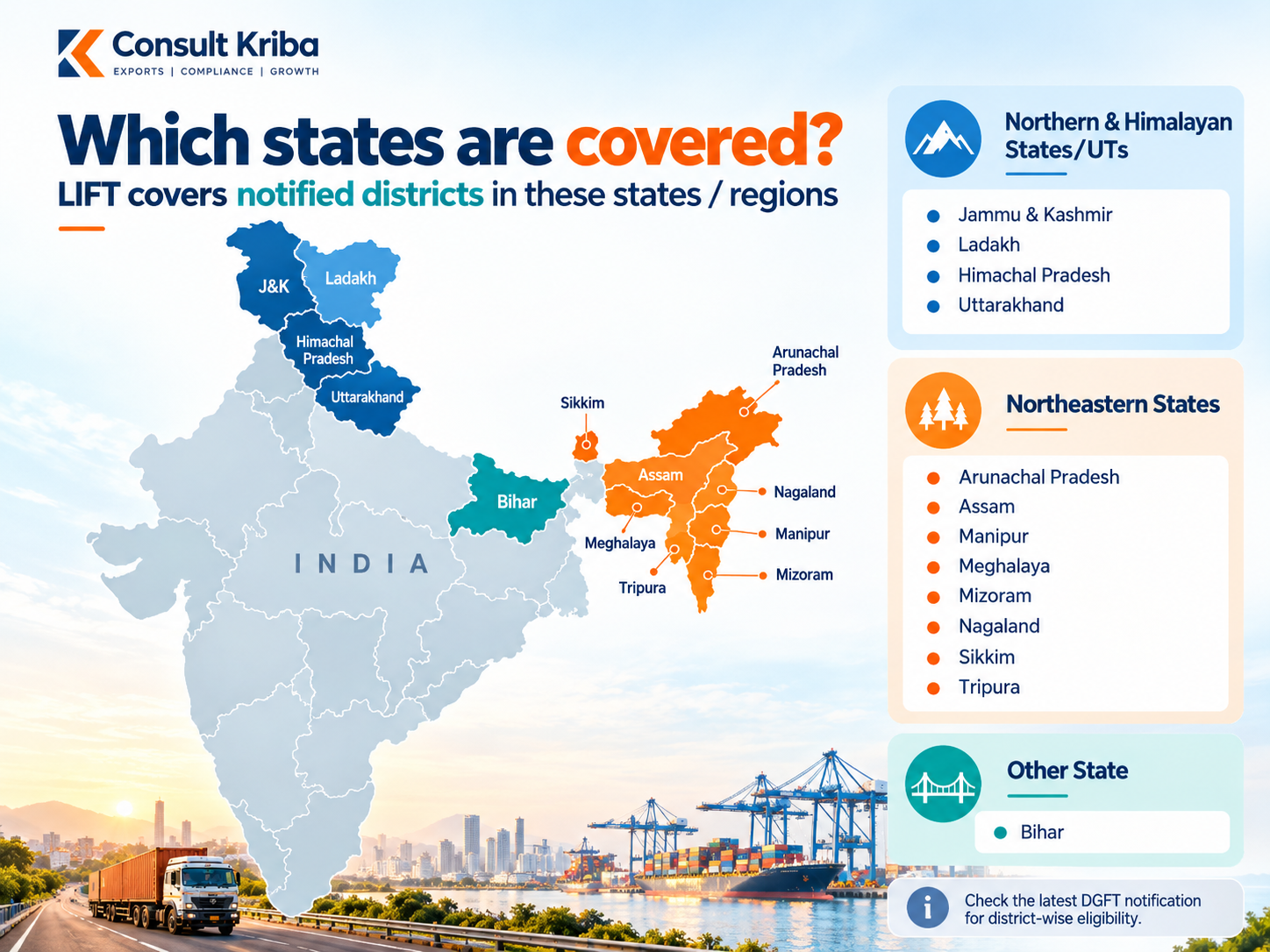
The scheme's notified district list, provided in Annexure V, includes districts in the Northeastern states and specified other regions.
The coverage includes identified districts in Bihar, Himachal Pradesh, Uttarakhand, Jammu & Kashmir and Ladakh, in addition to the Northeastern region.
Eligibility must be checked district by district, rather than assuming that every exporter in a state automatically qualifies.
For example, a manufacturer in an eligible district of Assam may qualify if its product and transport movement also satisfy the scheme conditions.
However, a manufacturer producing the same product in Chennai cannot automatically claim the benefit.
The scheme is not a general freight reimbursement programme for exporters across India.
Exporters should check Annexure V of the current DGFT guidelines to confirm their specific district.
Are all products eligible?
No.
DGFT has specified eligible products under Annexure VI.
Complete list of eligible products under LIFT Scheme 2026
No. | Eligible product | ITC (HS) code |
|---|---|---|
1 | Walnuts | 08023100 |
2 | Pineapple | 08043000 |
3 | Mandarin oranges | 08051000 |
4 | Lemons | 08055000 |
5 | Kiwi fruit | 08105000 |
6 | Litchi | 08109060 |
7 | Makhana (fox nuts) | 08109090 |
8 | Large cardamom | 09083100 |
9 | Mizo ginger | 09101100 |
10 | Saffron | 09102000 |
11 | Mixed spices | 09109990 |
12 | Bakery products | 19059000 |
13 | Jams, jellies and fruit purée | 20079900 |
14 | Agarbatti / incense sticks | 33074100 |
15 | Bamboo articles | 46021100 |
16 | Silk textiles (Ryndia textile) | 50079000 |
17 | Mizo silk fabric | 50079000 |
18 | Kullu shawls, Pashmina shawls, Shaphee Lanphee shawls | 62142010 |
19 | Fresh and processed apples | 08081000 / 20079940 |
20 | King chilli, Bhut Jolokia, Sirarakhong Hathei, Mizo chilli | 09042110 / 09042210 |
21 | Cinnamon | 09061100 / 09061900 |
22 | Millet and other cereals | 10082100 / 10082900 |
23 | Pickles, jams, preserved fruits and vegetables | 20019000 / 20079900 |
24 | Fruit-based processed products | 20079900 / 20089900 |
25 | Wooden handicrafts | 44200000 / 44209090 |
26 | Muga silk | 50010000 / 50020000 / 50030000 |
27 | Handmade carpets and floor coverings | 57010000–57050000 |
28 | Knitted socks and gloves | 61150000 / 61160000 |
Source: DGFT LIFT Guidelines, Annexure VI, pages 12–13. Product descriptions and HS codes are reproduced from the notified list.
1. The scheme covers selected products, not entire industries.
For example, the inclusion of silk textiles does not mean every textile product qualifies. Similarly, the presence of bakery products does not establish eligibility for every processed food.
2. The product's HS code is important.
Exporters should verify that their product is correctly classified under one of the notified codes. A similar product name alone is insufficient.
3. The list is heavily focused on regional products.
It includes horticulture products, spices, processed foods, silk textiles, shawls, handicrafts and other goods associated with the notified regions.
4. Product eligibility alone does not guarantee reimbursement.
The exporter must also satisfy district, MSME registration, transport distance, documentation and claim requirements.
This distinction matters because two exporters operating from the same district may have different eligibility outcomes depending on the products they export.
Manufacturers of processed, technical, engineering or other value-added products should check their exact product classification against the notified list.
A broad product description is not sufficient to establish eligibility.
Which transport costs qualify for reimbursement?
The LIFT intervention supports specified freight movements from MSME premises to export logistics facilities.
Eligible routes under the notified framework include movements to:
Inland Container Depots (ICDs).
Container Freight Stations (CFSs).
Seaports.
Air Cargo Complexes (ACCs).
Road and rail transport are covered within the prescribed conditions.
Additional support for air transport is provided for eligible Northeastern districts.
The minimum distance requirement is 200 km between the origin and destination for the qualifying freight movement.
An exporter transporting goods from a factory to a port should therefore check the route, mode of transport and actual eligible freight cost.
International ocean freight should not be confused with the qualifying inland transport expenditure under this intervention.
The distinction is especially important when preparing an export quotation.
How to apply for LIFT freight reimbursement
The DGFT framework provides a two-stage online procedure.
Stage 1: Intent-to-Claim
The exporter must submit an online Intent-to-Claim before obtaining the eligible transport service.
The declaration generates a unique reference that is subsequently linked to the reimbursement claim.
This means the exporter should examine scheme eligibility before arranging the transport movement.
Stage 2: Reimbursement Claim
After the eligible transport and export activity, the exporter submits the reimbursement claim with the relevant supporting records.
The application must refer to the previously submitted Intent-to-Claim.
The guidelines prescribe quarterly claims through the relevant DGFT Regional Authority.
The claim is subject to examination and approval.
Documents exporters should keep ready
Before planning a claim, prepare the following records, as applicable:
IEC and Udyam Registration details.
Eligible district and product information.
Shipping bill and relevant shipment documents.
Freight invoice and evidence of payment.
Transport movement and route details.
E-way bill, where applicable.
Intent-to-Claim reference number.
Bank and declaration details required by the claim process.
The final documentation requirements must be checked against the applicable DGFT procedure.
A correctly maintained record of each shipment can make the claim process easier to handle.
How does the LIFT scheme affect export pricing?
The real commercial value of the scheme becomes clearer when examining an export order's costs.
Consider an Indian manufacturer supplying customised engineering components to an overseas industrial distributor.
The manufacturer prepares a quotation based on raw materials, manufacturing, packing, inland transport, international freight where applicable, financing costs and the expected margin.
If the factory is located far from a major port, inland transport may account for a meaningful part of the order cost.
For an eligible MSME, LIFT could reduce the effective cost after reimbursement is approved and received.
But there are two different financial situations to consider.
First: The actual order cost before reimbursement.
This is the amount the exporter must finance and manage while executing the order.
Second: The effective cost after receiving an approved reimbursement.
This represents the potential improvement in the exporter's financial result.
The two figures should not be treated as the same.
Example: Impact on profitability
Assume an eligible manufacturer receives an export order worth ₹50 lakh.
Its estimated total order cost, including inland transport, is ₹46 lakh.
The expected profit before any LIFT reimbursement is therefore ₹4 lakh.
Now assume that ₹2.4 lakh in reimbursement is eventually approved and received.
The resulting profit could increase to ₹6.4 lakh, before considering any applicable tax and accounting effects.
This is a meaningful improvement.
However, what happens if the exporter reduces its quotation immediately based on that expected reimbursement, and the claim is later rejected?
The order's profitability could be lower than expected.
Our recommendation is to calculate export profitability both with and without expected reimbursement.
Exporters should take the benefit into account only to the extent that its eligibility, approval and payment risks are understood.
This is particularly important when negotiating large orders with small margins.
Export finance: Can the exporter fund the order?
Freight support can improve the financial outcome of an eligible shipment.
But it does not necessarily provide the working capital needed to manufacture and dispatch the goods.
At the August 2026 FIEO seminar in Guwahati, IDBI Bank discussed the financing facilities available to exporters.
These included pre-shipment and post-shipment export credit, packing credit, export credit in foreign currency, Letter of Credit Bill Discounting and bank guarantees.
The facilities serve different commercial requirements.
Pre-shipment finance
Pre-shipment finance can help eligible exporters fund expenditure before dispatch, such as purchasing raw materials, processing goods and preparing them for export.
Banks assess the exporter, export transaction and applicable documentation before sanctioning facilities.
Running Account packing credit
A Running Account facility may be available to eligible exporters based on the bank's approved arrangements and the applicable rules.
It allows certain exporters to access packing credit without linking every initial drawal to a separate confirmed export order, subject to subsequent compliance requirements.
Post-shipment finance
After dispatch, exporters may need to wait for the overseas buyer's payment.
Post-shipment finance can help eligible businesses manage the period between shipment and payment receipt.
Letter of Credit Bill Discounting
Where an export transaction is supported by a suitable Letter of Credit, a bank may provide bill discounting against compliant documents.
The exporter must understand the applicable charges, recourse conditions, bank requirements and payment risks.
Why finance should be included in export costing
Consider a manufacturer receiving a ₹1 crore export order.
The buyer agrees to pay 60 days after shipment.
The manufacturer must fund raw materials, production, packing and dispatch before receiving that money.
Even when the final order is profitable, the business may require substantial working capital.
Bank interest and related charges affect the actual margin.
Therefore, financing costs should be estimated before agreeing to the final quotation and payment terms.
How can Free Trade Agreements improve an exporter's competitiveness?
Free Trade Agreements (FTAs) were another important subject discussed during the FIEO seminar.
An FTA can provide preferential import duty treatment for qualifying products entering a partner market.
This may help an Indian manufacturer offer a more competitive landed cost to an overseas buyer.
However, the advantage depends on the exact product and the applicable trade agreement.
The exporter needs to understand the product classification, tariff preference, Rules of Origin and supporting documentation.
A Certificate of Origin or other prescribed origin proof may be required to claim the relevant benefit.
Why should exporters check FTA benefits before negotiating?
Consider two suppliers selling comparable engineering products to an overseas importer.
If the Indian product qualifies for a lower import duty under an applicable agreement, that difference may improve its competitive position.
However, competing supplier countries may also enjoy preferential tariffs.
The useful question is therefore:
Does the exact Indian product receive a tariff advantage compared with the products offered by competing countries?
This is more valuable than simply knowing that India has signed an FTA with a particular country.
Connecting freight costs, export finance and FTAs before approaching buyers
Freight support, finance and preferential market access may appear to be separate subjects.
For an exporter preparing a quotation, they are connected.
Freight determines part of the cost of moving the goods.
Financing determines how much it costs to fund production and wait for payment.
FTA benefits may affect the price the overseas buyer ultimately pays after import duties.
Together, these factors can influence the manufacturer's quotation and negotiation position.
For example, an exporter may be able to offer a competitive product price but still lose an order because the buyer's landed cost is higher than competing offers.
Another exporter may receive a large enquiry but lack sufficient working capital to execute the order on the payment terms requested.
These are commercial problems that need to be understood before negotiations progress.
This connects with Consult Kriba's Reverse Sourcing Method.
Under RSM, the important preparation is completed before connecting with buyers, wherever practical.
That includes understanding costs, suitable markets, applicable regulations, payment risks and delivery capability.
When a suitable buyer responds, the exporter is better prepared to discuss requirements, quotations, payment terms and the next commercial step.
Practical checklist before preparing your next export quotation
Before sending a quotation, an exporter should examine:
Product: Are the specifications, quality requirements and supply capability clear?
Market: Does the destination offer a realistic opportunity for the exact product?
Import duty: Is an FTA preference available, and does the product qualify?
Freight: What will transport actually cost under the agreed delivery terms?
Government support: Does any eligible reimbursement apply?
Finance: How much working capital is required and what will it cost?
Payment risk: Are the buyer's payment terms commercially acceptable?
Profitability: What margin remains after accounting for the full transaction cost?
These checks help the exporter make better decisions before committing to an order.
Frequently asked questions about LIFT Scheme 2026
Is the LIFT scheme available to every Indian exporter?
No. It is targeted at eligible MSMEs exporting notified products from identified districts. The exact district and product lists must be checked.
How much freight reimbursement can an MSME receive?
The scheme provides reimbursement of up to 30% of eligible freight expenditure, subject to the prescribed freight-value restrictions and a maximum of ₹20 lakh per IEC per financial year.
Is Udyam Registration compulsory?
Under the February 2026 guidelines, a valid MSME Udyam Registration and active IEC are among the eligibility requirements.
Can exporters claim reimbursement for every shipment?
Only qualifying shipments satisfying the applicable scheme and documentation requirements can be considered for reimbursement.
Does LIFT cover international ocean freight?
The notified intervention is designed around specified eligible freight movements from MSME premises to export logistics facilities. It should not be treated as a general ocean-freight reimbursement scheme.
Should exporters reduce their export price based on the expected reimbursement?
The potential benefit can be considered in commercial planning, but exporters should first calculate the order's profitability without the reimbursement and understand the claim risks.
Is LIFT the same as RoDTEP?
No. LIFT is a targeted freight-cost reimbursement intervention. RoDTEP addresses eligible embedded duties and taxes on exported products under a separate framework.
Conclusion: Export competitiveness depends on more than the factory price
For eligible MSMEs located far from major export gateways, freight expenses can affect their ability to compete with other manufacturers.
The LIFT scheme creates an opportunity to recover part of these costs, subject to specific conditions.
Export finance facilities may help exporters meet their working capital requirements, while FTAs can influence the cost of goods entering overseas markets.
The useful approach is to understand how these factors affect each export transaction before negotiating with buyers.
Want to Find More Overseas Buyers and Increase Export Sales?
Join Consult Kriba's Export Sales Process Workshop and learn how to find suitable overseas buyers, start buyer conversations, follow up effectively and convert enquiries into export orders using the Reverse Sourcing Method.
Register for the Export Sales Process Workshop
Official sources and references
1. DGFT -Trade Notice No. 29/2025-26, 20 February 2026
Facilitating Logistics Interventions for Freight & Transport (LIFT), including policy framework, operational guidelines, application procedure, eligible districts and products.
2. DGFT / APEDA Trade Notice Repository
Official trade-notice listing, including the LIFT notification.
https://apeda.gov.in/dgft-trade-notice
3. Reserve Bank of India
Official guidance on export credit, banking facilities and related regulatory requirements.
4. FIEO seminar, Guwahati -31 August 2026
Seminar on leveraging DGFT schemes, LIFT and export finance for enhanced export competitiveness. Source: seminar report supplied for this article.
Editorial note: Eligibility, rates and procedures should be confirmed against the latest applicable DGFT notification before submitting a claim.
