India's Dry Red Chilli Exports Cross USD 1 Billion: Top Markets, Buyers and Opportunities in 2026
India exported over USD 1 billion worth of whole dried chillies and related Capsicum and Pimenta products in 2025. China purchased more than half of India's exports under HS code 090421. But which other markets offer opportunities for Indian chilli manufacturers, processors and exporters?
India's dried chilli export business is substantial, but different markets buy different products.
A Chinese food processor looking for highly pungent chillies may have different requirements from a European spice manufacturer looking for colour, traceability and strict residue compliance.
This difference matters because an exporter selling Teja chilli cannot automatically approach the same buyers, with the same offer, as an exporter supplying Byadgi chilli.
According to FIEO's November 2026 report, India's exports under HS 090421 reached USD 1,010.35 million in 2025, compared with global imports of USD 1,805.53 million.
The opportunity for Indian exporters is to understand exactly which products international buyers require, which countries offer suitable demand and how to turn buyer interest into commercial enquiries and export orders.
Use AI to support your export research and sales work
Researching markets, identifying suitable companies, preparing product information and organising buyer follow-up can involve several repetitive activities.
Consult Kriba's AI Export Team Workshop introduces practical ways to use AI assistants to support these activities, while the exporter remains responsible for checking information and making sales decisions.
Explore the AI Export Team Workshop:https://consultkriba.com/ai

1. How much does India export under HS code 090421?
India is the world's leading exporter of dried, whole Capsicum and Pimenta products by value.
FIEO's November 2026 analysis provides the following figures.
Year | India's exports (USD million) | Global imports (USD million) |
|---|---|---|
2021 | 974.91 | 1,709.19 |
2022 | 844.31 | 1,636.24 |
2023 | 1,060.48 | 1,916.54 |
2024 | 1,013.97 | 1,962.23 |
2025 | 1,010.35 | 1,805.53 |
India's export value grew at a compound annual growth rate (CAGR) of 0.90% between 2021 and 2025, while global imports grew at 1.38%.
The average Indian export-to-global-import value ratio across these five years was approximately 54.32%.
These figures establish three important facts.
First, India already has a strong position in the international supply of whole dried Capsicum and Pimenta products.
Second, India's export value remained above USD 1 billion between 2023 and 2025, but did not show sustained rapid growth.
Third, global import demand was uneven, with the highest reported value in 2024, followed by a decline in 2025.
For exporters, this means international market size alone is not enough to select the next destination.
The important question is which market has demand for the exact chilli variety, grade and quantity that your business can supply competitively.
2. Which countries import the most dried chillies from India?
According to UN Comtrade-based trade information updated in October 2026, the five largest destinations for India's exports under HS 090421 in calendar year 2025 were China, Thailand, Bangladesh, Sri Lanka and Malaysia.
Market | India's 2025 exports | Share of India's exports | Reported annual change |
|---|---|---|---|
China | USD 551 million | 54.3% | +20.9% |
Thailand | USD 112 million | 11.1% | -13.1% |
Bangladesh | USD 93.9 million | 9.3% | -24.9% |
Sri Lanka | USD 70.8 million | 7.0% | -8.8% |
Malaysia | USD 44.9 million | 4.4% | -8.5% |
Source: ExportsMitra, reporting UN Comtrade data under HS 090421, updated October 2026. Values are rounded.
China was clearly the largest destination, accounting for more than half of India's export value in this product category.
The other four markets together represented approximately 31.8%.
An important development is that China recorded positive annual growth, while the other four markets recorded declines in India's export value.
These declines do not necessarily mean that overall demand in those countries fell. They could also reflect changes in prices, quantities, supplier competition or purchasing patterns.
To identify the reason, an exporter needs to compare destination-country import quantities, total import values, competing suppliers and changes in unit prices.
3. China: India's largest dried chilli export market
India exported approximately USD 551 million worth of HS 090421 products to China in 2025.
The reported annual increase of 20.9% makes China an important market to examine.
Who are the potential buyers?
The relevant buyer categories include:
Whole dried chilli importers supplying Chinese domestic buyers
Food ingredient distributors
Chilli grinding and processing companies
Manufacturers of seasonings, sauces and spice preparations
Industrial processors using chilli as a raw material
A processor purchasing chillies for extracting pungency may evaluate the product differently from a manufacturer seeking a particular flavour or red colour.
What should Indian exporters prepare?
Before approaching suitable Chinese importers, an exporter should establish the exact chilli variety, pungency, colour value, moisture level, available quantity, harvest period and packing format.
A test report and a specification sheet are more useful than a catalogue containing only the description "Indian Dry Red Chilli".
The first commercial decision is to identify whether the buyer needs high-pungency chilli, colour-rich chilli or a particular combination of both.
China is a large existing market, but exporters must also consider established supplier relationships, price competition and applicable Chinese import requirements.
Export opportunity: Identify processors and importers whose applications match your chilli's tested specifications, rather than approaching every Chinese food importer.
4. Thailand: Opportunities for chilli processors and food ingredient suppliers
India exported approximately USD 112 million worth of HS 090421 products to Thailand in 2025.
Thailand is relevant because of its food-processing industry and the use of chillies in sauces, seasonings and prepared food products.
However, India's export value to Thailand declined by 13.1% compared with the preceding year.
This makes buyer-level research particularly important.
Which buyers should exporters examine?
Indian exporters can assess:
Chilli processors and grinding companies
Seasoning and sauce manufacturers
Food ingredient importers
Spice wholesalers supplying food manufacturers
A supplier offering high-pungency dried chillies may be relevant to one processor, while another processor may require a specific colour and flavour profile.
Before preparing a quotation, exporters should identify the required chilli variety, processing application, monthly volume, testing parameters and delivery expectations.
Export opportunity: Focus on industrial users whose technical requirements match the exporter's product, and investigate changes in Indian shipments before treating Thailand as a growing market.
5. Bangladesh: A neighbouring market with significant Indian supply
India exported approximately USD 93.9 million worth of HS 090421 products to Bangladesh in 2025.
Bangladesh's geographical proximity makes it relevant for Indian exporters examining regional sales and land-based logistics options.
Nevertheless, the reported 24.9% decline in India's export value deserves attention.
What should exporters investigate?
Important questions include:
Has the buyer changed its sourcing country?
Have import quantities or average prices changed?
Are payment or foreign-exchange conditions affecting purchases?
Is the buyer seeking a different grade, price or delivery arrangement?
For businesses supplying established chilli varieties in commercial quantities, Bangladesh remains worth evaluating.
However, a quotation should reflect the actual delivery route, payment conditions, import rules and buyer's financial position.
Export opportunity: Examine repeat-purchase requirements among established importers and wholesalers, supported by careful pricing and payment-risk assessment.
6. Sri Lanka: Quality and compliance are important
India's exports under HS 090421 to Sri Lanka reached approximately USD 70.8 million in 2025.
The market is relevant to exporters supplying whole dried chillies for local distribution and further processing.
A particularly important regulatory development occurred in October 2026.
The Spices Board listed a notification dated 14 October 2026 concerning pre-shipment testing and clearance for aflatoxin in whole chilli exports to Sri Lanka.
This illustrates why an exporter should check current market-specific notifications before confirming an order.
Aflatoxins are harmful substances produced by certain fungi. Poor drying and storage conditions can increase contamination risk in agricultural products, including chillies.
Exporters should verify the applicable sampling and testing procedure, obtain the required results and ensure that the shipment meets the destination's rules.
Which buyers should be considered?
Relevant buyer categories include spice importers, wholesale distributors and food processors.
For suitable exporters, existing regional trade relationships can support buyer development, but quality control and correct documentation remain essential.
Export opportunity: Target established Sri Lankan importers with properly tested product lots and a clear plan for meeting applicable pre-shipment requirements.
7. Malaysia: A market for further buyer research
Malaysia imported approximately USD 44.9 million worth of HS 090421 products from India in 2025.
The reported annual decline was 8.5%.
Malaysia has several potential buyer categories, including food ingredient importers, spice processors, distributors and food manufacturers.
For an Indian exporter, the relevant question is whether the buyer needs whole chilli for grinding, further manufacturing or wholesale supply.
Product suitability should be established before preparing a market-entry plan.
For example, a processor supplying food manufacturers may ask for consistent heat, colour, moisture, hygiene standards and repeat-lot specifications.
Export opportunity: Identify importers and food processors that can use a specific Indian chilli variety and compare their existing sources of supply.
8. Germany and Spain: Can Indian chilli exporters compete in Europe?
Germany and Spain are relevant markets to examine for exporters capable of meeting European food-safety and commercial requirements.
The European Union has established rules governing food contaminants, pesticide residues, traceability and applicable import controls.
For Indian exporters, this creates a different type of sales discussion from one based mainly on bulk price.
What do European buyers typically examine?
Depending on the product and application, buyers may request information about:
Pesticide residue compliance
Aflatoxin levels
Microbiological quality
Moisture and cleanliness
Colour and pungency
Traceability
Packaging and storage
Product testing and quality-management systems
Some buyers may also require additional private certification or supplier audits.
What about import tariffs?
FIEO's November 2026 report provides a reference for HS 0904211000 in Germany and Spain, including an MFN rate of 9.6% and a general GSP rate of 6.1%.
These are reported reference rates, not a confirmed duty quotation for an Indian shipment.
Exporters must verify the applicable EU tariff and India's preferential eligibility on the date of import. Any future trade-agreement benefits should be used only when legally effective and applicable to the product.
Export opportunity: Examine importers and processors purchasing carefully specified, tested chillies where quality, documentation and supply reliability are part of the buying decision.
9. Which Indian chilli varieties are suitable for different buyers?
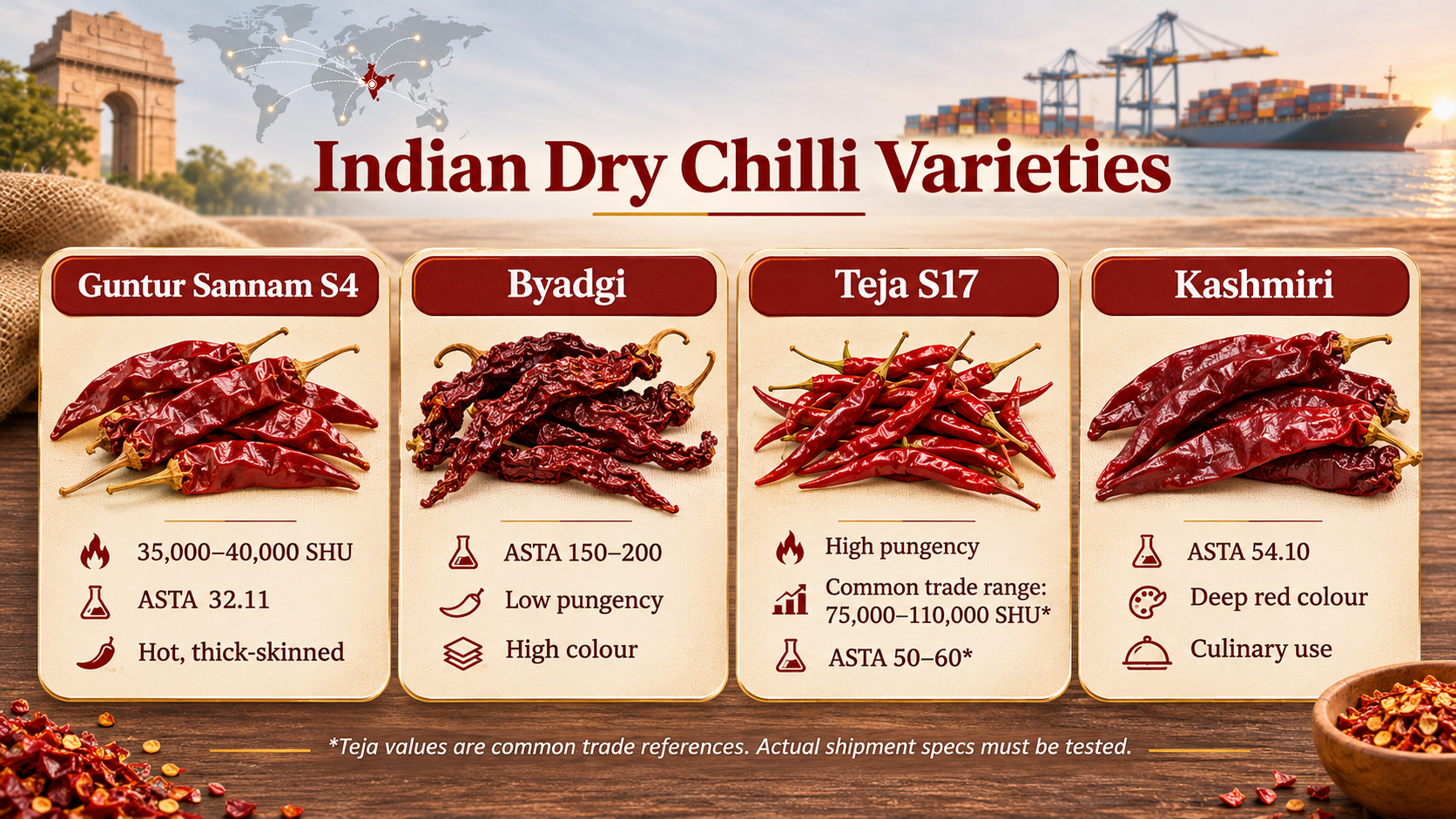
India produces different varieties of dry red chillies, each with distinct characteristics. Some are valued for high pungency, while others are preferred for their red colour, pod size or processing applications.
For international buyers, choosing a chilli variety depends on measurable specifications such as Scoville Heat Units (SHU), ASTA colour value, capsaicin content, pod size and quality consistency.
Comparison of Indian chilli varieties
Variety | Pungency (SHU) | ASTA colour | Key characteristics |
|---|---|---|---|
Guntur Sannam S4 | 35,000–40,000 | 32.11 | Thick-skinned, red, hot |
Byadgi / Byadagi | Low; no official SHU range established in cited GI specification | 150–200 | Deep red, wrinkled pods, low pungency |
Teja S17 | 75,000–110,000* | 50–60* | Very high pungency |
Kashmiri chilli | Not reliably established from the cited official source | 54.10 | Long, fleshy, deep red |
Sources: Spices Board chilli catalogue and GI specifications. *Teja values come from a commercial exporter's published product brochure and are indicative, not official variety standards. All figures must be verified for the actual shipment lot.
Guntur Sannam S4: A recognised export chilli from Andhra Pradesh
Guntur Sannam is a GI-registered chilli associated with Andhra Pradesh and Telangana.
Official GI specifications include:
Pod length: 5–15 cm
Pod diameter: 0.5–1.5 cm
Pungency: 35,000–40,000 SHU
Capsaicin content: approximately 0.226%
ASTA colour value: 32.11
Appearance: thick-skinned, red and pungent
Its characteristics make it relevant for buyers requiring pungency in food manufacturing, spice blends and further processing.
The Spices Board also identifies different commercial grades, including Sannam Special, Sannam General and Sannam Fair.
Byadgi chilli: High colour with low pungency
Byadgi chilli is a GI-registered variety grown mainly in Karnataka, particularly around Dharwad, Haveri and Gadag.
The Spices Board's GI document records:
ASTA colour value: 150–200
Capsaicin content: approximately 0.03%
Oleoresin content: 12–15%
Byadgi Kaddi pod length: 10–15 cm
Byadgi Dabbi pod length: 8–12 cm
Appearance: characteristic wrinkled red pods
Byadgi's strong colour characteristics make it relevant to food-colour extraction, oleoresin processing and spice manufacturers requiring red colour with relatively low heat.
The specific colour value and pungency must be confirmed through laboratory analysis.
Teja S17: A high-pungency commercial chilli
Teja S17 is commonly traded as a high-pungency Indian dried chilli.
One published Indian exporter brochure provides the following indicative commercial specifications:
Pod length: 6–8 cm
Pungency: 75,000–110,000 SHU
ASTA colour value: 50–60
Forms: with stem and without stem
Its high pungency makes it relevant for manufacturers producing hot sauces, strongly flavoured seasonings and certain chilli-based extracts.
Important distinction: The above numbers represent a supplier's published specifications. They are not verified universal standards for every Teja S17 crop or lot. Other exporters report different values.
An exporter should quote the tested SHU, ASTA and moisture values for the actual consignment rather than relying entirely on the variety name.
Kashmiri chilli: Deep red colour and culinary applications
The Spices Board's chilli catalogue describes Kashmiri chilli as long, fleshy and deep red.
Its published reference characteristics include:
Growing regions: Jammu and Kashmir, Himachal Pradesh and parts of northern India
Harvesting season: November–February
ASTA colour value: 54.10
Capsaicin content: 0.325%, as printed in the catalogue
Kashmiri chilli is commercially associated with red colour and Indian culinary preparations.
However, the official catalogue's published capsaicin figure should not be interpreted as proof that all Kashmiri chillies have mild pungency. Commercial descriptions and published heat ranges are inconsistent.
For export quotations, the actual pungency must be established by testing.
What should an exporter confirm before supplying these varieties?
A variety name helps identify the product, but an international buyer usually needs a more detailed product specification.
For every batch being offered, the exporter should confirm the following:
Parameter | How to establish it |
|---|---|
Variety and origin | Procurement records and supplier traceability |
Pungency | SHU test or appropriate capsaicinoid analysis |
Colour | Laboratory-tested ASTA value |
Moisture | Tested moisture percentage |
Aflatoxins | Applicable laboratory analysis |
Pesticide residues | Testing against destination-market requirements |
Pod size | Physical measurement and grading |
Broken/damaged pods | Inspection against agreed tolerances |
Foreign matter | Inspection against agreed cleanliness limits |
Packing | Buyer-approved packing specification |
For reference, the Spices Board's quality-marking regulations list a maximum moisture content of 11.5% for certain chilli grades. This should not be treated as one universal limit for all export shipments: the applicable standard and buyer contract govern the actual requirement.
What this means for Indian chilli exporters
A buyer requiring high pungency may be interested in Teja S17, while a manufacturer focused on red colour may consider Byadgi.
Guntur Sannam offers another set of characteristics suitable for relevant food-processing applications.
But variety names only provide the starting point.
The final buying decision depends on tested specifications, consistent supply, applicable food-safety requirements, pricing and delivery capability.
This is why Product Mastery is important in Consult Kriba's Reverse Sourcing Method: exporters should understand their exact products before identifying suitable overseas buyers.
10. What technical specifications should a chilli exporter provide?
A dried chilli export offer becomes stronger when the buyer can evaluate the product without repeatedly requesting basic information.
The following is a practical specification framework.
Specification | Why the buyer needs it |
|---|---|
Chilli variety and grade | To establish product suitability |
Pungency (SHU or capsaicin) | To match required heat |
ASTA colour value | To evaluate colour properties |
Moisture percentage | To assess quality and storage suitability |
Aflatoxin test results | To assess contaminant compliance |
Pesticide residue results | To verify market requirements |
Foreign matter and defects | To assess cleanliness and processing suitability |
Whole, broken or stemless form | To determine handling and processing needs |
Packing type and net weight | To plan transport, storage and processing |
Available quantity and delivery period | To evaluate supply reliability |
Traceability information | To support quality and regulatory checks |
The actual acceptance limits should come from the buyer's specification and applicable destination-market rules.
A complete offer should distinguish between a product's typical specification and a tested batch specification.
For a processor placing regular orders, consistency across shipments may be as important as the first sample.
11. Who competes with Indian dried chilli exporters?
FIEO identifies several exporting countries under HS 090421.
Their reported export-value growth rates from 2021 to 2025 include:
Country | CAGR |
|---|---|
India | 0.90% |
China | 1.08% |
Peru | 8.10% |
Mexico | 7.78% |
Germany | 3.75% |
Netherlands | -7.15% |
Spain | -13.38% |
Other countries in the FIEO top-ten list include Myanmar, Honduras and Uzbekistan.
The figures show faster reported export growth for Peru and Mexico than for India during the period.
However, growth rates alone cannot establish direct competition. Countries may supply different Capsicum varieties, processed applications and market segments.
For instance, a buyer seeking a particular paprika-type product may evaluate different origins from a buyer sourcing highly pungent Indian chillies.
Indian exporters should compare competitors against the actual requirement:
Product specification, available quantity, price, certification, delivery capability and supplier reliability.
An exporter offering tested, consistent and application-specific products may be better placed to compete than one supplying an unspecified variety on price alone.
12. What registrations and quality checks are needed to export dried chillies from India?
Before accepting an export order, businesses should confirm the requirements applicable to their operations and intended destination.
Indian exporter requirements
The Spices Board states that registration through the Certificate of Registration as Exporter of Spices (CRES) is mandatory for spice exporters.
An Importer Exporter Code (IEC) is also required, subject to applicable exceptions under Indian law.
Businesses should confirm additional requirements relating to food-safety licensing, manufacturing or processing, export documentation and the destination market.
Product quality and testing
For whole dried chillies, exporters should check the applicable requirements for contaminants, pesticide residues and microbiological parameters.
The Spices Board publishes notifications on mandatory testing, sampling and destination-specific procedures.
Current official notifications should be consulted before shipment because the requirements can change.
Export documentation
Depending on the shipment and destination, documentation may involve the commercial invoice, packing list, shipping documents, certificate of origin, phytosanitary documentation where applicable, and relevant inspection or test certificates.
The exact set must be established for the transaction.
The exporter should confirm these requirements before finalising the quotation, because compliance, testing and documentation can affect cost and delivery time.
13. How should Indian chilli exporters find suitable overseas buyers?
A market's import value establishes the size of international trade. It does not identify the right customer for every exporter.
Consult Kriba's Reverse Sourcing Method helps exporters prepare important commercial information before connecting with buyers.
For dried chilli exports, a practical process would be:
Step 1: Define the product.
Identify the actual variety, grade, tested specifications, supply quantity, packing options and key strengths.
Step 2: Select suitable markets.
Compare import demand, competition, destination requirements, logistics, payment conditions and the exporter's ability to supply.
Step 3: Identify buyer categories.
Separate industrial processors, ingredient importers, wholesale distributors and private-label businesses.
Step 4: Find the relevant decision-makers.
Determine who handles sourcing, purchasing, quality approval or supplier development within the buyer's company.
Step 5: Begin a relevant conversation.
Explain the specific product and its potential suitability for the buyer's application, supported by specifications and evidence.
Step 6: Qualify the requirement before quoting.
Confirm grade, quantity, packing, destination, testing requirements, delivery terms, payment expectations and purchasing timeline.
Step 7: Follow up with a clear business purpose.
Each follow-up should move the discussion towards specification approval, sample evaluation, quotation, negotiation or a commercial decision.
This process helps the exporter distinguish a general contact from a genuine sales opportunity.
14. Example: Selling Indian chilli to an overseas processor
Consider an Indian exporter supplying high-pungency Teja chilli.
The exporter identifies a food-processing company purchasing whole dried chillies.
Instead of sending a general company introduction and price list, the exporter prepares a focused offer.
It includes the product variety, current batch test results, available quantity, packing details, supply schedule and relevant quality evidence.
During the buyer conversation, the exporter confirms whether the processor requires a particular pungency range, moisture limit, test certificate or sample.
The quotation is then prepared against the confirmed requirement.
This is an illustrative sales situation, not a claim about an actual buyer or order.
It demonstrates how product knowledge can make buyer discussions more relevant and reduce repeated clarification.
15. Five decisions every dried chilli exporter should make before expanding sales
1. Which chilli variety is our strongest export product?
Identify the actual product advantage and verify it through specifications and test reports.
2. Which market has buyers for that product?
Use destination-wise trade data, buyer-category research and current import conditions.
3. Why would a buyer consider our supply?
Prepare evidence of quality, consistency, application suitability, processing capability or another meaningful advantage.
4. Can we quote and deliver profitably?
Calculate all relevant costs, including procurement, processing, packing, testing, freight, payment terms and commercial risk.
5. How will we manage the sales process?
Establish responsibility for buyer conversations, enquiries, samples, quotations, negotiations, follow-up and repeat-order discussions.
These decisions help exporters focus on commercially suitable opportunities rather than increasing buyer contacts without a clear plan.
Frequently Asked Questions
Which country buys the most whole dried chilli products from India?
China was India's largest destination under HS 090421 in 2025, accounting for approximately USD 551 million, or 54.3% of India's export value, according to UN Comtrade-based data.
What is the HS code for dried red chilli exports from India?
HS 090421 covers dried Capsicum or Pimenta fruits that are neither crushed nor ground. Crushed or ground products fall under HS 090422. The appropriate Indian eight-digit classification should be confirmed for the actual product.
Which Indian chilli variety is suitable for colour?
Byadgi is known for strong red colour and relatively low pungency. Actual colour specifications should be confirmed through testing.
Which Indian chilli is suitable for high-pungency applications?
Teja is commonly traded for high-pungency applications. The actual heat level must be verified for the supplied batch.
What certificates are required for dried chilli exports?
Requirements depend on the exporter, product and destination. Indian spice exporters require applicable registrations, including IEC and CRES. Destination-specific tests, certificates and shipment documents must also be verified.
How can an Indian chilli exporter find overseas buyers?
Start by matching the chilli variety and tested specifications with the markets and buyer categories that use that product. Identify relevant importers or processors, approach the appropriate decision-makers and manage requirements, samples, quotations and follow-up systematically.
Conclusion: India's chilli export strength creates room for better sales decisions
India's exports under HS 090421 crossed USD 1 billion in 2025.
China remains the largest destination, followed by important Asian markets such as Thailand, Bangladesh, Sri Lanka and Malaysia.
At the same time, differences in chilli varieties, buyer applications, international competition and food-safety requirements make careful preparation essential.
Indian exporters who understand their products deeply, select suitable markets and build dependable buyer relationships will be better prepared to pursue profitable export opportunities.
The next export order begins with understanding what the buyer actually needs and being prepared to supply it.
Build a stronger export sales process with Consult Kriba
Finding overseas buyers is only one part of increasing export sales.
Consult Kriba's Export Sales Process Workshop helps Indian manufacturers and exporters understand how to prepare for buyer conversations, identify suitable overseas buyers and improve their approach to follow-up, quotations and sales conversion.
Explore the Export Sales Process Workshop:https://consultkriba.com/exportsales

Sources and references
FIEO News, November 2026, page 41. Export values, global import figures and exporter growth rates for HS 090421, calendar years 2021–2025. Data supplied from the report.
UN Comtrade-based export information, updated October 2026. Country-wise export values and annual changes for HS 090421, as presented by ExportsMitra:
https://exportsmitra.com/hs-code-finder/090421Spices Board India — Chilli Product Catalogue. Indian chilli varieties and product characteristics:
https://indianspices.com/spice-catalog/chilli-1.htmlSpices Board India — Trade Information and Export Performance.
https://www.indianspices.com/box2infoSpices Board India — Trade Notifications. Including the October 2026 notification on aflatoxin testing for whole chilli exports to Sri Lanka:
https://www.indianspices.com/indianspices/trade/trade-notifications.htmlSpices Board India — Exporter Registration and FAQs.
https://www.indianspices.com/box3_faq.htmlEuropean Commission — Access2Markets. For verification of current EU tariffs and product requirements:
https://trade.ec.europa.eu/access-to-markets/en/home
Data note: FIEO's average share figure of 54.32% is consistent with averaging the five annual India-export-to-world-import ratios. It is different from the separate market-penetration index shown in FIEO's report. India-export and global-import values can also be affected by reporting and valuation differences. The country-wise Comtrade-based dataset has a slightly different 2024 value from the supplied FIEO dataset, so the two series are presented separately.
